
Preparation method for polyetheretherketone
A technology of polyether ether ketone and difluorobenzophenone, which is applied in the field of preparation of special functional engineering resins, can solve problems such as strong water absorption of potassium carbonate, small molecular weight, and impact on industrial production, and reduce the introduction of impurities and reaction conditions Mild, raw material reduction effect
Patent Information
- Authority / Receiving Office
- CN · China
- Patent Type
- Applications(China)
- Current Assignee / Owner
- Publication Date
- 2008-07-09
Smart Images
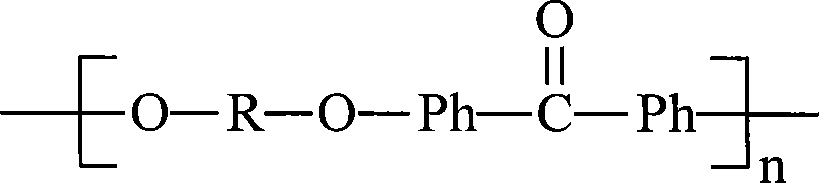
Figure 1
Abstract
Description
technical field
[0001] The invention relates to a method for preparing a special functional engineering resin, more specifically a method for preparing polyether ether ketone. Background technique
[0002] Polyetheretherketone (PEEK) is an aromatic linear polymer. It not only has good processing performance, but also has excellent high temperature resistance. Its load heat distortion temperature is as high as 315°C, and its continuous use temperature can reach 260°C. , At the same time, this polymer also has many excellent properties such as good wear resistance, chemical resistance, flame retardancy, hydrolysis resistance, and radiation resistance. In view of this, in addition to the application in national defense and military, PEEK is also widely used in many fields such as aerospace, automobile manufacturing, electronic appliances, medical treatment and food.
[0003] From a structural point of view, PEEK is a polymer composed of ether bonds and ketone groups connecting...
Examples
Embodiment 1
[0018] Vacuumize the reactor equipped with mechanical stirrer, thermometer and condenser, and then fill it with high-purity nitrogen. After three times, the air in the system will be completely replaced with nitrogen. Phenylsulfone, after heating until it dissolves, add 172.2 grams of 4,4'-difluorobenzophenone (0.79 moles) to dissolve it, add 72.6 grams of biphenol (0.39 moles) to dissolve it, and add 42.9 grams of terephthalate Phenol (0.39 moles) was used to dissolve it, and the previously dried Na 2 CO 3 After crushing and sieving, accurately weigh 95.4 grams (0.9 moles) of powder and immediately add it to the reaction system, stir for 30 minutes to make it salt with diphenol and dissolve, quickly raise the temperature of the system to 190°C, and react for 30 minutes , raise the system temperature to 300°C within 10 minutes, react for 1 hour, rapidly raise the temperature to 325°C, and immediately add 1.1 grams of hydroquinone (0.01 mole) as a chain extender, increase the ...
Embodiment 2
[0020] Under the same reaction conditions as in Example 1, the mol ratio of hydroquinone and biquinone was 1: 2 when charging for the first time, and other conditions did not change, that is, when charging for the first time, hydroquinone was 28.6 grams (0.26 moles), biphenol is 96.7 grams (0.52 moles), and the experimental results are shown in Table 1.
Embodiment 3
[0022] Under the same reaction conditions as in Example 1, the mol ratio of hydroquinone and biquinone was changed to 1: 3 when charging for the first time, and other conditions did not change, that is, hydroquinone was added when charging for the first time. It is 20.9 grams (0.19 moles), and biphenol is 110 grams (0.57 moles). The experimental results are shown in Table 1.