
A method for aluminum salt-assisted hydrothermal synthesis of pseudo-boehmite
A technology of pseudo-boehmite and pseudo-boehmite powder, which is applied in the direction of alumina/aluminum hydroxide, can solve the problems of unsatisfactory demand and low pore volume retention rate, and achieve easy control, significant manufacturing cost, and high pore volume. High volume retention effect
- Summary
- Abstract
- Description
- Claims
- Application Information
AI Technical Summary
Problems solved by technology
Method used
Image

Examples
Embodiment 1
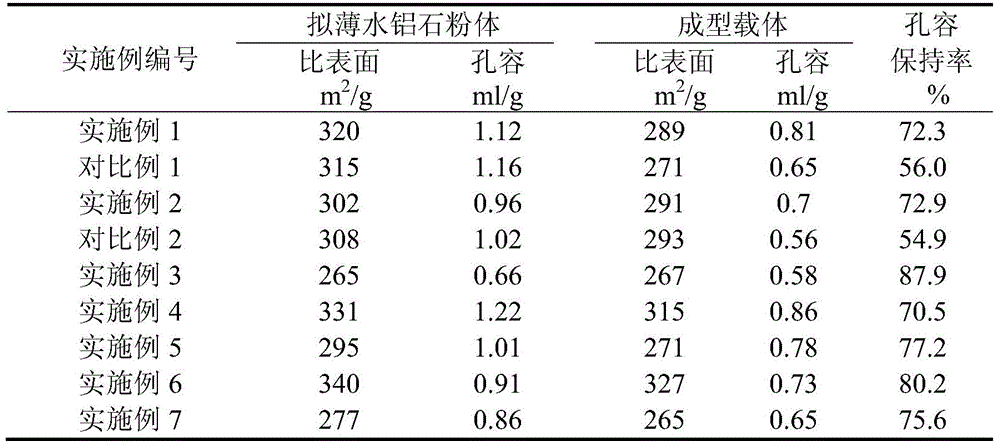
[0021] Add 666g of aluminum sulfate octadecahydrate to 9.6kg of deionized water, then add 240g of urea, and add 24g of cetyltrimethylammonium bromide. After fully dissolving, add 1.9kg of activated alumina in batches, and stir to obtain a solid-liquid mixture. , the obtained slurry was sand-milled to obtain a slurry with an average particle size of 0.4 μm, and then the slurry obtained by sand-milling was transferred to a high-pressure reactor, and hydrothermally reacted at 150 ° C for 24 hours. After the reaction, the obtained slurry was separated from solid and liquid, fully Washing, spray drying to obtain pseudo-boehmite powder. The obtained powder is kneaded into a plastic body with 3% nitric acid as a binder, extruded, dried at 120°C, and calcined at 550°C to obtain a shaped carrier. The characterization results of pseudo-boehmite powder and molding carrier are listed in Table 1.
Embodiment 2
[0025] Add 260g of aluminum sulfate octadecahydrate to 10kg of deionized water, then add 80g of urea, and add 80g of polyethylene glycol-2000, after fully dissolving, add 1.2kg of activated alumina in batches, stir evenly to obtain a solid-liquid mixture, and carry out the obtained slurry Sand milling treatment to obtain a slurry with an average particle size of 1.5 μm, and then transfer the slurry obtained by sand milling to a high-pressure reactor, and conduct a hydrothermal reaction at 200 ° C for 8 hours. After the reaction, the obtained slurry is separated from solid and liquid, fully washed, and spray-dried to obtain Pseudo-boehmite powder. The obtained powder is kneaded into a plastic body with 3% nitric acid as a binder, extruded, dried at 120°C, and calcined at 550°C to obtain a shaped carrier. The characterization results of pseudo-boehmite powder and molding carrier are listed in Table 1.
Embodiment 3
[0029] Add 34g of aluminum sulfate octadecadecane to 10kg of deionized water, then add 12g of urea, and add 24g of sodium tartrate. After fully dissolving, add 0.5kg of activated alumina in batches, stir to obtain a solid-liquid mixture, and obtain a slurry with an average particle size of 12 μm. Then the obtained slurry was transferred to an autoclave for hydrothermal reaction at 250° C. for 1 hour. After the reaction, the obtained slurry was separated from solid to liquid, fully washed, and spray-dried to obtain pseudo-boehmite powder. The obtained powder is kneaded into a plastic body with 3% nitric acid as a binder, extruded, dried at 120°C, and calcined at 550°C to obtain a shaped carrier. The characterization results of pseudo-boehmite powder and molding carrier are listed in Table 1.
PUM
| Property | Measurement | Unit |
|---|---|---|
| particle size | aaaaa | aaaaa |
| particle size | aaaaa | aaaaa |
Abstract
Description
Claims
Application Information
 Login to View More