
A truncated uridine-5'-diphosphate xylose synthase, its nucleotide sequence and application
A xylose diphosphate, truncated technology, applied in the field of genetic engineering, to achieve the effect of great economic benefits
- Summary
- Abstract
- Description
- Claims
- Application Information
AI Technical Summary
Problems solved by technology
Method used
Image

Examples
Embodiment 1
[0032] Example 1. Transcriptome Sequencing and Sequence Analysis
[0033] After extracting the total RNA from the sterile bulb of Dieffenbachia tiger eye, using the mRNA as a template, the first cDNA strand was synthesized with six base random primers (randomhexamers), and then the second cDNA was synthesized by adding buffer, dNTPs, RNase H and DNA polymerase I After purification by QiaQuick PCR kit and elution with EB buffer, end repair, poly(A) was added and sequencing adapters were connected, then fragment size selection was performed by agarose gel electrophoresis, and finally PCR amplification was carried out to construct Good sequencing library with Illumina HiSeq TM 2000 for sequencing.
[0034] The original image data obtained by sequencing is converted into sequence data through base calling, that is, raw data or rawreads. Perform data filtering on raw reads, remove reads with adapters, duplicates, and low-quality sequencing, and obtain clean reads. Use the short ...
Embodiment 2
[0036] Example 2 Cloning of OsaUXS3 gene
[0037] Take 100mg of aseptic bulbs of Dieffenbachia tiger's eye, freeze them quickly in liquid nitrogen, grind them into fine powder with a mortar, and use Trizol extraction to extract total RNA from the aseptic bulbs of Dieffenbachia tiger's eye. Using RT-PCR Kit (ReverTra-Plus-, TOYOBO company) to reverse transcribe the total RNA of Diofenbachia sterile bulbs into cDNA. The reverse transcription system and procedure are as follows: add 1 μg of total RNA to 20 μL system, RNase Free H 2 O 4 μL, Oligo(dT) 20 1 μL, after incubating at 65°C for 5 minutes, immediately place it on ice to cool, then add 4 μL of 5×RT buffer, 1 μL of RNase Inhibitor (10U / μL), 1 μL of dNTP Mixture (10mM) and ReverTra Ace to the above tube, at 30°C Incubate for 10 minutes, incubate at 42°C for 60 minutes, denature at 85°C for 5 minutes, and place on ice for 5 minutes to complete cDNA synthesis. The cDNA was stored at -20°C for later use.
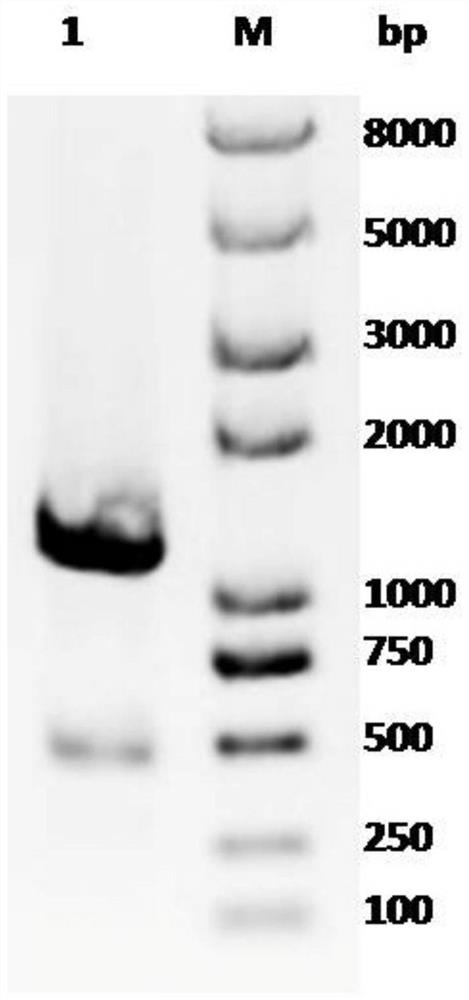
[0038] Two pairs...
Embodiment 3
[0041] Example 3 Construction of OsaUXS3 expression vector
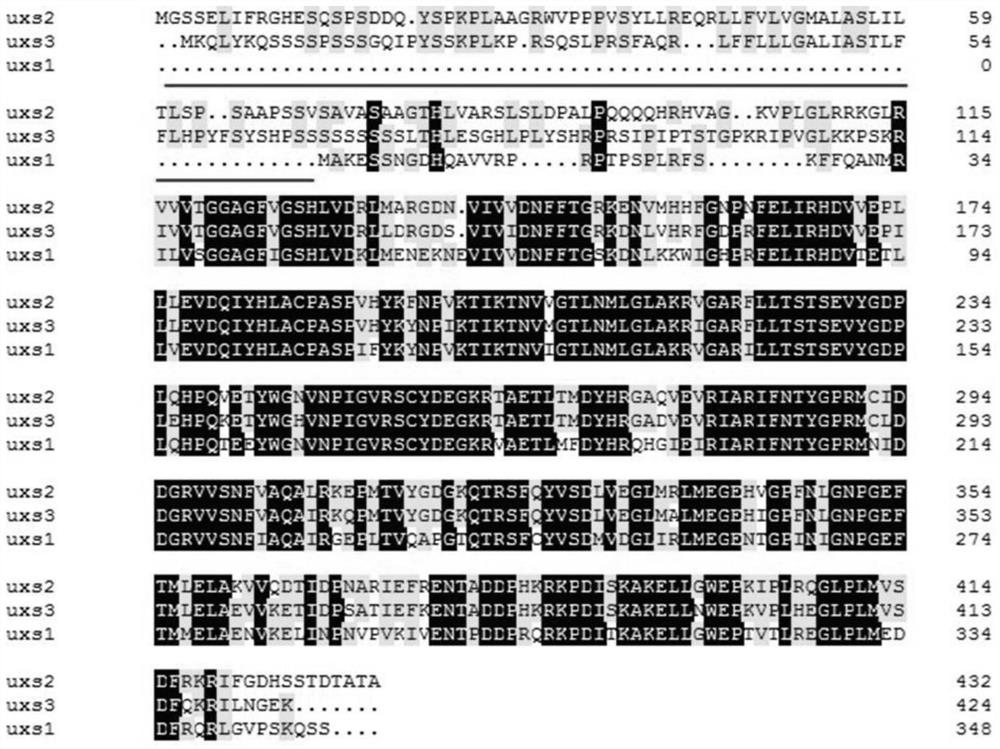
[0042] The results of multiple sequence alignment showed that, compared with the protein sequence of cytoplasmic UXS, OsaUXS3 (SEQ ID NO.9) had about 100 more amino acid sequences at the nitrogen terminal ( image 3 ). With TMHMM( http: / / www.cbs.dtu.dk / services / TMHMM / ) predicted the transmembrane region of OsaUXS3 protein, the results showed that OsaUXS3 had an obvious transmembrane region, and OsaUXS3 protein was predicted to be a type II membrane protein ( Figure 4 ). Therefore, in order to express the protein as a soluble protein in the prokaryotic system, it is necessary to remove its transmembrane region when designing In-Fusion primers.
[0043] According to the principle of homologous recombination of In-Fusion (Clontech Company), using the correctly sequenced plasmid pEASY-OsaUXS3 as a template, FET28aUXS3 (5'-tcgcggatccgaattcatgcacccttacttctcttac-3', SEQ ID NO.10) and RET28aUXS3 (5'-gtgcggccgcaagctt...
PUM
 Login to View More
 Abstract
Description
Claims
Application Information
 Login to View More