Red long-lasting phosphorescent material and preparation method thereof
A long afterglow luminescence and red technology, which is applied in the direction of luminescent materials, chemical instruments and methods, etc., can solve the problems that the excitation intensity in the visible light region needs to be improved, the luminous brightness and afterglow time are not enough, and the afterglow time does not meet the application requirements, etc., to achieve long afterglow Excellent performance, improved chemical stability, and long afterglow time
- Summary
- Abstract
- Description
- Claims
- Application Information
AI Technical Summary
Problems solved by technology
Method used
Image

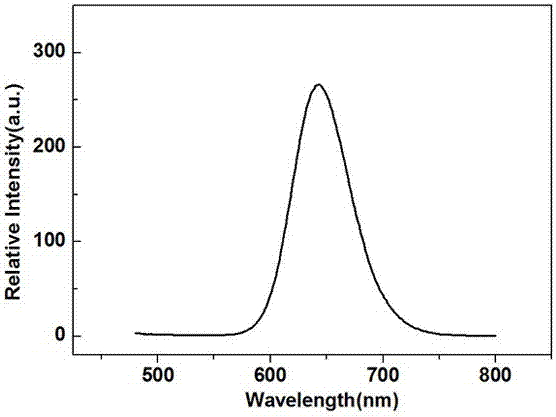
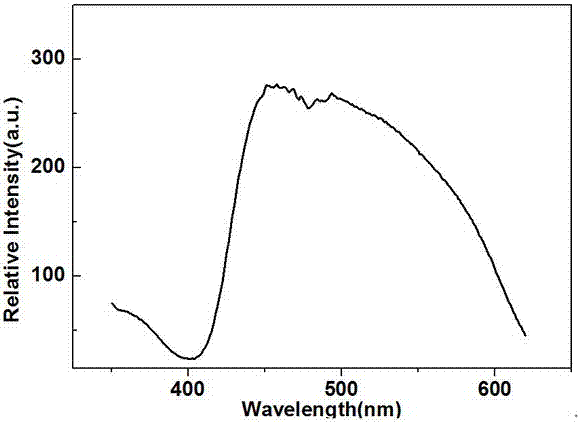
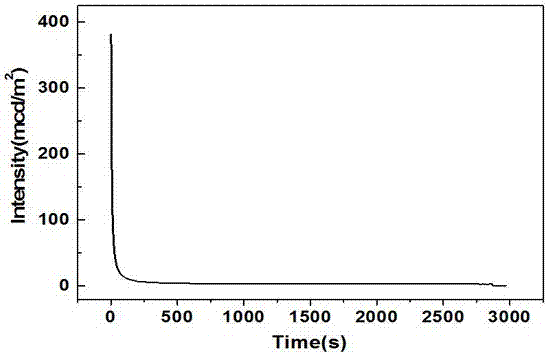
Examples
Embodiment 1
[0036] a) Weigh calcium carbonate, tin dioxide and europium oxide at the stoichiometric molar ratio Ca:Sn:Eu=2:1:0.01, relative to the matrix CaSnO 3 The addition of boric acid is taken by weighing 20 mol%;
[0037] b) Add water to the mixture in step a), the amount of water is twice the weight of the mixture, and wet blending and grinding for 1 h;
[0038] c) Drying the homogeneously mixed raw materials in step b) at a drying temperature of 150°C and a drying time of 2 h;
[0039] d) Grinding the dried raw materials in step c) into powder, using coal powder as a reducing agent, performing a high-temperature solid-phase reaction in a weak reducing atmosphere, the calcination temperature is 1300 ° C, and the holding time is 1 h;
[0040] e) Take out the calcined sample in step d) and grind to obtain a red long-lasting luminescent material.
Embodiment 2
[0042] a) Weigh calcium carbonate, tin dioxide, europium oxide and sublimed sulfur according to the stoichiometric molar ratio Ca:Sn:Eu:S=2:1:0.004:0.01;
[0043] b) Add water to the mixture in step a), the amount of water is 3 times of the weight of the mixture, wet blending and grinding for 2 h;
[0044] c) Dry the uniformly mixed raw materials after step b) at a drying temperature of 200°C and a drying time of 1 h;
[0045] d) Grinding the dried raw materials in step c) into powder, using activated carbon as a reducing agent, and carrying out a high-temperature solid-phase reaction in a weak reducing atmosphere, the calcination temperature is 1350 ° C, and the holding time is 0.5 h;
[0046] e) Take out the calcined sample in step d) and grind to obtain a red long-lasting luminescent material.
Embodiment 3
[0048] a) Weigh calcium carbonate, tin dioxide, europium oxide, neodymium oxide and sublimed sulfur in stoichiometric molar ratio Ca:Sn:Eu:Nd:S=2:1:0.0006:0.0007:0.05, relative to the matrix CaSnO 3 The add-on is 30 mol% and takes by weighing boric acid;
[0049] b) Add ethanol to the mixture in step a), the amount of ethanol is 1 times the weight of the mixture, and wet blending and grinding for 2 h;
[0050] c) Dry the uniformly mixed raw materials after step b) at a drying temperature of 60°C and a drying time of 6 h;
[0051] d) Grind the dried raw materials in step c) into powder, use an atmosphere furnace to create a weak reducing atmosphere for high-temperature solid-phase reaction, the volume ratio of hydrogen to nitrogen is 10:90, the calcination temperature is 900 °C, and the holding time is 8 h ;
[0052] e) Take out the calcined sample in step d) and grind to obtain a red long-lasting luminescent material.
PUM
 Login to View More
 Abstract
Description
Claims
Application Information
 Login to View More
 - R&D
- Intellectual Property
- Life Sciences
- Materials
- Tech Scout
- Unparalleled Data Quality
- Higher Quality Content
- 60% Fewer Hallucinations
Browse by: Latest US Patents, China's latest patents, Technical Efficacy Thesaurus, Application Domain, Technology Topic, Popular Technical Reports.
© 2025 PatSnap. All rights reserved.Legal|Privacy policy|Modern Slavery Act Transparency Statement|Sitemap|About US| Contact US: help@patsnap.com