
Environment-friendly water-borne paint and preparation method
A water-based paint, environmentally friendly technology, applied in the field of paint, can solve problems such as poor hardness and wear resistance, environmental pollution, and difficulty in defoaming, and achieve the effects of strong adhesion, good weather resistance and low price.
- Summary
- Abstract
- Description
- Claims
- Application Information
AI Technical Summary
Problems solved by technology
Method used
Image

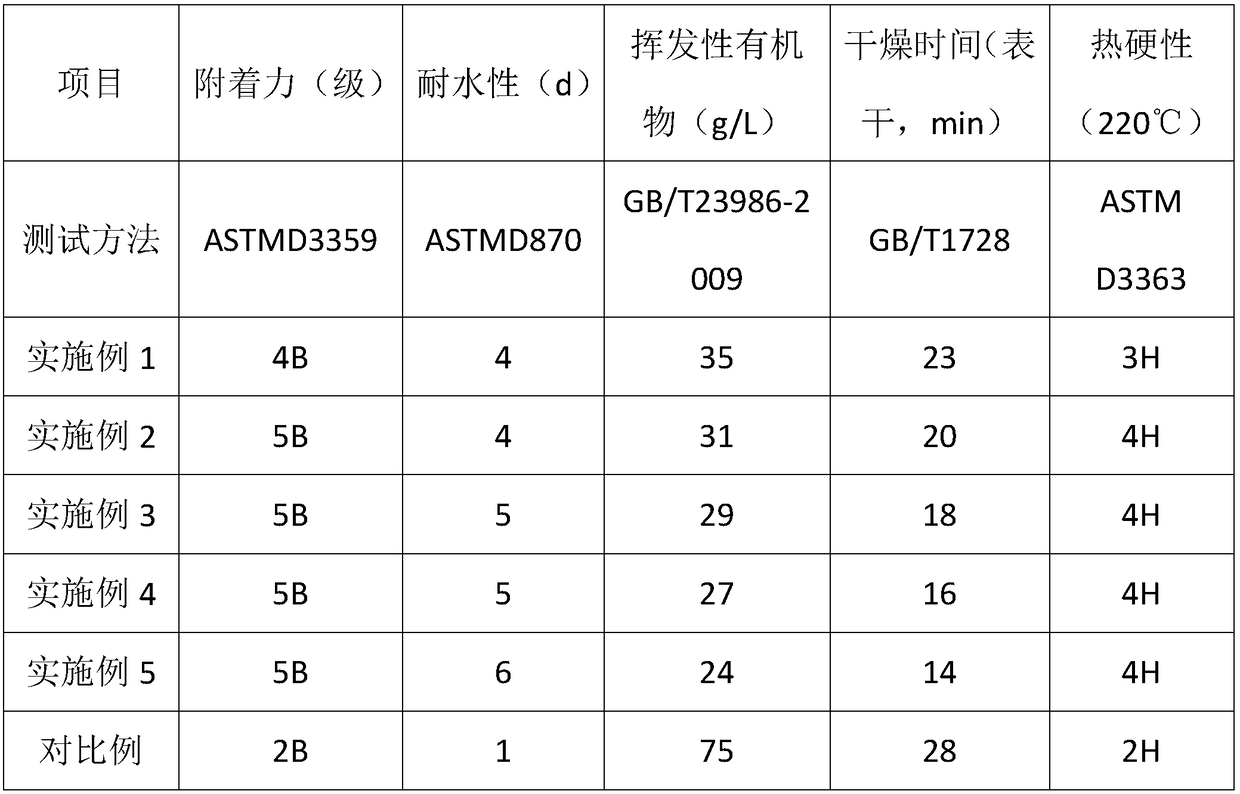
Examples
Embodiment 1
[0029] An environmentally friendly water-based paint, made of the following raw materials in parts by weight: 50 parts of maleimide-based polyether film-forming polymers, 5 parts of Ti-Zn-S-O, 10 parts of calcium carbonate, and 1 part of sodium hexametaphosphate , 1 part of polyacrylate leveling agent, 1 part of tributyl phosphate, 15 parts of water.
[0030] The preparation method of described maleimide-based polyether film-forming polymer, comprises the steps:
[0031] 1) Under a nitrogen atmosphere, mix 10 g of 1,8-bis(maleimido)-3,6-dioxahexane with 13.5 g of 2,3-dimethoxy-1,3-butadiene g was added to a three-necked flask equipped with a reflux condenser and an electric stirrer, and then 50 g of isopropanol was added to the bottle, refluxed and stirred at 110°C for 3 hours, and then the isopropanol was removed by rotary evaporation to obtain an intermediate product;
[0032] 2) 10 g of the intermediate product prepared in step 1), 10 g of diacetone acrylamide, 20 g of pol...
Embodiment 2
[0036] An environmentally friendly water-based paint, made of the following raw materials in parts by weight: 53 parts of maleimide-based polyether film-forming polymers, 6 parts of Ti-Zn-S-O, 12 parts of calcium carbonate, 2 parts of polycarboxylate sodium salt 2 parts, cellulose acetate leveling agent 2 parts, defoamer Deqian 31001 parts, water 17 parts.
[0037] The preparation method of described maleimide-based polyether film-forming polymer, comprises the steps:
[0038] 1) Under a helium atmosphere, mix 10 g of 1,8-bis(maleimido)-3,6-dioxahexane with 2,3-dimethoxy-1,3-butadiene Add 13.5g into a three-necked flask equipped with a reflux condenser and an electric stirrer, then add 60g of acetone to the bottle, reflux and stir at 113°C for 3.2 hours, and then remove the acetone by rotary evaporation to obtain an intermediate product;
[0039]2) Dissolve 10 g of the intermediate product prepared in step 1), 10 g of diacetone acrylamide, 20 g of poly(ethylene glycol) phenyl...
Embodiment 3
[0043] An environmentally friendly water-based paint, made of the following raw materials in parts by weight: 55 parts of maleimide-based polyether film-forming polymers, 7 parts of Ti-Zn-S-O, 13 parts of calcium carbonate, and 3 parts of sodium hexametaphosphate , 2 parts of polyvinyl butyral leveling agent, 2 parts of defoamer BYK088, 19 parts of water.
[0044] The preparation method of described maleimide-based polyether film-forming polymer, comprises the steps:
[0045] 1) Under a neon atmosphere, mix 10 g of 1,8-bis(maleimide)-3,6-dioxahexane with 2,3-dimethoxy-1,3-butadiene Add 13.5 g into a three-neck flask equipped with a reflux condenser and an electric stirrer, then add 65 g of dichloromethane into the bottle, reflux and stir at 116°C for 3.6 hours, and then spin evaporate to remove the dichloromethane to obtain an intermediate product;
[0046] 2) Dissolve 10 g of the intermediate product prepared in step 1), 10 g of diacetone acrylamide, 20 g of poly(ethylene gl...
PUM
 Login to View More
 Abstract
Description
Claims
Application Information
 Login to View More