
Medical application of small molecule peptide of black food in liver damage repair
A small molecule peptide, black food technology, applied in medical preparations containing active ingredients, microorganism-based methods, peptides, etc., can solve problems such as the pathogenesis of chronic liver injury that has not yet been elucidated, and achieve good anti-inflammatory and repairing effects, The preparation method is simple and practical, and the effect of small toxic and side effects
- Summary
- Abstract
- Description
- Claims
- Application Information
AI Technical Summary
Problems solved by technology
Method used
Image

Examples
Embodiment 1
[0090] 1) Total RNA extraction and reverse transcription
[0091] The total RNA of AtD-SAT yeast was extracted with Total RNA extraction reagent RNAiso Plus, and its integrity was detected by 1% agarose gel electrophoresis, and its concentration and purity were determined by a nucleic acid quantifier. 1 μg of total RNA was taken and analyzed by AOLP For primer: 5'- GGCCACGCGTCGACTAGTACT16 (G / A / C)- 3' reverse transcription to synthesize cDNA;
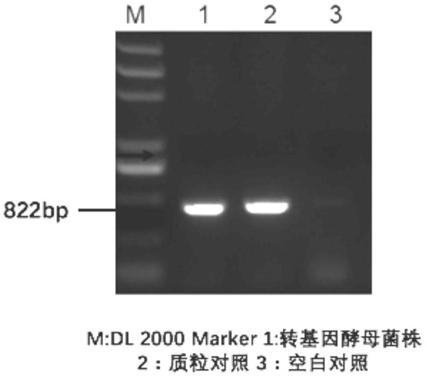
[0092] 2) Gene cloning, construction of recombinant expression vectors and electrotransformation
[0093] According to the yeast transcriptome sequence information, design specific primers DBTN F: AGCAATGGTG GAAGAGTAAA, and use cDNA as a template to amplify; design primers according to the mature peptide sequence encoded by yeast AtD-SAT gene, and introduce restriction site Eco RI at the 5' end of the primers and Xba I;
[0094] Upstream primer P1: 5'-CGGGAATTCATGTCGTGTGAAGAACTG-3';
[0095] Downstream primer P2: 5'-CTAGTCTGAGGATCCCAT...
Embodiment 2
[0104] 1) Weigh 3kg of black beans, 3kg of black peanuts, 1kg of black sesame, 1kg of black rice, 1kg of black mulberry, 500g of black fungus and 100g of black wolfberry, wash them with flowing water, grind them with broken walls, add 3.4-3.5kg of sugar Quickly pour into the fermenter;
[0105] 2) After sterilizing the material in 1) at 121 degrees Celsius for 20 minutes, add sterile water 3.5-4 times the volume of the material to the fermenter and stir evenly;
[0106] 3) At 25-30 degrees Celsius, add 2.3-2.8 g of the AtD-SAT transgenic yeast strain described in Example 1, and seal it for 3 days for fermentation;
[0107] 4) Raise the temperature of the fermentation broth in step 3) to 50-55°C, add 2.3-2.8g of papain, react at pH 6.0-7.0, and react for 18-24h;
[0108] 5) Put them into centrifuge tubes and centrifuge at 3000-5000r / min for 20-30min, save the supernatant and precipitate separately, and take the supernatant.
Embodiment 3
[0110] 1) Weigh 2kg of black beans, 2kg of black peanuts, 1kg of black sesame, 1kg of black rice, 1kg of black mulberries, 500g of black fungus and 100g of black wolfberry, wash them with flowing water, grind them with broken walls, and add 3.4-3.5kg of sugar Quickly pour into the fermenter;
[0111] 2) After sterilizing the material in 1) at 121 degrees Celsius for 20 minutes, add sterile water 3.5-4 times the volume of the material to the fermenter, and stir evenly after disinfection;
[0112] 3) At 25-28 degrees Celsius, add 2.3-2.8 g of the AtD-SAT transgenic yeast strain described in Example 1, and seal it for 3 days for fermentation;
[0113] 4) Raise the temperature of the fermentation broth in step 3) to 50-55°C, add 2.3-2.8g of papain, react at pH 6.0-7.0, and react for 18-24h;
[0114] 5) Put them into centrifuge tubes and centrifuge at 6000-7000r / min for 20-30min, save the supernatant and precipitate separately, and take the supernatant.
PUM
 Login to View More
 Abstract
Description
Claims
Application Information
 Login to View More