Saccharomyces cerevisiae genetically engineered bacterium for synthesizing lycopene as well as construction method and application of saccharomyces cerevisiae genetically engineered bacterium
A technology of genetically engineered bacteria and Saccharomyces cerevisiae is applied to the genetic engineering bacteria of Saccharomyces cerevisiae for synthesizing lycopene and its construction field, and can solve the problems of many by-products, difficult chemical synthesis, low accumulation of lycopene and the like
- Summary
- Abstract
- Description
- Claims
- Application Information
AI Technical Summary
Problems solved by technology
Method used
Image

Examples
Embodiment 1
[0044]Embodiment 1: Construction of lycopene biosynthetic pathway:
[0045] 1. Construction of inducible fusion protein module plasmid
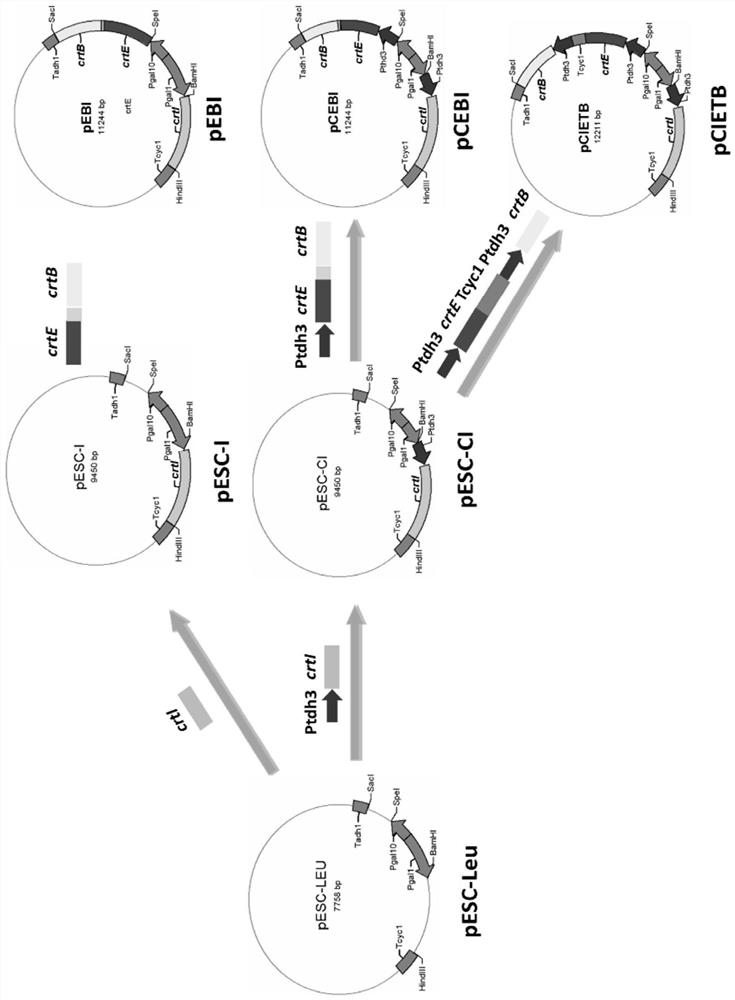
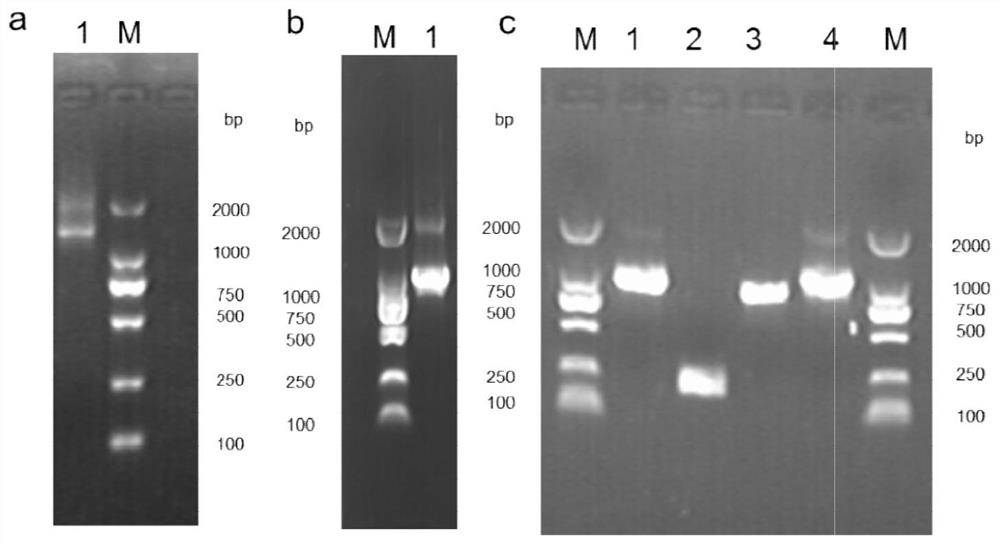
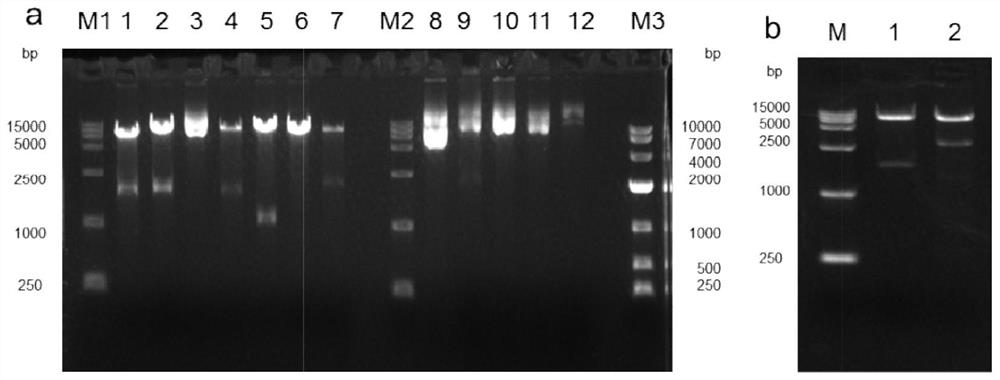
[0046] The crtE, crtB, and crtI genes were codon-optimized and primers were designed using the software Vector NTI 9.0, and the optimized genes were used as templates, according to figure 1 As shown, crtI and recombinant fragment I were sequentially amplified ( figure 2 ), the crtI gene and the recombinant fragment I were respectively connected to the plasmid pESC-Leu and pESC-I by the method of BamHI / HindIII and SpeI / SacI double enzyme digestion-ligation, and the recombinant plasmid pESC-I and the fusion protein module were obtained Plasmid pEBI.
[0047] Recombinant fragment I is an inducible fusion protein module, and crtE and crtB are fused and connected by homologous recombination (remove the TAA on the crtE gene, and add the Linker sequence of 5'-GGTGGTGGTGGTTCTGGTGGTGGTGGTTCA-3').
[0048] The primer sequences are:
[0049] IF: TA...
Embodiment 2
[0080] Example 2: Verification of the expression of key carotenoid enzymes by recombinant strains to produce lycopene.
[0081] YPD medium: 10g / L yeast extract powder, 20g / L peptone, 20g / L glucose.
[0082] YPG medium: 10g / L yeast extract powder, 20g / L peptone, 20g / L galactose.
[0083] SD-Leu medium: 6.7g / L amino-free yeast nitrogen source (YNB), 20g / L glucose, 0.69g / L CSM-Leu.
[0084] SG-Leu medium: 6.7g / L amino-free yeast nitrogen source (YNB), 20g / L galactose, 0.69g / L CSM-Leu.
[0085] Inoculate positive clones into 50mL SD-Leu liquid medium, place on a shaker at 30°C, and cultivate at 200rpm until the OD600 value is about 4-6. Centrifuge at 4000r / min for 10min, collect all the bacteria, and transfer all the bacteria into Continue to culture in 50mL SG-Leu and YPG medium or fresh SD-Leu and YPD medium for 48-96h. After the bacterial cell culture was completed, the bacterial cells were collected by centrifugation at 5000 rpm for 10 min at 4°C, washed twice with distille...
Embodiment 3
[0086] Example 3: Analysis of mRNA content of lycopene synthesis gene.
[0087] The TRIzol method was used to extract the total RNA in the 48-96h fermentation of the recombinant bacteria, and the RNA was reverse-transcribed into cDNA, and the cDNA was used as a template to design corresponding primers for the determination of fluorescent quantitative PCR. Each sample was repeated 3 times. 18SrRNA gene was selected as the internal reference gene, and 2 -△△Ct method to analyze the data. Comparison of gene expression in different strains Figure 6 , Figure 7 .
[0088] The primer sequences are:
[0089] crtB-F: TGGTTTTATGGTTGCTCC
[0090] crtB-R:CCAAGTCACCCAAATGTCT
[0091] crtE-F: TGGTGTTCCAGTTGCTAT
[0092] crtE-R: GTTGACCTTCTGCTGTTCT
[0093] crtI-F: CAGCTCCATCACCATACAC
[0094] crtI-R: CTAATACCCCAAAGCCAAAC
[0095] crtEB-F:GCTGCTCCAGATCCACAA
[0096]crtEB-R:AGCGTAAACTGCCCAAAC
[0097] 18S-F: GTTGGTGGAGTGATTTGTCTGC
[0098] 18S-R: GCACGACGGAGTTTCACAAGAT
[0099...
PUM
 Login to View More
 Abstract
Description
Claims
Application Information
 Login to View More
 - R&D
- Intellectual Property
- Life Sciences
- Materials
- Tech Scout
- Unparalleled Data Quality
- Higher Quality Content
- 60% Fewer Hallucinations
Browse by: Latest US Patents, China's latest patents, Technical Efficacy Thesaurus, Application Domain, Technology Topic, Popular Technical Reports.
© 2025 PatSnap. All rights reserved.Legal|Privacy policy|Modern Slavery Act Transparency Statement|Sitemap|About US| Contact US: help@patsnap.com