Unlock instant, AI-driven research and patent intelligence for your innovation.

Electronic device and method for producing the same

a technology of electronic devices and electrodes, applied in the field of electronic devices, can solve the problems of high power consumption and unattainable length in view of processing accuracy, and achieve the effect of improving conductivity and superior performance to the devi

Inactive Publication Date: 2009-03-19
SONY CORP
View PDF7 Cites 2 Cited by
  • Summary
  • Abstract
  • Description
  • Claims
  • Application Information

AI Technical Summary

Benefits of technology

The present invention relates to electronic devices that include a first tubular carbon molecule and a second tubular carbon molecule that partially covers the first tubular carbon molecule. The first tubular carbon molecule has semiconductivity and is connected to a voltage-applying means, while the second tubular carbon molecule has conductivity and is connected to a current-output means. The invention also includes methods for producing these electronic devices using multi-walled carbon nanotubes with at least two layers. The technical effects of the invention include improved control of the electrical state of the first tubular carbon molecule, increased efficiency in producing carbon nanotube-based electronic devices, and expanded applicability of the invention to various carbon molecules with hollow parts.

Problems solved by technology

This leads to high power consumption.
Such a length seems unattainable in view of processing accuracy.

Method used

the structure of the environmentally friendly knitted fabric provided by the present invention; figure 2 Flow chart of the yarn wrapping machine for environmentally friendly knitted fabrics and storage devices; image 3 Is the parameter map of the yarn covering machine
View more

Image

Smart Image Click on the blue labels to locate them in the text.
Viewing Examples
Smart Image
  • Electronic device and method for producing the same
  • Electronic device and method for producing the same
  • Electronic device and method for producing the same

Examples

Experimental program
Comparison scheme
Effect test

first embodiment

Insulated-Gate Field-Effect Transistor

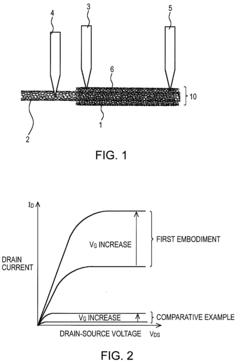
[0104]FIG. 1 is a schematic diagram showing the structure of an insulated-gate field-effect transistor according to a first preferred embodiment of the present invention.

[0105]This field-effect transistor is composed of a multi-walled carbon nanotube 10 having an outer semiconductive carbon nanotube layer 1 and an inner metallic carbon nanotube layer 2 that is partially covered by the semiconductive carbon nanotube layer 1. A metal source electrode 3 and a metal drain electrode 5 are brought into contact with both ends of the semiconductive carbon nanotube layer 1 while a metal gate electrode 4 is brought into contact with the metallic carbon nanotube layer 2.

[0106]To implement transistor operation, a control gate voltage VG is applied to the metallic carbon nanotube layer 2 via the gate electrode 4 while a drain-source voltage VDS is applied to the semiconductive carbon nanotube layer 1 (channel region) between the source electrode 3 and the dr...

second embodiment

Production of Insulated-Gate Field-Effect Transistor

[0112]A process of producing the insulated-gate field-effect transistor according to the first embodiment will now be described.

[0113]

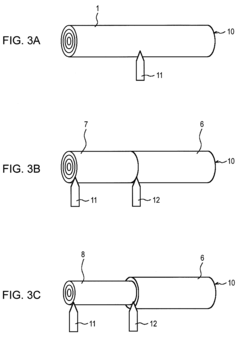
[0114]Multi-walled carbon nanotubes, as a raw material, are prepared by a known method. In thermal CVD (chemical vapor deposition), a hydrocarbon-based source gas is introduced into a reaction tube at a reaction temperature of 600° C. to 1,300° C. to grow multi-walled carbon nanotubes on a catalyst supported by, for example, zeolite placed in the reaction tube.

[0115]The catalyst used is a powder of transition-metal-based fine particles, such as iron, nickel, and cobalt. These particles are supported on the surface of zeolite by, for example, dispersing the zeolite in a mixed solution of iron acetate and cobalt acetate, allowing the zeolite to adsorb the iron acetate and the cobalt acetate, and drying the zeolite.

[0116]The reaction gas used is preferably a hydrocarbon gas such as acetylene (C2H2), whi...

third embodiment

Production of Insulated-Gate Field-Effect Transistor

[0137]Another method for producing a multi-walled carbon nanotube having the outer semiconductive carbon nanotube layer 1 and the inner metallic carbon nanotube layer 2 that is partially covered by the inner semiconductive carbon nanotube layer 1 will now be described with reference to FIGS. 5A to 5C.

[0138]First, any multi-walled carbon nanotube 20 is selected.

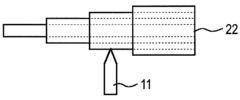
[0139]The outermost layer of the multi-walled carbon nanotube 20 is then fixed. A first probe 11 is brought into contact with the outermost layer of the multi-walled carbon nanotube 20 in parallel with the axial direction of the multi-walled carbon nanotube 20 in a vacuum chamber. The multi-walled carbon nanotube 20 is left to deposit carbon-containing impurities in the vacuum chamber on the contact portion so that the outermost layer of the multi-walled carbon nanotube 20 is fixed to the first probe 11.

[0140]Next, a second probe 12 is fixed to the inner layers of the multi-w...

the structure of the environmentally friendly knitted fabric provided by the present invention; figure 2 Flow chart of the yarn wrapping machine for environmentally friendly knitted fabrics and storage devices; image 3 Is the parameter map of the yarn covering machine
Login to View More

PUM

PropertyMeasurementUnit
currentaaaaaaaaaa
voltageaaaaaaaaaa
semiconductiveaaaaaaaaaa
Login to View More

Abstract

A microelectronic device and a method for producing the device can overcome the disadvantages of known electronic devices composed of carbon molecules, and can deliver performance superior to the known devices. An insulated-gate field-effect transistor includes a multi-walled carbon nanotube (10) having an outer semiconductive carbon nanotube layer (1) and an inner metallic carbon nanotube layer (2) that is partially covered by the outer semiconductive carbon nanotube layer (1). A metal source electrode (3) and a metal drain electrode (5) are brought into contact with both ends of the semiconductive carbon nanotube layer (1) while a metal gate electrode (4) is brought into contact with the metallic carbon nanotube layer (2). The space between the semiconductive carbon nanotube layer (1) and the metallic carbon nanotube layer (2) is used as a gate insulating layer. Two layers including the outer semiconductive carbon nanotube layer (1) and the inner metallic carbon nanotube layer (2) are selected from carbon nanotube layers of a multi-walled carbon nanotube. These layers are processed into a form suitable for use as the multi-walled carbon nanotube (10).

Description

CROSS REFERENCES TO RELATED APPLICATIONS[0001]The present invention is a Divisional of U.S. application Ser. No. 10 / 535,927, filed Feb. 17, 2006, which, in turn, claims priority under 35 U.S.C. §119 to Japanese Patent Application No. JP 2002-335879, filed in the Japanese Patent Office on Nov. 20, 2002, the entire contents of which being incorporated herein by reference.TECHNICAL FIELD[0002]The present invention relates to electronic devices composed of carbon molecules and methods for producing the devices.BACKGROUND ART[0003]A hexagonal network structure (honeycomb structure) composed of six-membered rings of carbon atoms, namely benzene rings, combined in a plane is called a graphene sheet. A large number of graphene sheets are stacked to form a graphite crystal. Graphite has high electrical conductivity equivalent to metal because delocalized π electrons can move in graphite via a conjugated system formed along the carbon chains of the hexagonal network structure (if a non-metal ...

Claims

the structure of the environmentally friendly knitted fabric provided by the present invention; figure 2 Flow chart of the yarn wrapping machine for environmentally friendly knitted fabrics and storage devices; image 3 Is the parameter map of the yarn covering machine
Login to View More

Application Information

Patent Timeline
no application Login to View More
Patent Type & Authority Applications(United States)
IPC IPC(8): H01L21/66H01J9/02B82B1/00B82B3/00H01J1/304H01L51/30
CPCB82Y10/00H01L51/0048H01L51/0508Y10S977/938Y10S977/762Y10S977/936Y10S977/949H01L51/0595H10K85/221H10K10/46H10K10/701H01L29/0669H01L21/02606
Inventor MARUYAMA, RYUICHIROATA, MASAFUMISHIRAISHI, MASASHI
Owner SONY CORP