
Cyanobacterial extracts, processes for preparing the same and uses thereof
a technology of cyanobacterium and cyanobacterium, which is applied in the field of new cyanobacterium extract, can solve the problems of insufficient vaccines, inability to detect rsv, and inability to develop such vaccines, and achieve the effect of reducing protein content and increasing sugar conten
- Summary
- Abstract
- Description
- Claims
- Application Information
AI Technical Summary
Benefits of technology
Problems solved by technology
Method used
Image

Examples
example 1
on and Compositional Analysis of the Hot-Water AM Extracts
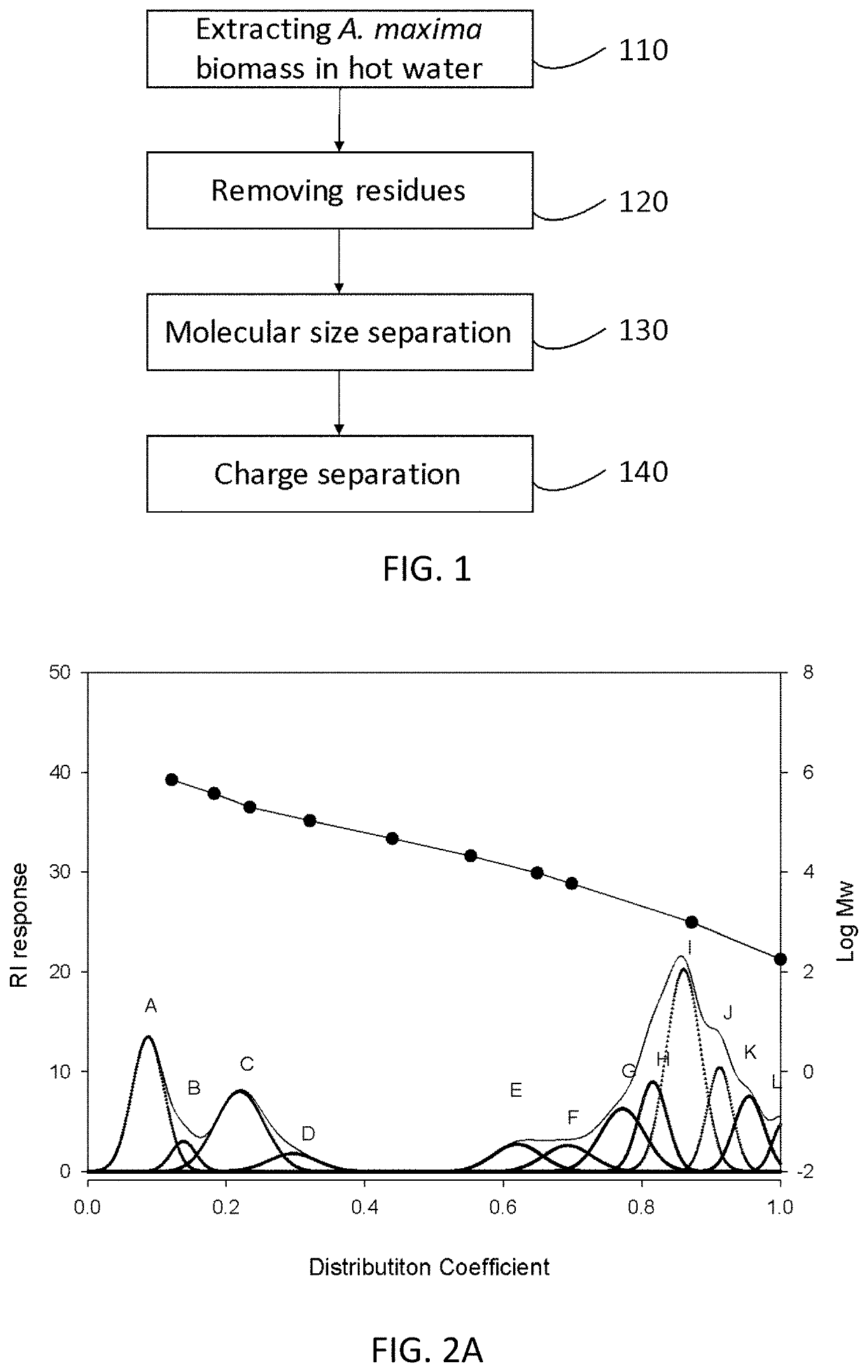
[0096]Dried A. maxima biomass (10 g) was suspended in d.d. water (100 ml) with agitation. The suspension was heated to about 80° C. to 120° C. for at least 1 hour, thereby obtaining a crude extract. The crude extract was centrifuged at 3,500 rpm for about 20 to 30 minutes, and the supernatant thus collected is the hot-water AM extract (SH extract). The aqueous SH extract was lyophilized to yield SH powder for further analysis.
[0097]For molecular size separation, the SH powder was dissolved in 10- to 50-fold d.d. water and then filtered with Amicon Ultra-15 Centrifugal Filter Unit using the Ultracel-100 membrane (MWCO: 100 KD). The retentate fraction (i.e., those retained within the sample side) was collected as the high-molecular-weight AM extract (SH1 extract), which lyophilized to give SH1 powder for subsequent use.
[0098]For charge separation, the DEAE gel (Sepharose™ Fast Flow) was used for anion-exchange chromatography. B...
example 3
Activity of AM Extracts Against Enterovirus
[0109]The antiviral efficacy and the cytotoxicity of the AM extracts was investigated by the neutralization test and MTT assay, respectively. Results are expressed as means±SD from four wells, unless specified otherwise.
[0110]RD cells were grown in Dulbecco's Modified Eagles's Medium (DMEM), supplemented with 10% fetal bovine serum (FBS). EV71 / TWN / 4643 / 1998 was obtained from Jen-Ren Wang, National Cheng Kung University (Tainan, Taiwan); EV71 / CA / BrCr / 1970, the prototype of EV71 (ATCC Accession No.: VR 784), was obtained from the ATCC. EV71 / TWN / 1743 / 1998 and TWN / 2231 / 1998.
[0111]For neutralization test, the inhibition of the cytopathic effect induced by Enteroviruses on RD cells was measured. Monolayer of RD cells in 96-well plates (6,000 cells / well) were infected with EV71 viruses and were treated with serial concentrations of the AM extracts. For adhesion, cells were incubated at 37° C. for 1 hour; following adsorption, the infected cell pla...
example 4
ic Efficacy of SHD1 on EV71 / MP4 Infected ICR Mice
[0128]At day 0, 10-days old ICR mice were inoculated with EV71 / MP4 (3.0×10⁶ PFU / mouse) via i.p. route. One hour after the inoculation, the mice were administered with 0.375, 0.75, 1.5, or 3 mg / kg / day of SHD1 extract via i.p. injection or orally administered with 1, 5, or 50 mg / kg / day of SHD1 extract once daily for 10 consecutive days. The clinical scores and survival rate were monitored for 15 days (from day 0 to day 14); results were summarized in FIG. 5A (for i.p. injection of SHD1 extract) and FIG. 5B (for oral administration of SHD1 extract). The Clinical scores of “0” means healthy, “1” means weakness, “2” means paralysis of one leg, “3” means paralysis of two legs, and “4” means death.
[0129]The data in FIG. 5A demonstrate that mice treated with 1.5 or 3 mg / kg / day of SHD1 extract manifested a better clinical score, as compare with vehicle-treated control mice. On the other hand, for the oral administration group, mice given 5 mg / ...
PUM
| Property | Measurement | Unit |
|---|---|---|
| wt % | aaaaa | aaaaa |
| wt % | aaaaa | aaaaa |
| wt % | aaaaa | aaaaa |
Abstract
Description
Claims
Application Information
 Login to View More