Unlock instant, AI-driven research and patent intelligence for your innovation.
Hemostatic agent and container containing the same
Pending Publication Date: 2022-06-02
DALIM TISSEN
View PDF0 Cites 2 Cited by
Summary
Abstract
Description
Claims
Application Information

AI Technical Summary
This helps you quickly interpret patents by identifying the three key elements:
Problems solved by technology
Method used
Benefits of technology
The present invention is a hemostatic composition that includes collagen, a stabilizer, and thrombin. This composition has an excellent hemostatic effect and can be easily stored and used quickly and conveniently because it can be mixed under low load. The container holding this composition is less toxic, does not have a problem with blood infection, and has a high rate of biodegradation. It expands with a high coefficient of expansion upon contact with blood, making it an excellent hemostatic kit.
Problems solved by technology
Although existing surgical techniques such as suturing exhibit strong tensile strength, those surgical techniques have problems such as the pain felt by patients and the necessity of removal after surgical procedures.
On the other hand, tissue adhesives have numerous advantages such as a rapid adhesion time, convenient usability, and no necessity of removal after procedures; however, tissue adhesives have limitations such as low adhesiveness, low tensile strength, and noticeable deterioration of adhesiveness in the presence of moisture.
Furthermore, cyanoacrylate-based tissue adhesives are so toxic that they are hardly used at the present time, and although those cyanoacrylate-based tissue adhesives are partially used clinically in countries other than the United States, use of those tissue adhesives has been limited due to histotoxicity and vulnerability.
However, those fibrin glue adhesives have limitations such as weak adhesive force, a rapid rate of biodegradation, and a risk of blood infection.
In addition to that, tissue adhesives such as gelatin-glutaraldehyde have been developed, which exhibit high tissue adhesiveness; however, those tissue adhesives have a disadvantage that formalin or glutaraldehyde, both of which are used as crosslinking agents, undergo a crosslinking reaction also with proteins in the biological body and cause histotoxicity.
However, these adhesives have a disadvantage that aromatic diisocyanates, which are raw materials for synthesis, have biological toxicity.
Hemostats containing collagen as a single component, such as “Avitene” (Alcon) and “Helitene” (Duhamed) are non-blood products; however, since these agents are very expensive and are single-component preparations having no tissue adhering effect, the agents are used only as hemostats.
However, these have problems that since blood products such as fibrinogen, thrombin, blood coagulants, and aprotinin, bovine-derived proteins, and the like are used in adhesive hemostat products, there is a risk of contagion of particular diseases that can be induced at this time, and the manufactured products are highly expensive due to the excessive cost required for raw materials securement and storage, production processes, and the like.
However, since this product is separated into three major components, namely, thrombin, gelatin, and a calciumchloride solution, and solutions of each of these three components are not mixed at once but are mixed in two steps, the process is time-consuming.
Therefore, during a surgical operation, when serious ligature and hemorrhage occur in an extremely urgent state, there is no time to mix the components according to the manual of such a complicated product, the operation that proceeds sequentially may threaten the life of an urgent bleeding patient, and this product has a problem of causing inconvenience to the user.
Method used
the structure of the environmentally friendly knitted fabric provided by the present invention; figure 2 Flow chart of the yarn wrapping machine for environmentally friendly knitted fabrics and storage devices; image 3 Is the parameter map of the yarn covering machine
View more
Image
Smart Image Click on the blue labels to locate them in the text.
Viewing Examples
Smart Image
Click on the blue label to locate the original text in one second.
Reading with bidirectional positioning of images and text.
[0150]A crosslinked collagen powder was produced by the following procedure.
[0151](1) The esterified collagen produced in Production Example 1 was added to purified water and stirred.
[0152](2) EDC (1-ethyl-3-(3-dimethylaminopropyl)-carbodiimide) was introduced into the esterified collagen solution that was sufficiently mixed.
[0153](3) The mixture was thoroughly mixed so that EDC would sufficiently react with the esterified collagen.
[0154](4) The mixture was left to stand for 2 to 3 days in a refrigerated state.
[0155](5) The crosslinked collagen solution that had been crosslinked and solidified was added to purified water and dispersed therein.
[0156](6) The crosslinked collagen solution was left to stand, and when layer separation occurred, only the crosslinked collagen was collected while the solution was discarded.
[0157](7) The process of (6) was repeated 3 to 5 times to obtain only the crosslinked collagen.
[0158](8) The crosslinked collagen was added to a Buff...
experimental example 1
lity
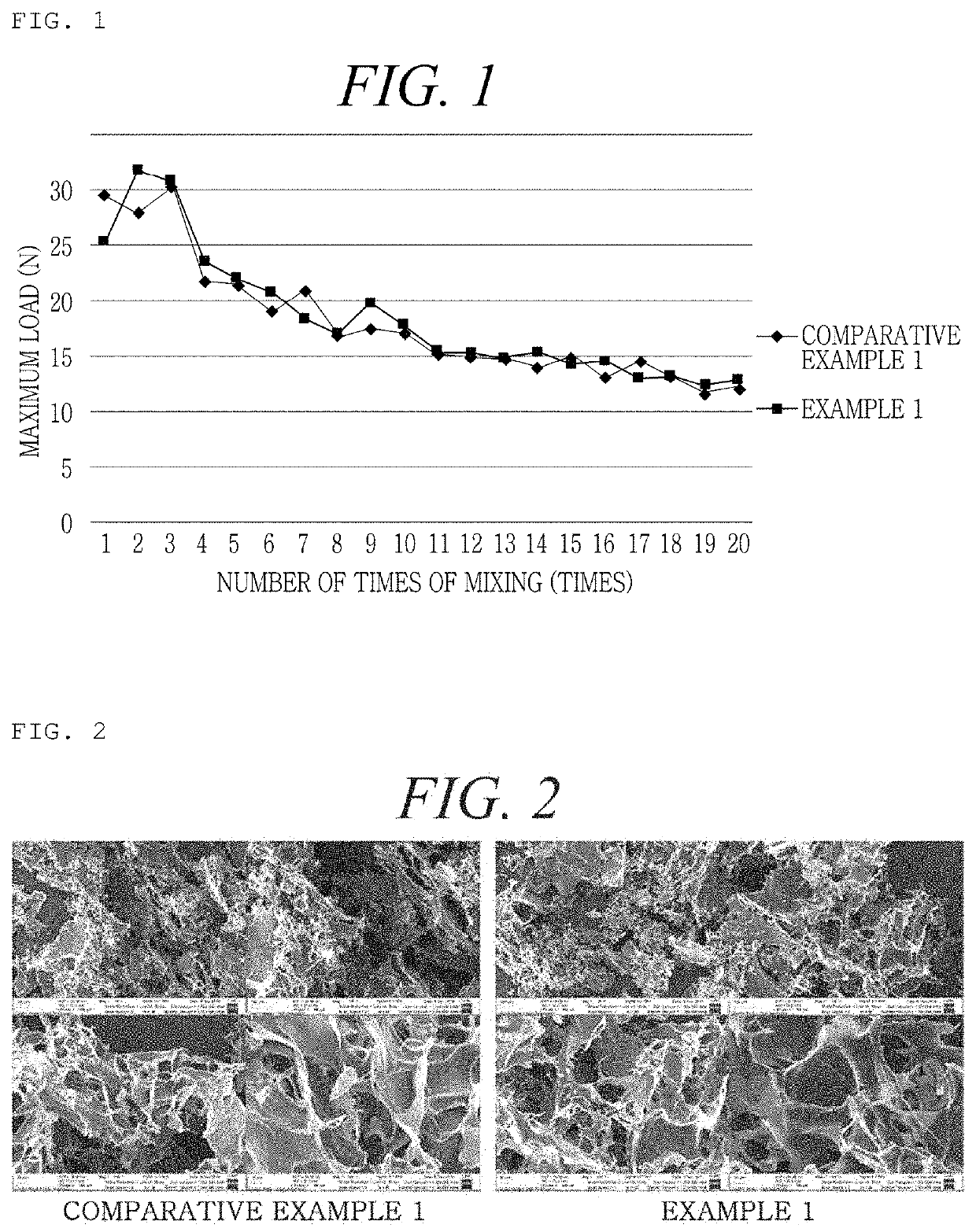
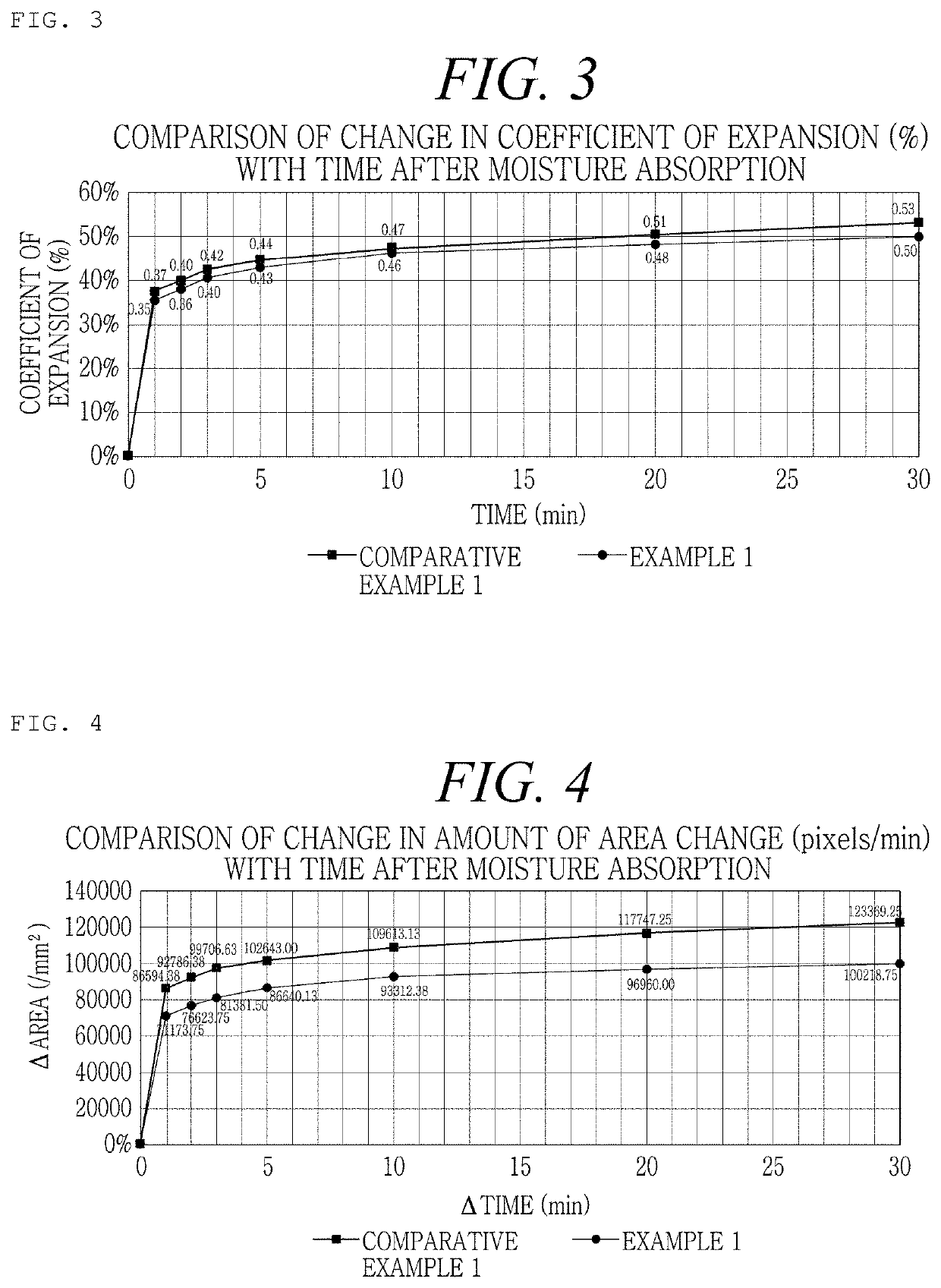
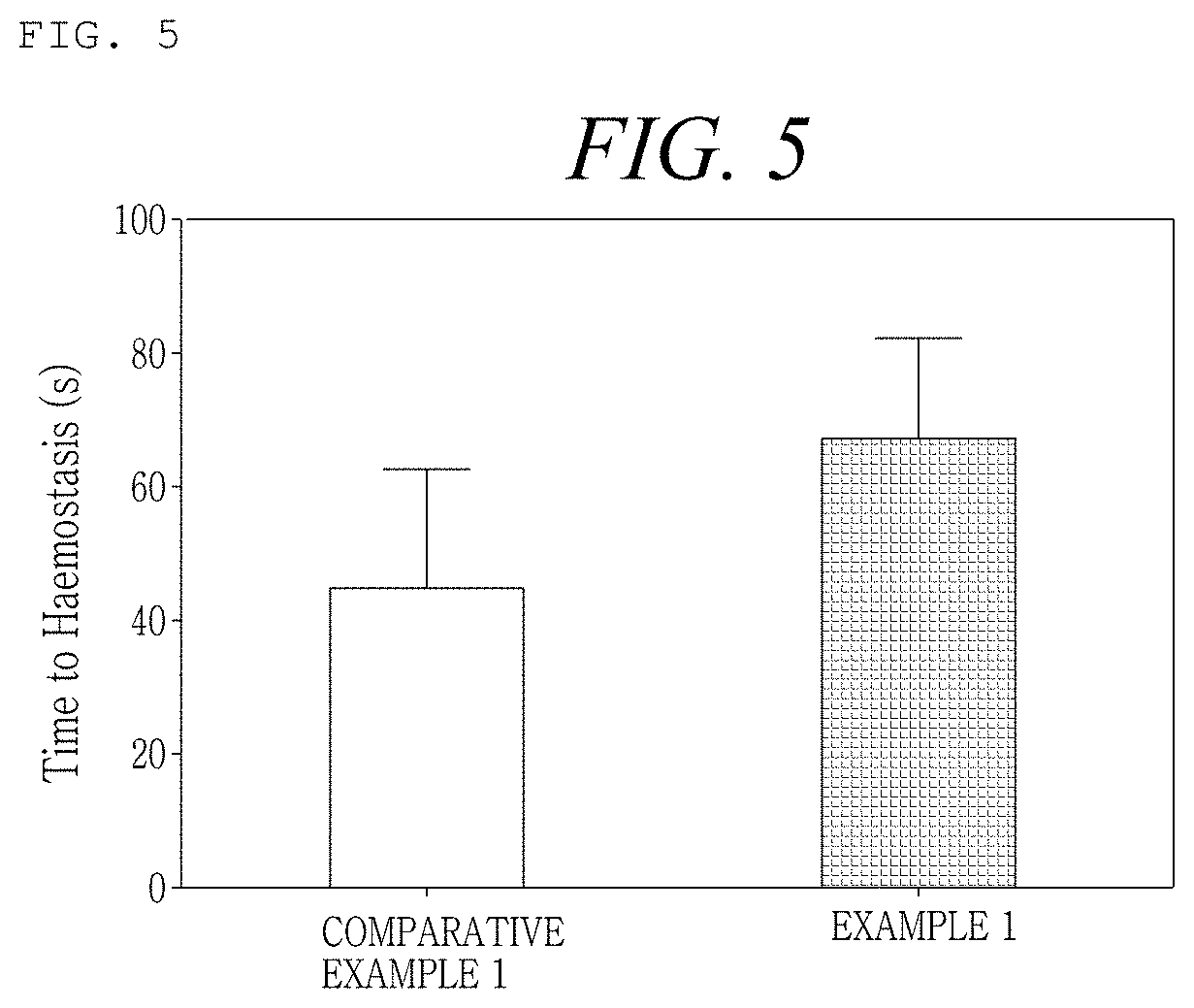
[0162]An Example was prepared as shown in the following Table 1, in order to examine the difference in flowability at the time of mixing the hemostatic composition with a calciumchloride solution as a diluent according to the order of disposition of mannitol as a stabilizer, thrombin, and collagen in the hemostatic composition. At this time, regarding mannitol and thrombin, powder-type manufactured products sold in the market were used, and the crosslinked collagen obtained from Production Example 2 was used.
[0163]Regarding Examples 1 to 4 and Comparative Example 1 prepared as shown in Table 1 above, the force required at the time of mixing was measured by the following method, and t...
the structure of the environmentally friendly knitted fabric provided by the present invention; figure 2 Flow chart of the yarn wrapping machine for environmentally friendly knitted fabrics and storage devices; image 3 Is the parameter map of the yarn covering machine
Login to View More
PUM
Property
Measurement
Unit
Fraction
aaaaa
aaaaa
Pore size
aaaaa
aaaaa
Pore size
aaaaa
aaaaa
Login to View More
Abstract
The present invention relates to a hemostatic composition including collagen, a stabilizer, and thrombin, and a container holding this hemostatic composition. The hemostatic composition and the container holding this hemostatic composition can be applied to an urgent bleeding patient by a simple method of use, and the hemostatic composition is less toxic, does not have a problem of blood infection, has a fast rate of biodegradation, has an excellent hemostatic effect, and can be usefully used as a hemostat.
Description
TECHNICAL FIELD[0001]The present application claims priority based on Korean Patent Application No. 10-2019-0062613, filed on May 28, 2019, the entire disclosure of which is incorporated herein by reference.[0002]The present invention relates to a hemostatic composition and a container holding the hemostatic composition.BACKGROUND ART[0003]Research and development in the field of tissue adhesives containing sealants and hemostats is in a rapid progress. A fibrinsealant was approved by the Food and Drug Administration (FDA) of the United States in 1998, and since then, new tissue adhesives have been continuously developed every year. These tissue adhesives are in the limelight as materials that can substitute for techniques such as suturing, clipping, and cautery, which have been traditionally used in surgical and medical operations.[0004]Although existing surgical techniques such as suturing exhibit strong tensile strength, those surgical techniques have problems such as the pain f...
Claims
the structure of the environmentally friendly knitted fabric provided by the present invention; figure 2 Flow chart of the yarn wrapping machine for environmentally friendly knitted fabrics and storage devices; image 3 Is the parameter map of the yarn covering machine
Login to View More
Application Information
Patent Timeline
Application Date:The date an application was filed.
Publication Date:The date a patent or application was officially published.
First Publication Date:The earliest publication date of a patent with the same application number.
Issue Date:Publication date of the patent grant document.
PCT Entry Date:The Entry date of PCT National Phase.
Estimated Expiry Date:The statutory expiry date of a patent right according to the Patent Law, and it is the longest term of protection that the patent right can achieve without the termination of the patent right due to other reasons(Term extension factor has been taken into account ).
Invalid Date:Actual expiry date is based on effective date or publication date of legal transaction data of invalid patent.