

In situ-forming hydrogel for tissue adhesives and biomedical use thereof
a bioadhesive and hydrogel technology, applied in the field of in situ-forming bioadhesive hydrogel, can solve the problems of low adhesiveness, pain, postoperative thread removal, tensile strength, etc., and achieve excellent tissue adhesiveness, excellent biocompatibility and mechanical strength, and prevent organ adhesion
- Summary
- Abstract
- Description
- Claims
- Application Information
AI Technical Summary
Benefits of technology
Problems solved by technology
Method used
Image

Examples
preparation example 1
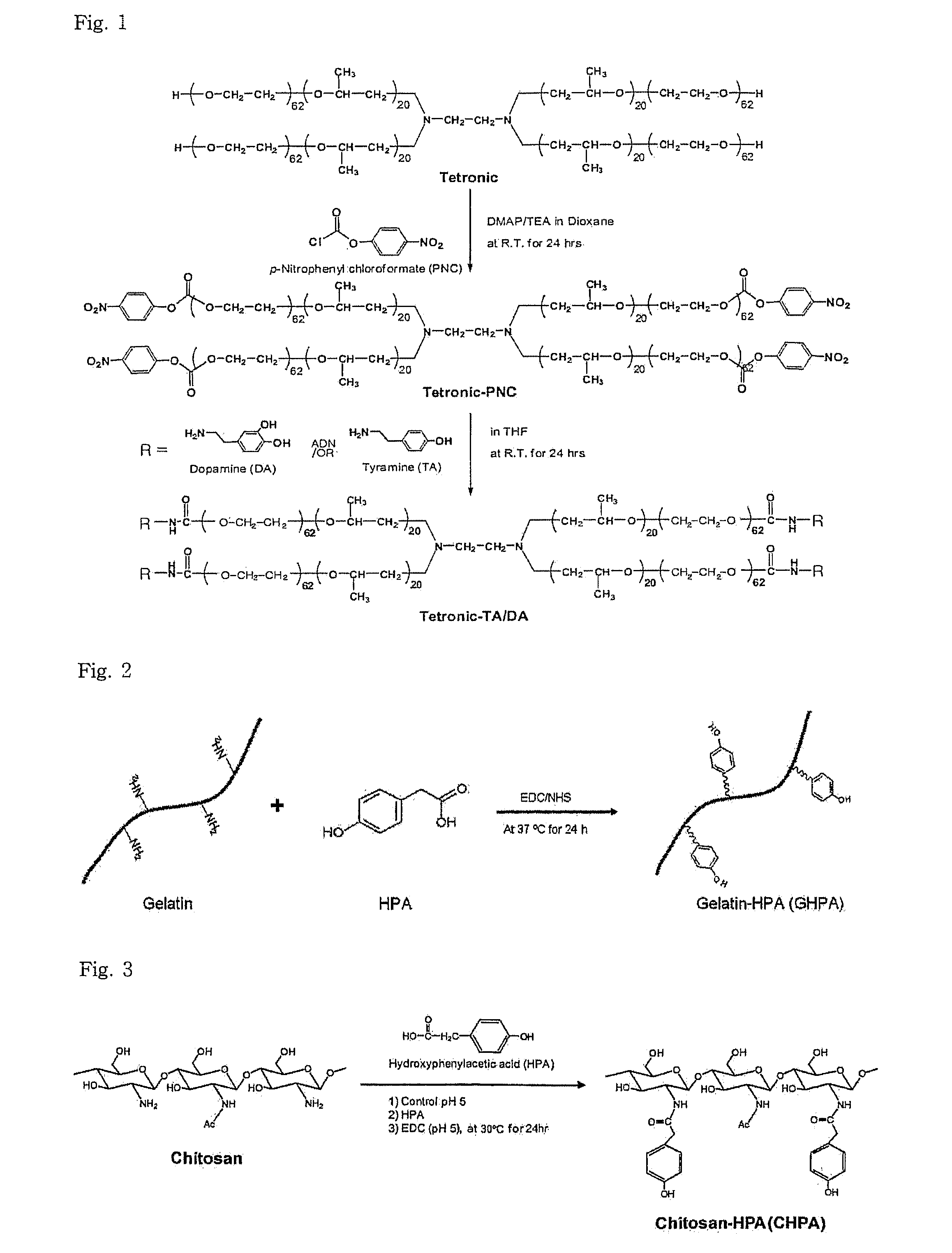
Synthesis of Tetronic-Tyramine / Dopamine (Tet-TA / DA)
[0106]FIG. 1 is a reaction scheme for synthesizing Tet-TA / DA.
[0107]1. Synthesis of Tetronic-(p-nitrophenyl chloroformate) ┌Tet-PNC┐
[0108]A solution of 30 g (1.67 mmol) of tetronic in 300 mL of dioxin was mixed sequentially with a solution of 1.018 g (8.33 mmol) of 4-dimethylaminopyridine (DMAP) and 0.843 g (8.33 mmol) of triethylamine (TEA) in 40 mL of dioxane and a solution of 1.679 g (8.33 mmol) of p-nitrophenyl chloroformate (PNC) in 50 mL of dioxane. The molar ratio of tetronic:PNC:DMAP:TEA was 1:5:5:5. The reaction was performed at 30° C. for 24 hrs in a nitrogen atmosphere.
[0109]After completion of the reaction, remaining reagents were removed through a filter and the reaction product was concentrated using a rotary evaporator. The concentrated solution was dropwise added to 1600 mL of chilled ether to form precipitates which were then filtered.
[0110]The filtered powder was left for 24 hrs in a vacuum oven to remove the remain...
preparation example 2
Synthesis of Gelatin-Hydroxyphenylacetic Acid (GHPA)
[0117]FIG. 2 is a reaction scheme for the synthesis of GHPA.
[0118]10 Grams of gelatin was dissolved in 200 mL of 0.1 M 2-(N-morpholino)ethanesulfonic acid (MES) to prepare a solution A. Separately, 0.609 g (4 mmol) of 4-hydroxyphenylacetic acid (HPA) was dissolved in 50 mL of 0.1 M MES to give a solution B. 0.92 Grams (4.8 mmol) of 1-ethyl-3-(3-dimethylaminopropyl)-carbodiimide (EDC) and 0.276 g (2.4 mmol) of N-hydroxysuccinimide (NHS) were dissolved in respective 5 mL of 0.1 M MES. The EDC solution and the NHS solution were sequentially at intervals of 15 min to the solution B. 15 min after addition of the NHS solution, the solution B containing EDC / NHS was mixed with the solution A. The reaction was performed at 40° C. for 24 hrs.
[0119]After completion of the reaction, the reaction mixture was filtered through a syringe filter (450 nm). Then, the filtrate was subjected to membrane dialysis against distilled water (molecular weigh...
preparation example 3
Synthesis of Chitosan-Hydroxyphenylacetic Acid (CHPA)
[0120]FIG. 3 is a reaction scheme for the synthesis of CHPA.
[0121]0.644 Grams of low molecular weight chitosan with a degree of deacetylation of 75˜85% was added to 80 mL of distilled water and its acidity was adjusted to a pH of 3 with 1 N HCl to form a solution. After 0.404 g (2.6 mmol) of HPA was added to the solution, its acidity was increased to a pH of 5 with 0.1 M NaOH. After the addition of 0.768 g (4 mmol) of EDC, the reaction was performed at 30° C. for 24 hrs.
[0122]When the reaction was completed, the reaction mixture was subjected to membrane dialysis against distilled water (molecular weight cutoff 3500 Da) to remove unreacted HPA. The dialyzed solution was lyophilized to produce CHPA in the form of semi-transparent non-woven fabric.
PUM
| Property | Measurement | Unit |
|---|---|---|
| mechanical strength | aaaaa | aaaaa |
| molecular weight | aaaaa | aaaaa |
| pH | aaaaa | aaaaa |
Abstract
Description
Claims
Application Information
 Login to View More