Unlock instant, AI-driven research and patent intelligence for your innovation.

Method for producing 2-aminoethylmethacrylate hydrochloride

a technology of methacrylate and hydrochloride, which is applied in the preparation of amino-hyroxy compounds, chemistry apparatus and processes, and organic chemistry, etc., can solve the problems of slow reaction speed, technical and economic disadvantage, and the need to recover the supply of methacrylic acid, etc., and achieves low cost and high yield. , the effect of high purity

Active Publication Date: 2018-06-05
MITSUBISHI GAS CHEM CO INC
View PDF21 Cites 0 Cited by
  • Summary
  • Abstract
  • Description
  • Claims
  • Application Information

AI Technical Summary

Benefits of technology

The present invention allows for the transformation of a specific chemical compound to a different compound with very few side reactions. This results in a higher purity and yield of the desired compound. The transformed compound can be used as an additive in various industries such as polymer flocculants, fiber treatment agents, and medical materials. It can also be used in further synthesis of other organic compounds. Overall, the invention provides a simple and efficient way to produce a high-purity compound.

Problems solved by technology

The resulting excessive methacrylic acid supply needs to be recovered after the final step of salt exchange with hydrochloric acid or sulfuric acid, which is technically and economically disadvantageous.
In Patent Literature 6, 2-isopropenyl-2-oxazoline, water and hydrochloric acid are used to synthesize aminoethylmethacrylate hydrochloride but the reaction speed thereof is slow and inevitably the reaction requires a large excess amount of water in order to complete the reaction within a practical time.
However, methacryloyl chloride and methacrylic anhydride that are used as raw materials in Patent Literatures 8 and 9 are generally difficult to handle and expensive, and thus unsuitable to be used as raw materials in an industrial process that assumes certain production quantity.
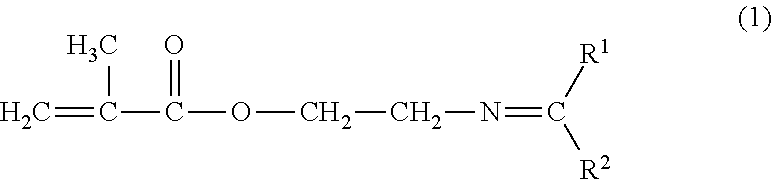
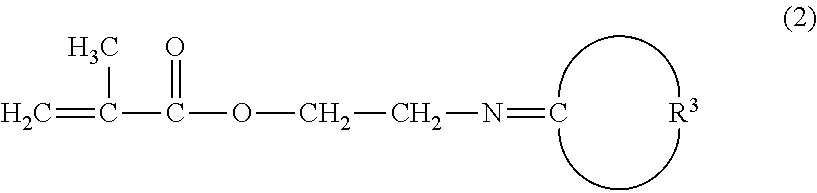
Moreover, Patent Literature 2 discloses a method in which an aqueous hydrochloric acid solution is added to 2-aminoethyl methacrylate methyl ethyl ketimine at 25° C. According to these methods, however, the compound of interest, that is, 2-aminoethyl methacrylate hydrochloride, was difficult to be isolated with a good yield.

Method used

the structure of the environmentally friendly knitted fabric provided by the present invention; figure 2 Flow chart of the yarn wrapping machine for environmentally friendly knitted fabrics and storage devices; image 3 Is the parameter map of the yarn covering machine
View more

Image

Smart Image Click on the blue labels to locate them in the text.
Viewing Examples
Smart Image
  • Method for producing 2-aminoethylmethacrylate hydrochloride
  • Method for producing 2-aminoethylmethacrylate hydrochloride
  • Method for producing 2-aminoethylmethacrylate hydrochloride

Examples

Experimental program
Comparison scheme
Effect test

synthesis example 1

[0120](Ketimination step)

[0121]100.0 g (1.6 mol) of 2-aminoethanol, 443 g (4.4 mol) of methyl isobutyl ketone and 84 g (1.0 mol) of cyclohexane were fed into to a three-neck flask (internal volume: 1000 ml) that was equipped with a magnetic stirrer, a rectifying column (inner diameter: 25 mmφ) packed with 6-mm McMahon packing to a height of 300 mm, a Dean-Stark trap and a reflux condenser, which was heated at a kettle liquid temperature of 90.7-105.9° C. under reflux to synthesize ketimine while draining water accumulated in the Dean-Stark trap from the system. Two hours later, the conversion rate of 2-aminoethanol was 100% while the yield of 2-aminoethanol methyl isobutyl ketimine was 99%.

[0122](Transesterification Step)

[0123]The excessive methyl isobutyl ketone and cyclohexane were distilled away from the resulting reaction solution by distillation under reduced pressure. To the remaining kettle liquid, 20.1 g of zinc acetylacetone complex, 317 g (3.2 mol) of methyl methacrylate a...

synthesis example 2

[0124](Ketimination step)

[0125]49.0 g (0.80 mol) of 2-aminoethanol, 173 g (2.4 mol) of methyl ethyl ketone and 162 g (1.9 mol) of hexane were fed into to a three-neck flask (internal volume: 1000 ml) that was equipped with a magnetic stirrer, a Dean-Stark trap, a rectifying column (inner diameter: 25 mmφ) packed with 6-mm McMahon packing to a height of 300 mm and a reflux condenser, which was heated at a kettle liquid temperature of 63.7-69.8° C. under reflux to synthesize ketimine while draining water accumulated in the Dean-Stark trap from the system. Six hours later, the conversion rate of 2-aminoethanol was 100% while the yield of 2-aminoethanol methyl ethyl ketimine was 99%.

[0126](Transesterification Step)

[0127]The excessive methyl ethyl ketone and hexane were distilled away from the resulting reaction solution. To the remaining kettle liquid, 10.6 g of zinc acetylacetone complex, 0.16 g of p-methoxyphenol and 160 g (1.6 mol) of methyl methacrylate were added. The Dean-Stark tr...

example 1

[0128]770 g (7.7 mol, containing 200 ppm of water) of methyl isobutyl ketone and 16.1 g (0.894 mol) of water were fed into a three-neck flask (internal volume: 2000 ml) that was equipped with a stirring blade and a dropping tube, and cooled in a methanol-ice bath. The total amount of the fed water was 0.903 mol including the water contained in methyl isobutyl ketone. To this, 32.5 g (0.890 mol) of hydrogen chloride gas was supplied with stirring and 181 g (0.858 mol) of 2-aminoethyl methacrylate methyl isobutyl ketimine obtained in Synthesis example 1 was dropped at the same time by spending 40 minutes. Here, the temperature in the system was maintained at 0° C. or lower, and the ratio of the accumulated supply amount of hydrogen chloride gas to the accumulated supply amount of 2-aminoethyl methacrylate methyl isobutyl ketimine was controlled to keep 1.04 / 1.00 in equivalent ratio from the starting point of mixing 2-aminoethyl methacrylate methyl isobutyl ketimine and hydrogen chlori...

the structure of the environmentally friendly knitted fabric provided by the present invention; figure 2 Flow chart of the yarn wrapping machine for environmentally friendly knitted fabrics and storage devices; image 3 Is the parameter map of the yarn covering machine
Login to View More

PUM

PropertyMeasurementUnit
carbon numberaaaaaaaaaa
weight ratioaaaaaaaaaa
carbon numberaaaaaaaaaa
Login to View More

Abstract

Provided is a method for producing 2-aminoethyl methacrylate hydrochloride that, according to one embodiment, includes a step (A) for reacting a ketimine compound of 2-aminoethyl methacrylate with water and hydrogen chloride and obtaining a mixture containing 2-aminoethyl methacrylate hydrochloride, wherein in the step (A), the ratio of the total amount of hydrogen chloride to the total amount of ketimine compound of 2-aminoethyl methacrylate is 1.0-1.5 expressed in terms of equivalents, and the ratio of the total amount of water to the total amount of ketimine compound of 2-aminoethyl methacrylate is 1.0-2.0 expressed in terms of equivalents.

Description

TECHNICAL FIELD[0001]The present invention relates to a method for producing 2-aminoethyl methacrylate hydrochloride by reacting a ketimine compound of 2-aminoethyl methacrylate with water and hydrogen chloride. 2-Aminoethyl methacrylate hydrochloride provided by the present invention is a useful compound as a raw material monomer for a polymer flocculant or coagulant, a fiber treatment agent, a modifier or a processing agent for paper, paint, ink, toner, a gluing agent, an adhesive, a chelating resin, an ion-exchange resin, a medical material, a hair care product, cosmetics, an antibacterial agent, a dispersant, a surface treatment agent, an antistatic agent, an additive for lubricating oil or fuel oil, a resist or the like.BACKGROUND ART[0002]Conventionally, various methods have been proposed as a method for producing 2-aminoethyl methacrylate salt. According to Patent Literatures 3 and 7, 2-aminoethyl methacrylate is generated from methacrylic acid and ethyleneimine, which is rea...

Claims

the structure of the environmentally friendly knitted fabric provided by the present invention; figure 2 Flow chart of the yarn wrapping machine for environmentally friendly knitted fabrics and storage devices; image 3 Is the parameter map of the yarn covering machine
Login to View More

Application Information

Patent Timeline
no application Login to View More
Patent Type & Authority Patents(United States)
IPC IPC(8): C07C213/02C07C249/02C07C69/54C07C219/08C07C251/24C07C251/04
CPCC07C213/02C07C69/54C07C219/08C07C251/24C07C249/02C07C251/04C07C219/20
Inventor IIDA, YURITAKEMOTO, MASAKISATO, HIDEYUKI
Owner MITSUBISHI GAS CHEM CO INC