Chlorine-resistant and pollution-resistant polyamide reverse osmosis composite membrane and preparation method thereof
A reverse osmosis composite membrane and reverse osmosis membrane technology are applied in the field of chlorine-resistant and pollution-resistant polyamide reverse osmosis composite membrane and the preparation field of the above-mentioned polyamide reverse osmosis composite membrane, which can solve problems such as immature technical solutions and avoid easy flushing. The effect of drop, improved contamination resistance, and simple operation method
- Summary
- Abstract
- Description
- Claims
- Application Information
AI Technical Summary
Problems solved by technology
Method used
Image



Examples
Embodiment 1
[0067] Preparation method of chlorine-resistant and pollution-resistant polyamide reverse osmosis composite membrane
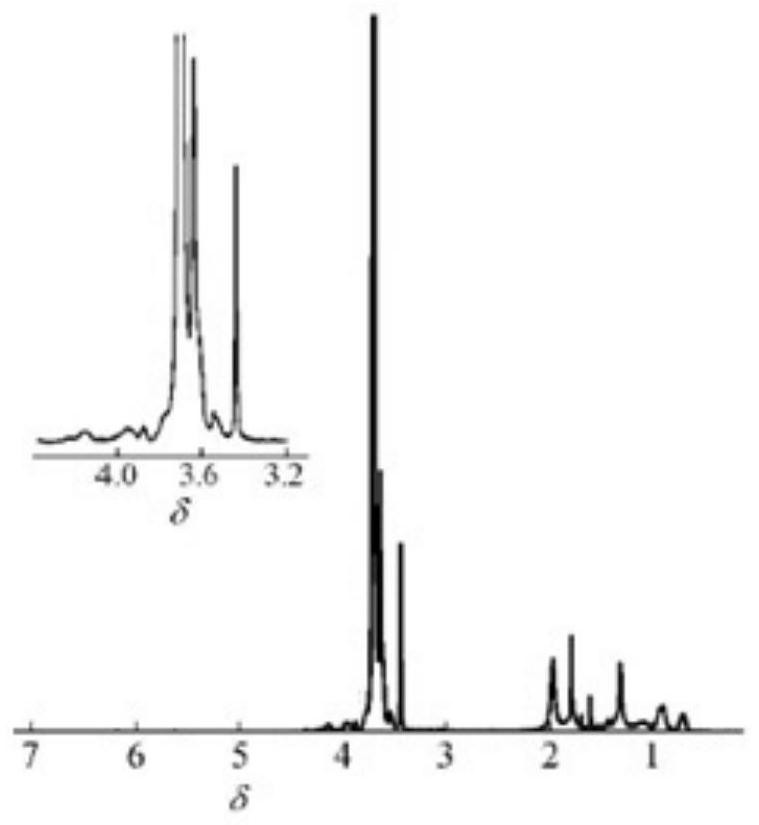
[0068] Preparation of 3-(trimethoxysilane) propyl acrylate-copolyethylene glycol methyl ether methacrylate copolymer: 3-(trimethoxysilane) propyl acrylate and polyethylene glycol methyl ether Methacrylate (weight-average molecular weight 300) is added to a mixed solvent of tetrahydrofuran and chloroform with a volume ratio of 1:1 according to the molar ratio of 1:2, and then the initiator azobisisobutyronitrile of 1 wt% of the total monomer weight is added , and then reacted at 75°C for 24h under nitrogen atmosphere. After the reaction was completed, n-hexane was used as a precipitating agent to obtain 3-(trimethoxysilane)propyl acrylate-co-polyethylene glycol methyl ether methacrylic acid by co-precipitation method Ester copolymer (weight-average molecular weight: 50,000-60,000), and dried under vacuum at 40°C for 24 hours to obtain copolymer powder. The NMR...
Embodiment 2
[0072] Preparation of chlorine-resistant and pollution-resistant polyamide reverse osmosis composite membrane: except that the concentration of 3-(trimethoxysilane) propyl acrylate-co-polyethylene glycol methyl ether methacrylate copolymer is formulated as 500ppm, In the same manner as in Example 1, a chlorine-resistant and pollution-resistant polyamide reverse osmosis composite membrane was prepared.
[0073] The obtained chlorine-resistant and pollution-resistant polyamide reverse osmosis composite membrane has an initial desalination rate of 99.7% and a permeation flux of 34.6L / m 2 / h, after evaluating the chlorine resistance of sodium hypochlorite solution, the desalination rate is 99.3%, and the permeation flux is 36.7L / m 2 / h, the rate of decrease of water flux after pollution is 10%.
Embodiment 3
[0075] Preparation of chlorine-resistant and pollution-resistant polyamide reverse osmosis composite membrane: except that the concentration of the ethanol solution of 3-(trimethoxysilane) propyl acrylate-co-polyethylene glycol methyl ether methacrylate copolymer is prepared as 1000ppm In addition, the same manner as in Example 1 was carried out to prepare a chlorine-resistant and pollution-resistant polyamide reverse osmosis composite membrane.
[0076] The obtained chlorine-resistant and pollution-resistant polyamide reverse osmosis composite membrane has an initial desalination rate of 99.7% and a permeation flux of 34.1L / m 2 / h, after evaluating the chlorine resistance of sodium hypochlorite solution, the desalination rate is 99.5%, and the permeation flux is 36.3L / m 2 / h, the rate of decrease in water flux after pollution is 6%.
PUM
 Login to View More
 Abstract
Description
Claims
Application Information
 Login to View More
PatSnap Eureka turns technology decisions into work you can execute. Powered by our Innovation Knowledge Graph, it runs expert workflows across engineering, life sciences, materials and intellectual property. Get your review-ready output in minutes.


