Unlock instant, AI-driven research and patent intelligence for your innovation.

Photoelectric and photothermal conversion material containing condensed ring electron withdrawing end group and preparation method and application thereof

A light-to-heat conversion material and electron-absorbing technology, applied in circuits, photovoltaic power generation, electrical components, etc., to achieve the effects of easy purification, high yield, and low polarity

Pending Publication Date: 2022-06-10
SOUTH CHINA UNIV OF TECH
View PDF2 Cites 0 Cited by
  • Summary
  • Abstract
  • Description
  • Claims
  • Application Information

AI Technical Summary

Problems solved by technology

However, the electron-absorbing ability of the end group of this material is weak, the absorption cannot reach the near-infrared region, the energy level is high, and the band gap is wide, so it is not suitable for the field of organic solar cell acceptors and photothermal conversion.

Method used

the structure of the environmentally friendly knitted fabric provided by the present invention; figure 2 Flow chart of the yarn wrapping machine for environmentally friendly knitted fabrics and storage devices; image 3 Is the parameter map of the yarn covering machine
View more

Image

Smart Image Click on the blue labels to locate them in the text.
Viewing Examples
Smart Image
  • Photoelectric and photothermal conversion material containing condensed ring electron withdrawing end group and preparation method and application thereof
  • Photoelectric and photothermal conversion material containing condensed ring electron withdrawing end group and preparation method and application thereof
  • Photoelectric and photothermal conversion material containing condensed ring electron withdrawing end group and preparation method and application thereof

Examples

Experimental program
Comparison scheme
Effect test

Embodiment 1

[0046]

[0047] (1) Add 3-bromofluoren-9-one (100mg, 0.39mmol), 5,6-dichloro-3-(dicyanomethylene)inden-1-one (113mg, 0.43mmol) and solvent tetrahydrofuran (15mL), after stirring evenly, add 0.2ml of pyridine and 0.2ml of titanium tetrachloride solution, and heat to reflux at 60°C for 1h. After the reaction was completed, it was cooled to room temperature, quenched by adding ice water, extracted three times with dichloromethane, collected the organic layer, and removed the solvent by rotary evaporation. 1 vol / vol) was used as the eluent and dried in vacuo to obtain 153 mg of fused-ring electron-withdrawing terminal compound A1 (red solid, yield 77.6%). The proton spectrum result of this product is: 1H-NMR (CDCl 3 ,500MHz)δ8.60(d,J=8.0Hz,1H),8.46(d,J=8.4Hz,1H),8.01(d,J=1.6Hz,1H),7.65(m,2H),7.48( m,2H), 7.43–7.39(m,2H).

[0048] (2) The fused-ring electron-withdrawing terminal compound A1 (82mg, 0.162mmol), 6,6,12,12-tetrakis(4-hexylphenyl)-6,12-dihydrodithiophene[2,3-d :...

Embodiment 2

[0058]

[0059] (1) Add 3-bromofluoren-9-one (280mg, 1.08mmol), 5,6-difluoro-3-(dicyanomethylene)inden-1-one (300mg, 1.29mmol) and solvent tetrahydrofuran (40mL), after stirring evenly, add 0.6ml of pyridine and 0.6ml of titanium tetrachloride solution, and heat to reflux at 70°C for 2h. After the reaction was completed, it was cooled to room temperature, quenched by adding ice water, extracted three times with dichloromethane, collected the organic layer, and removed the solvent by rotary evaporation. 1 vol / vol) was used as the eluent, and vacuum-dried to obtain 480 mg of fused-ring electron-withdrawing terminal compound A2 (red solid, yield 84.2%). The proton spectrum result of this product is: 1 H-NMR (CDCl 3 ,500MHz)δ8.47(d,J=8.4Hz,1H),8.40(m,1H),7.75(m,1H),7.68(m,1H),7.62(d,J=1.9Hz,1H), 7.49(m,1H),7.44–7.38(m,2H),7.25–7.23(m,1H).

[0060] (2) The fused-ring electron-withdrawing terminal compound A2 (38mg, 0.081mmol), 6,6,12,12-tetrakis(4-hexylphenyl)-6,12-dihydrodi...

Embodiment 3

[0063]

[0064] The fused ring electron-withdrawing terminal compound A2 (97mg, 0.206mmol), 4,4,9,9-tetraoctyl-4,9-dihydro-s-indolo[1,2-b:5,6 -b']dithiophene-2,7-bistrimethyltin (IDT-Sn) (80mSg, 0.086mmol), catalyst trisdibenzylideneacetone dipalladium (7.8mg, 0.0086mmol), ligand tri(o Methylphenyl)phosphine (8.1mg, 0.0258mmol) and solvent toluene (16mL) were added into the reaction vessel, stirred evenly at room temperature under nitrogen protection, and then heated to 110°C for 12h. After the reaction was completed, it was cooled to room temperature, extracted three times with dichloromethane, the organic layer was collected, and the solvent was removed by rotary evaporation. The solvent was removed and vacuum-dried to obtain 62 mg of photoelectric and photothermal conversion material LY3 (dark solid, yield 52.1%).

[0065] Example 4:

the structure of the environmentally friendly knitted fabric provided by the present invention; figure 2 Flow chart of the yarn wrapping machine for environmentally friendly knitted fabrics and storage devices; image 3 Is the parameter map of the yarn covering machine
Login to View More

PUM

PropertyMeasurementUnit
thicknessaaaaaaaaaa
Login to View More

Abstract

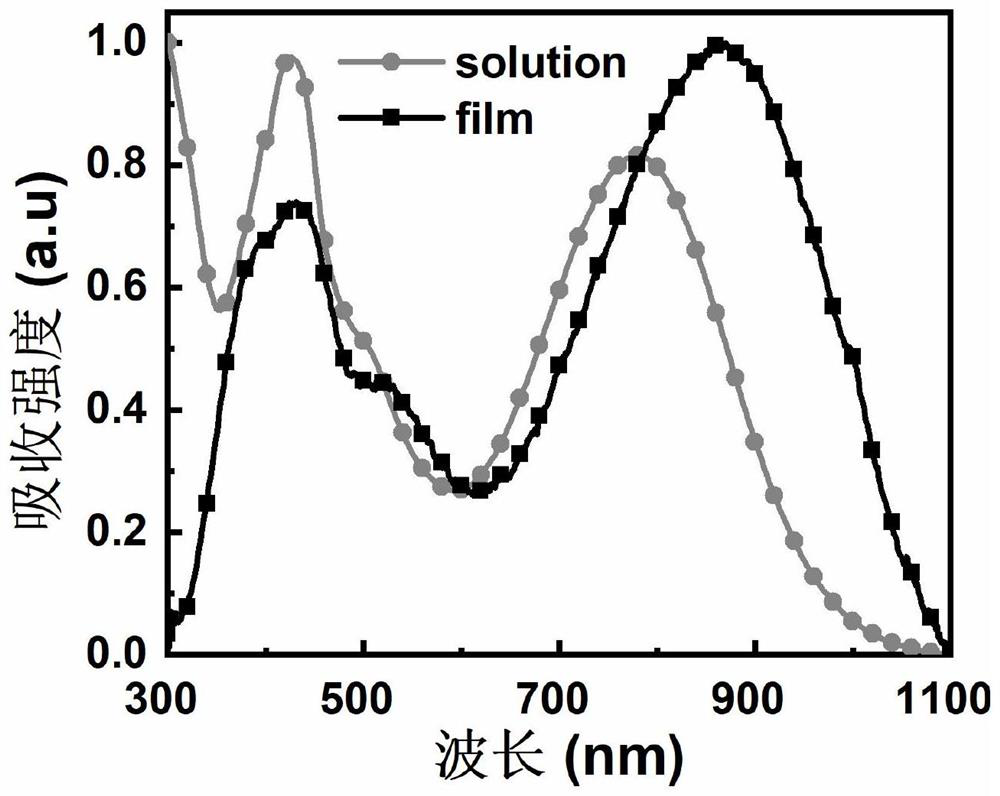
The invention belongs to the field of organic semiconductor materials, and discloses a photoelectric and photothermal conversion material containing a fused ring electron withdrawing end group, and a preparation method and application thereof. The material is based on an acceptor-donor-acceptor (A-D-A) structure, during preparation, 3-bromofluorene-9-one and a compound with active methylene, pyridine and titanium tetrachloride are used for preparing a monobromine-containing fused ring electron withdrawing end group, then a palladium catalyst and a ligand are added, and the material is prepared through a stile coupling reaction, so that the material has the advantages of simple synthesis method, high yield, low cost and the like, and is suitable for industrial production. In addition, the material has strong absorption in a range of 700-1100 nm, and the band gap is narrow. The energy conversion efficiency of an organic solar cell based on the material as a receptor is 0.40-0.43%; the material shows good photothermal conversion performance, can be rapidly heated to 180 DEG C under irradiation of 808nm laser with the power of 0.8 W / cm < 2 >, and has excellent circulating photothermal stability and bleaching resistance.

Description

technical field [0001] The invention belongs to the field of organic semiconductor materials, and in particular relates to a preparation method and application of a photoelectric and photothermal conversion material containing fused-ring electron-attracting terminal groups. Background technique [0002] Organic solar cells have attracted extensive attention and research due to their unique advantages such as light weight, flexibility, and solution processability. In recent years, the development of non-fullerene acceptors has made the photoelectric conversion efficiency record of organic solar cells continuously hit new highs, which has exceeded 19% at present. However, this kind of high-performance non-fullerene acceptor is generally constructed by the condensation reaction of the active methylene group on the electron-withdrawing unit and the aldehyde group in the electron-donating unit. This synthesis method makes an unstable The exocyclic carbon-carbon double bond is pr...

Claims

the structure of the environmentally friendly knitted fabric provided by the present invention; figure 2 Flow chart of the yarn wrapping machine for environmentally friendly knitted fabrics and storage devices; image 3 Is the parameter map of the yarn covering machine
Login to View More

Application Information

Patent Timeline
no application Login to View More
Patent Type & Authority Applications(China)
IPC IPC(8): C07D495/22C07D495/04C07D513/22H01L51/42H01L51/46
CPCC07D495/22C07D495/04C07D513/22H10K85/615H10K85/626H10K85/657H10K85/6576H10K30/00Y02E10/549
Inventor 李远梁维轩
Owner SOUTH CHINA UNIV OF TECH