[0038] One
advantage of the invention is that immersion of tissue structures, such as skin, in the electrically-
conductive fluid, reduces the impedance of the electrosurgical output, such that
skin surfaces can be
cut, vaporized, contoured (cutaneous thermabrasion) or otherwise thermally modified, whilst minimizing
char formation and undesirable
thermal damage to tissue margins. This is particularly advantageous when debriding wounds or ulcers, and in the treatment of a variety of cutaneous or
dermatological disorders. Such disorders include: malignant tumors (whether primarily or secondarily involving the skin); port
wine stains;
telangiectasia; granulomas; adenomas; haemangioma; pigmented lesions; nevi; hyperplastic, proliferative and inflammatory fibrous papules; rhinophyma; seborrhoeic keratoses; lymphocytoma; angiofibromata; warts; neurofibromas; condylomata;
keloid or
hypertrophic scar tissue.
[0039] Another
advantage of the invention is that the
desiccation capability is considerably improved by the immersion of structures in the electrically-
conductive fluid, particularly as it applies to simple
probe type devices such as hooks. This is a result of several factors. The first of these relates to the fact that tissue surfaces dry out quite quickly during
surgical procedures, which increases the impedance of electrical contact with tissues. As
desiccation performance is current-driven, the
high impedance prevents adequate current delivery, and the
output impedance of a desiccate
voltage range is exceeded. As a result, the tissue is incompletely desiccated and, if this occurs during
desiccation of a
blood vessel, the lumen will still be patent and any bleeding will not be controlled. The second of these factors occurs as a result of this
high impedance tissue adhering to the surface of the tissue treatment electrode. This compounds the problem, as it further reduces the effectiveness of desiccation. The third is that both these factors are enhanced when the tissue treatment electrode has a small contact surface area, particularly if this electrode is a hook which has been used for
cutting, as this leads to carbonisation and pitting of the electrode surface, prior to use as a desiccating instrument. These disadvantages are overcome by use of the present invention. In particular, the improved desiccation performance is useful when sealing venous or thin-walled vascular structures as may be encountered during treatment of haemangioma, varicosities or other vascular anomalies as well as during venous harvesting.
[0040] Yet a further
advantage of the present invention is that the
irrigation of artificial cavities with an electrically-conductive or physiological solution, such as normal
saline, provides a number of benefits. The surfaces of tissues exposed during the procedure are prevented from dehydrating, thereby improving their viability, particularly when the healing process is initiated. Tissue debris, electrosurgical
smoke and blood are washed from the operative site so improving
visualization. Such devascularised debris produces tissue reactions which could potentially
delay healing, increase post-operative pain associated with inflammatory mediators, and increase the risk of
wound infection. The consistency of
electrical performance of the invention is improved by immersion of the operative site in an electrically-conductive liquid, whereby the
voltage potential required to initiate an arc in vapor is more constant compared to the variable effects of different gaseous environments on arc potential.
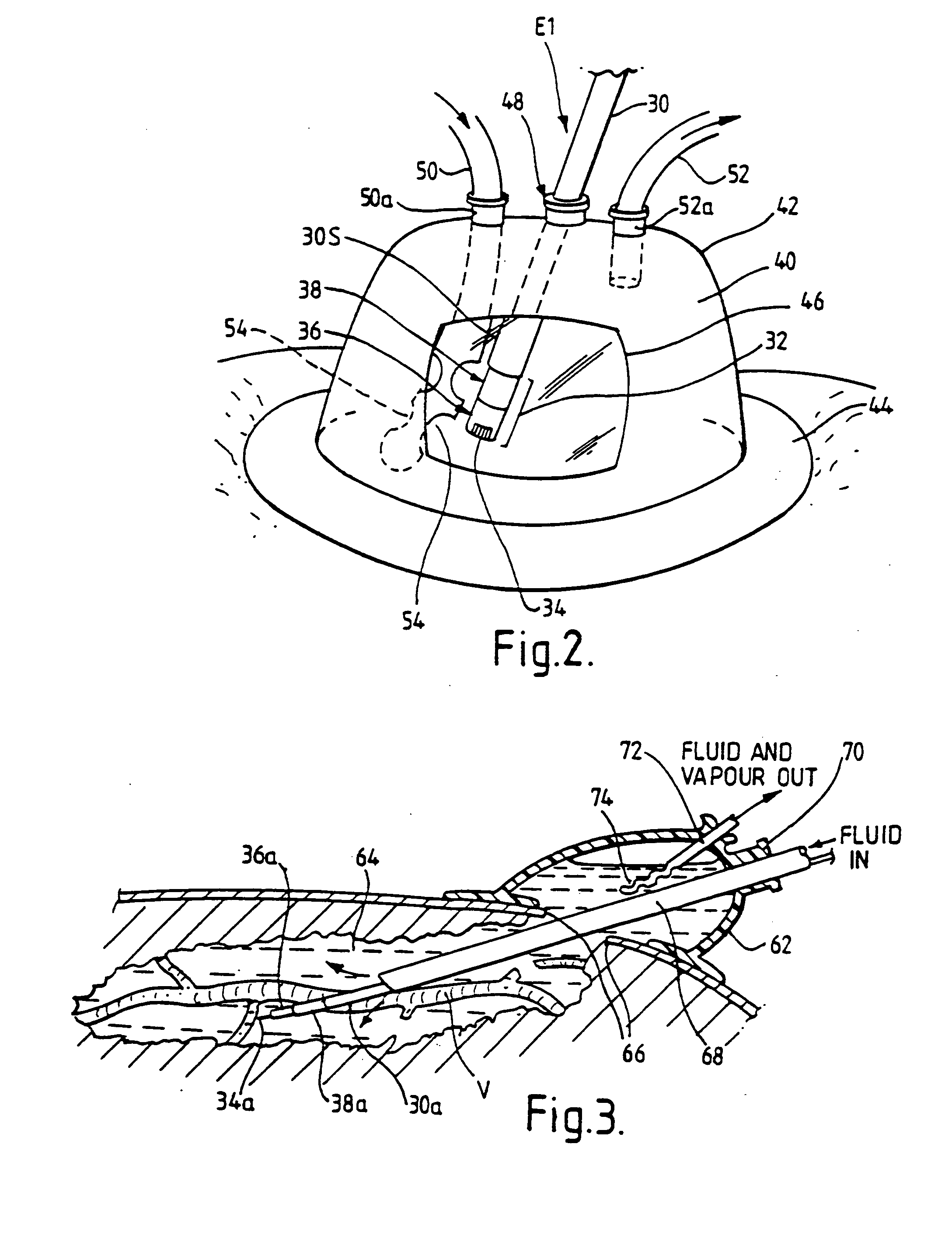
[0041] Still another advantage of the present invention is in providing tunneled access to tissue structures for which, when immersed in an electrically-conductive fluid, the desiccation function can be utilized thermally to modify these structures. Such access techniques can be used to modify collagen-containing tissues which have become lax for a variety of reasons. The laxity of support ligaments is a common cause for prolapse or descent of structures which, when not supported correctly, commonly do not function correctly. An example of such a situation is bladder neck descent in women, wherein the closure mechanism of the bladder becomes ineffective under conditions of stress, such as straining, coughing or
physical activity. The ligaments of the bladder neck and
pelvic floor could be accessed by tunneling through the
perineum to create a working cavity adjacent to these support structures. Such a cavity can then be distended by utilizing the present invention for the purposes of modifying these support structures.
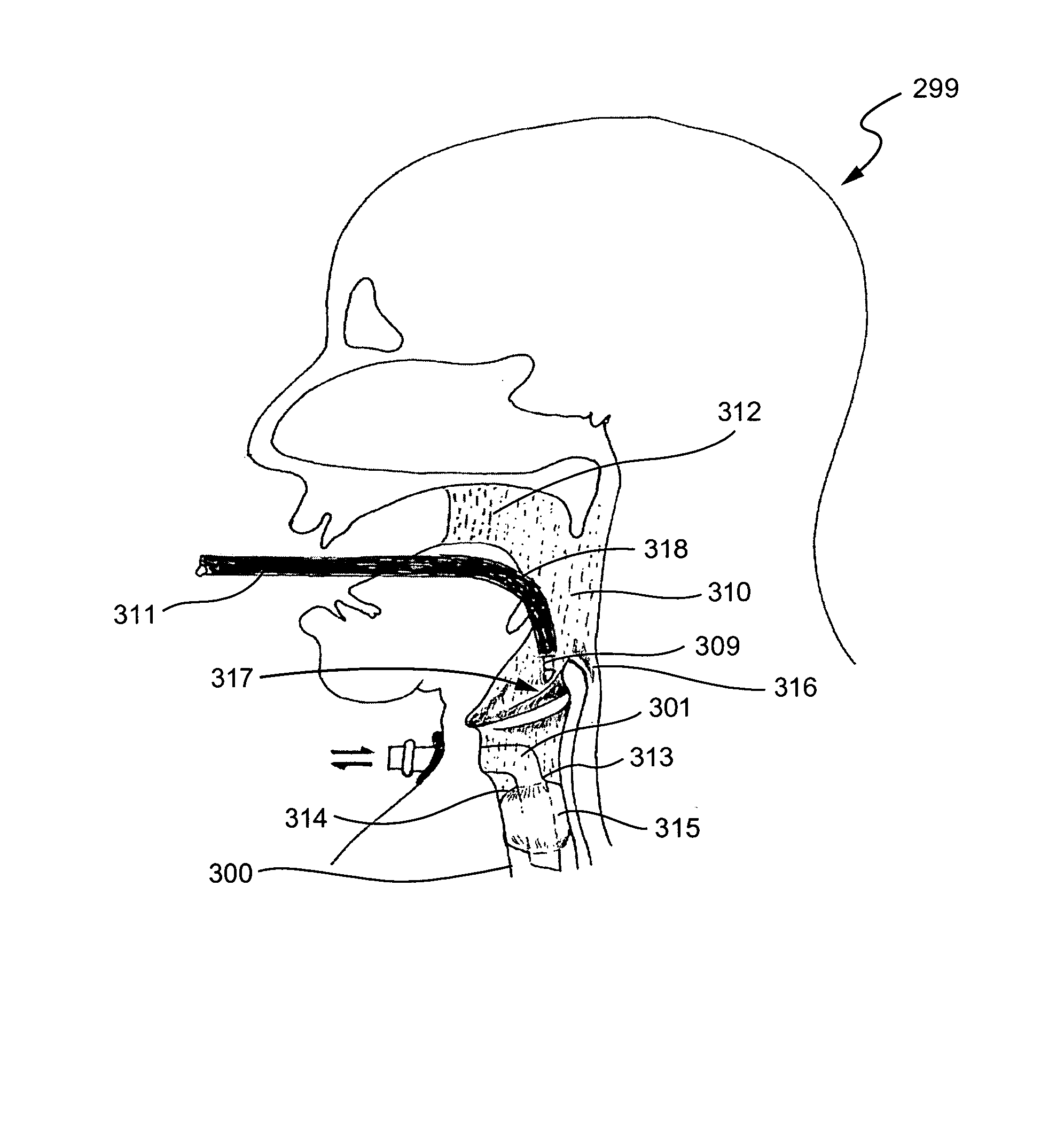
[0042] The invention further includes a method of treating benign conditions, such as enlarged tonsils and / or adenoids located in the
throat or nasopharynx of a patient, or
soft tissue lesions located in the oropharynx or larynx of the patient. According to the method, an
enclosure of electrically-conductive fluid, such as saline, is formed including the patient's nasopharynx, oropharynx or
pharynx and larynx by isolating the nasopharynx, oropharynx or complete
pharynx from the patient's trachea and lungs using an
inflatable cuffed tracheostomy tube or a nasotracheal tube. The tracheostomy tube is inserted in the patient's trachea via an incision, and the
cuff is inflated to occlude the trachea and prevent the fluid from filling the patient's lungs when the oropharynx and larynx are filled with the fluid. Alternatively, the nasotracheal tube is inserted in the patient's trachea through his or her
nose, such that a portion of the long tube of the nasotracheal tube protrudes from the patient's
nose. Here again, a cuff surrounding the tube is inflated to occlude the patient's trachea. To form the
enclosure of saline fluid, the patient is put in the
supine position, whereupon the sub-glottic region of the larynx, the vocal cords, supra-glottic region of the larynx, the
epiglottis and piriform fossae, the nasopharynx and the oropharynx are filled with the fluid. The upper extension of the fluid will depend on the volume of the fluid used and the position of the patient, and, thus, a varying degree of the patient's tongue will be immersed, depending on the level of fluid employed from time to time during the
surgery.
[0043] Alternatively, the upper boundary of the
fluid field bay be contained using another
inflatable device, such as a laryngeal
mask, well known in the prior art as an anaesthetic device, modified for use in conjunction with the invention to allow instrumental access and fluid
irrigation. The lower extension of the fluid is bounded by the upper side of the tracheostomy tube or nasotracheal tube cuff. The opening to the
esophagus is also present within the
fluid field, but is either likely to be collapsed during the procedure or provide a manageable leak of fluid from the field such that physical
occlusion should not be necessary. It should be noted that the laryngeal
mask can be used with either the tracheostomy tube or the nasotracheal tube. The laryngeal
mask can be used for the treatment of enlarged adenoids and tonsils, provided that the mask is positioned anterior to the
soft palate.


 Login to View More
  Login to View More