[0075] It is a particular
advantage of the present invention that exogenous or extra activators need not be administered to a patient. Collagen, a major component of connective tissues, is a strong activator of platelets. Thus, when the inventive
platelet composition is administered to skin, platelets in the platelet composition may bind to the collagen and then be activated. This reduces or eliminates the need for administering an exogenous activator such as
thrombin. The disadvantages of
thrombin use have been noted above. Other strong activators, such as
calcium ions, can cause
severe pain, unintentional clotting, and other undesirable side effects. Thus, in an embodiment of the invention, no or substantially no exogenous activator is present or added as part of the inventive platelet composition, or is used in the preparation of the inventive platelet composition. Of course, exogenous activators may still be employed if a physician determines that they are medically necessary or desirable. Thus, the composition of the invention may consist only of platelets as the
active ingredient.
[0076] The platelet composition may be prepared using any conventional method of isolating platelets from
whole blood or platelet-containing blood fractions. These include centrifugal methods,
filtration, affinity columns, and the like. If the platelet composition comprises PRP, then conventional methods of obtaining PRP, such as those disclosed in U.S. Pat. Nos. 5,585,007 and 5,788,662 both to Antanavich et al., incorporated herein by reference in their entirety, may be utilized.
[0077] Adjusting the pH of platelet compositions has been used to prolong the storage time of unactivated platelets, as disclosed in U.S. Pat. No. 5,147,776 to Koerner, Jr. and U.S. Pat. No. 5,474,891 to Murphy, incorporated by reference herein. pH may be adjusted using a variety of pH adjusting agents, which are preferably physiologically tolerated buffers, but may also include other agents that modify PRP pH including agents that modify
lactic acid production by stored platelets. Especially useful are those pH adjusting agents that result in the pH of the platelet composition becoming greater than or equal to physiological pH. In an embodiment, the pH adjustment agent comprises
sodium bicarbonate. Physiological pH, for the purposes of this invention, may be defined as being a pH
ranging from about 7.35 to about 7.45. pH adjusting agents useful in the practice of this invention include
bicarbonate buffers (such as
sodium bicarbonate),
calcium gluconate,
choline chloride, dextrose (d-glucose), ethylenebis(oxyethylenenitrilo)tetraacetic acid (EGTA), 4-(2-hydroxyethyl)- 1 -piperazineethanesulfonic acid (
HEPES),
maleic acid, 4-morpholinepropanesulfonic acid (
MOPS), 1,4-piperazinebis(
ethanesulfonic acid) (PIPES),
sucrose, N-
tris(
hydroxymethyl)methyl-2-aminoethanesulfonic acid (TES),
tris(
hydroxymethyl)aminomethane (
TRIS BASE),
tris(
hydroxymethyl)aminomethane
hydrochloride (
TRIS.HCl), and
urea. In a preferable embodiment, the pH adjusting agent is a bicarbonate buffer, more preferably,
sodium bicarbonate.
Platelet Alloimmunization
[0078] Platelets present a variety of antigens, including HLA and platelet-specific antigens. Patients transfused with platelets which are not their own often develop HLA antibodies. The patient may become
refractory to all but HLA-matched platelets. When platelets are transfused to a patient with an
antibody specific for an expressed
antigen, the survival time of the transfused platelets may be markedly shortened. Nonimmune events may also contribute to reduced platelet survival. It is possible to distinguish immune from nonimmune platelet refractoriness by assessing platelet
recovery soon after infusion, i.e., 10 - 60 minutes postinfusion platelet increment. In immune
refractory states secondary to serologic incompatibility, there is poor
recovery in the early postinfusion interval. In nonirmune mechanisms, i.e., splenomegaly,
sepsis, fever, intravascular devices, and DIC, platelet
recovery within 1 hour of infusion may be adequate while long-term survival (i.e., 24-hour survival) is reduced. Serologic tests may be helpful in selecting platelets with acceptable survival. In accordance with the present invention the platelets are preferably taken from the same patient they will be used to treat. In a similar manner the platelet releasate or any portion thereof is taken from the same patient treated with the formulation. Alternatively, the patient is treated with platelets, platelet releasate and portions thereof extracted from a donor patient tested for and found to have a close serologic match with the patient being treated.
Cell Cultures
[0079] The
cell cultures of the present invention involved the use of PRP and, for example may use PRP from the same patient the cells (e.g.
fibroblast cells) being cultured were obtained from.
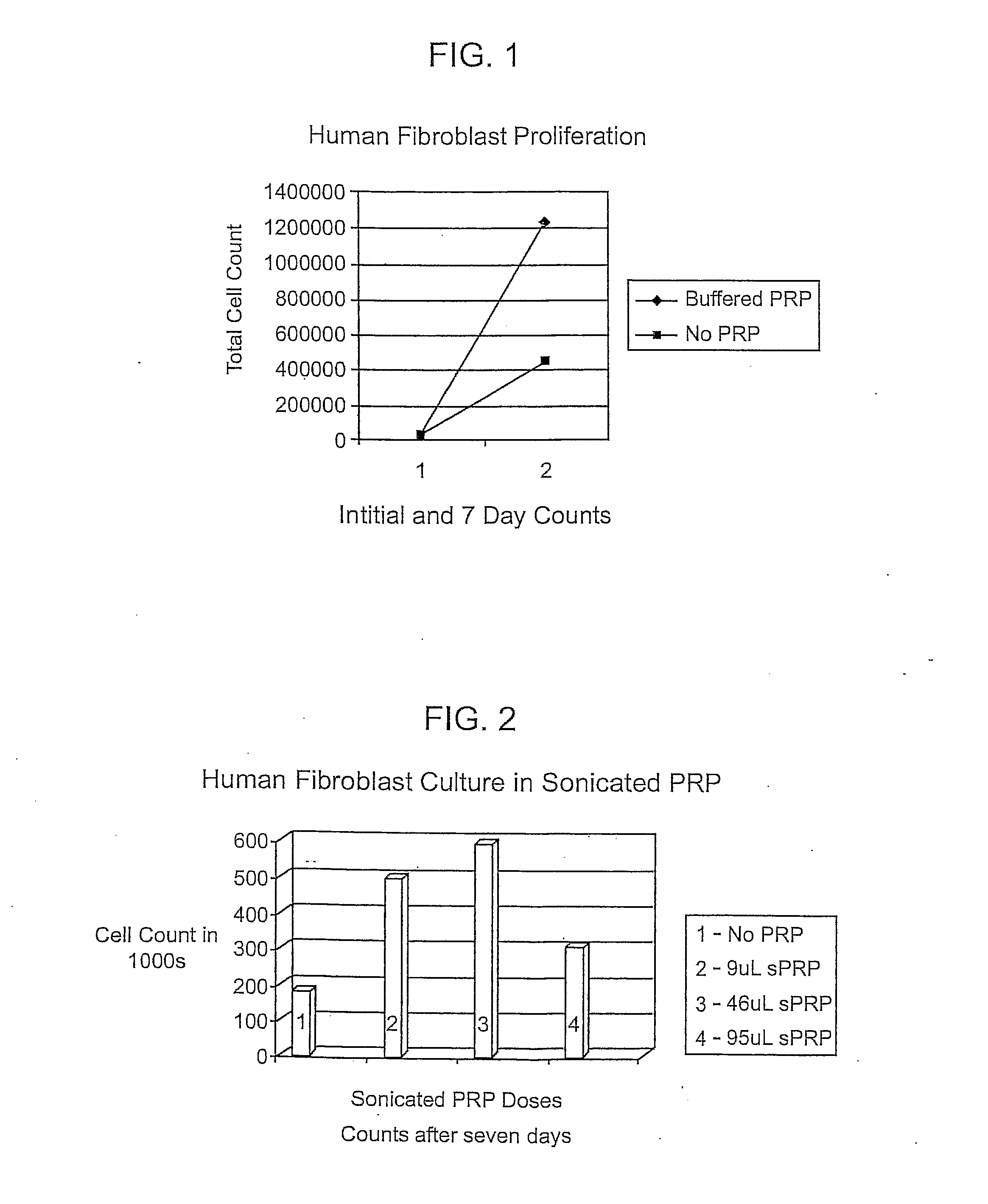
[0080] Example 5 below shows the
cell culture with PRP therein and Example 6 shows the
cell culture with three different concentrations of platelet releasate therein. The platelets may be treated in any manner to open the platelets or allow the releasate to escape. The treatment may be with an energy wave (e.g.
ultra sound), agitation, temperature (heating / cooling-freezing / thawing), and chemical treatments or any combination thereof.


 Login to View More
  Login to View More