
Dielectric film and dielectric element
a dielectric element and dielectric film technology, applied in the direction of fixed capacitors, thin/thick film capacitors, metallic material coating processes, etc., can solve the problems of difficult to achieve the currently required capacitance, no consideration, and difficulty in solving the problem, so as to achieve maximum two-layer characteristics, increase grain boundary resistivity, and high dielectric constant
- Summary
- Abstract
- Description
- Claims
- Application Information
AI Technical Summary
Benefits of technology
Problems solved by technology
Method used
Image

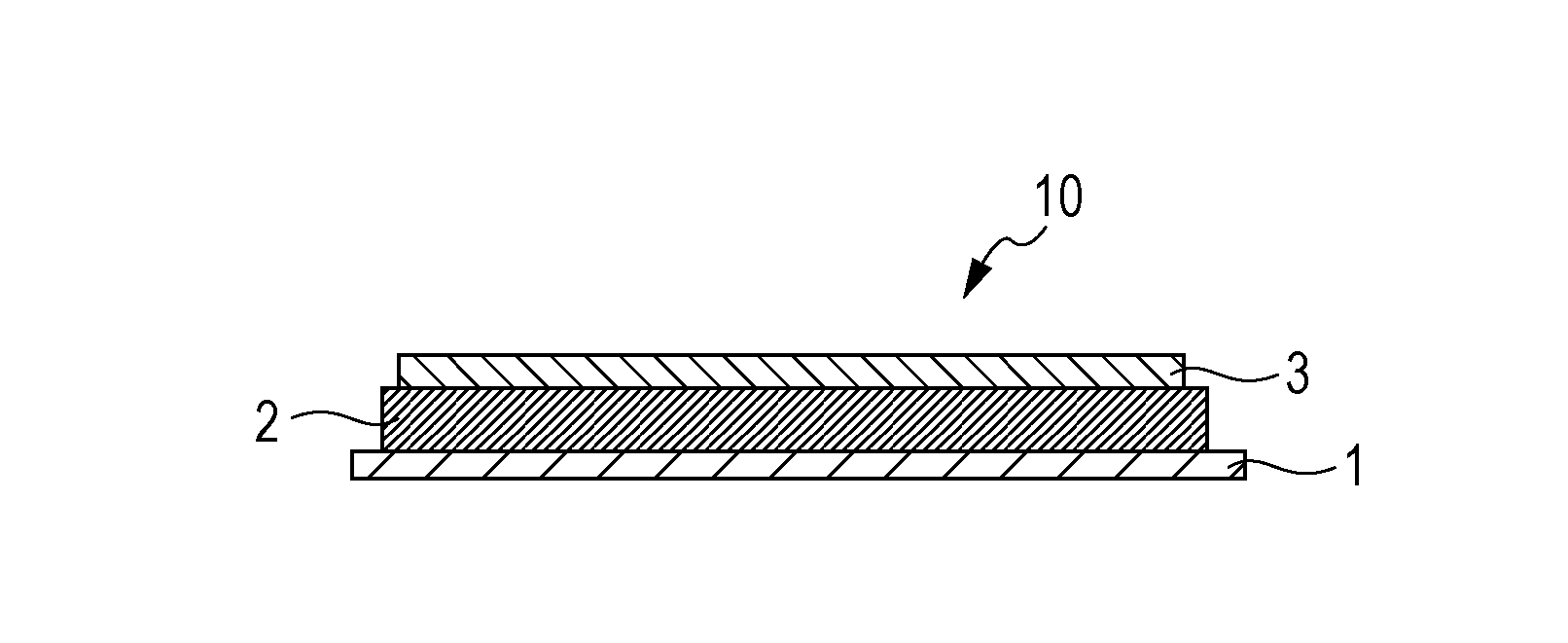
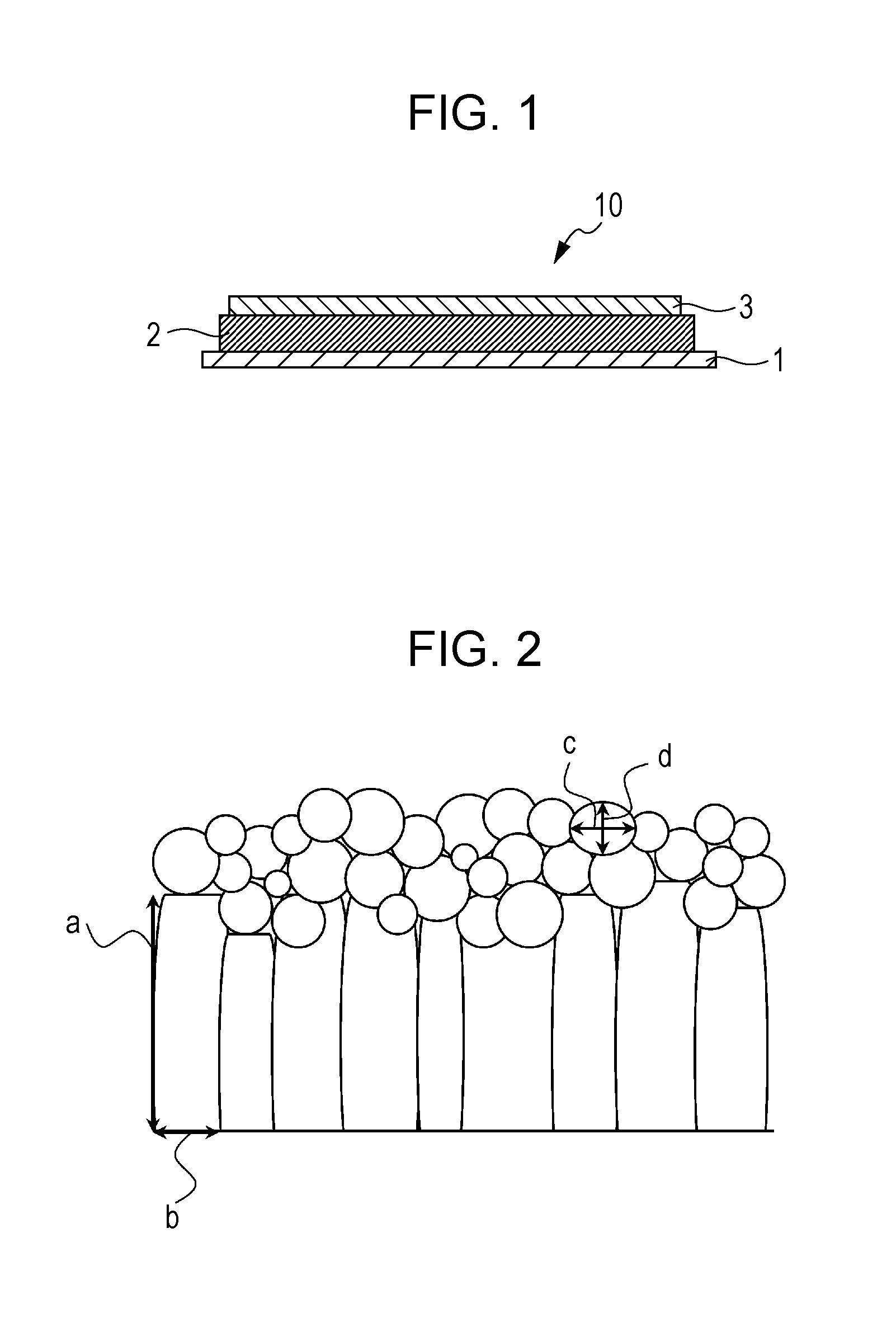
Examples
example 1 , examples 3 to 31
Example 1, Examples 3 to 31, and Comparative Examples 3 to 13
[0055]A Ni plate having a thickness of 50 μm was prepared as a lower electrode. The Ni plate had dimensions of 10 mm in length and 10 mm in width.
[0056]A target for sputtering was produced by a solid phase method. The mixing ratios of raw material powders of BaO, CaO, SrO, TiO2, and ZrO2 in the target and a sub-component were adjusted so as to obtain each of the dielectric film compositions shown in Table 1 to Table 4.
[0057]Next, the raw material powders were wet-mixed in a ball mill for 20 hours using water as a solvent, and the resultant mixed powder was dried at 100° C.
[0058]The mixed powder was pressed to form a molded body. The molding conditions included a pressure of 100 Pa, a temperature of 25° C., and a pressing time of 3 minutes.
[0059]Then, the molded body was sintered at a retention temperature of 1300° C. for a temperature keeping time of 10 hours in an air atmosphere.
[0060]Then, the resultant sintered body was...
example 32
[0087]A target for sputtering was produced by the same solid-phase method as in Example 1. The mixing ratios of raw material powders of BaO, CaO, TiO2, and ZrO2 in the target and a sub-component were adjusted so as to obtain the dielectric film composition shown in Table 5.
[0088]A dielectric film was formed under the same conditions as in Example 1.
[0089]Annealing was performed under annealing conditions including a (wet N2+H2) mixed gas atmosphere (oxygen partial pressure of 3×10⁻¹¹ MPa), a heating rate of 600° C. / hour, a retention temperature of 950° C., a retention time of 1.0 hour.
[0090]Then, a sample of Example 32 was formed by the same method as in Example 1 except that the annealing conditions were as described above.
[0091]The resultant sample of Example 32 was evaluated by the same method as in Example 1. The results are shown in Table 5.
example 33
[0092]A target for sputtering was produced by the same solid-phase method as in Example 1. The mixing ratios of raw material powders of BaO, CaO, TiO2, and ZrO2 in the target and a sub-component were adjusted so as to obtain the dielectric film composition shown in Table 5.
[0093]A dielectric film was formed under the same conditions as in Example 1.
[0094]Annealing was performed under annealing conditions including a (wet N2+H2) mixed gas atmosphere (oxygen partial pressure of 3×10⁻¹¹ MPa), a heating rate of 600° C. / hour, a retention temperature of 950° C., a retention time of 1.0 hour. Then, annealing was performed under annealing conditions including a (wet N2+H2) mixed gas atmosphere (oxygen partial pressure of 1×10⁻⁶ MPa), a heating rate of 600° C. / hour, a retention temperature of 500° C., a retention time of 1.0 hour.
[0095]A sample of Example 33 was formed by the same method as in Example 1 except that the annealing conditions were as described above.
[0096]The resultant sample o...
PUM
| Property | Measurement | Unit |
|---|---|---|
| dielectric constant | aaaaa | aaaaa |
| thickness | aaaaa | aaaaa |
| thickness | aaaaa | aaaaa |
Abstract
Description
Claims
Application Information
 Login to View More