
Upconversion fluorescence resonance energy transfer detection composition and detection method based on dopamine polymerization reaction regulation
A technology of fluorescence resonance energy and detection method, which is applied in the direction of fluorescence/phosphorescence, measuring device, and material analysis through optical means, and can solve the problems of lower detection sensitivity, lower detection convenience, and increased detection cost
- Summary
- Abstract
- Description
- Claims
- Application Information
AI Technical Summary
Problems solved by technology
Method used
Image

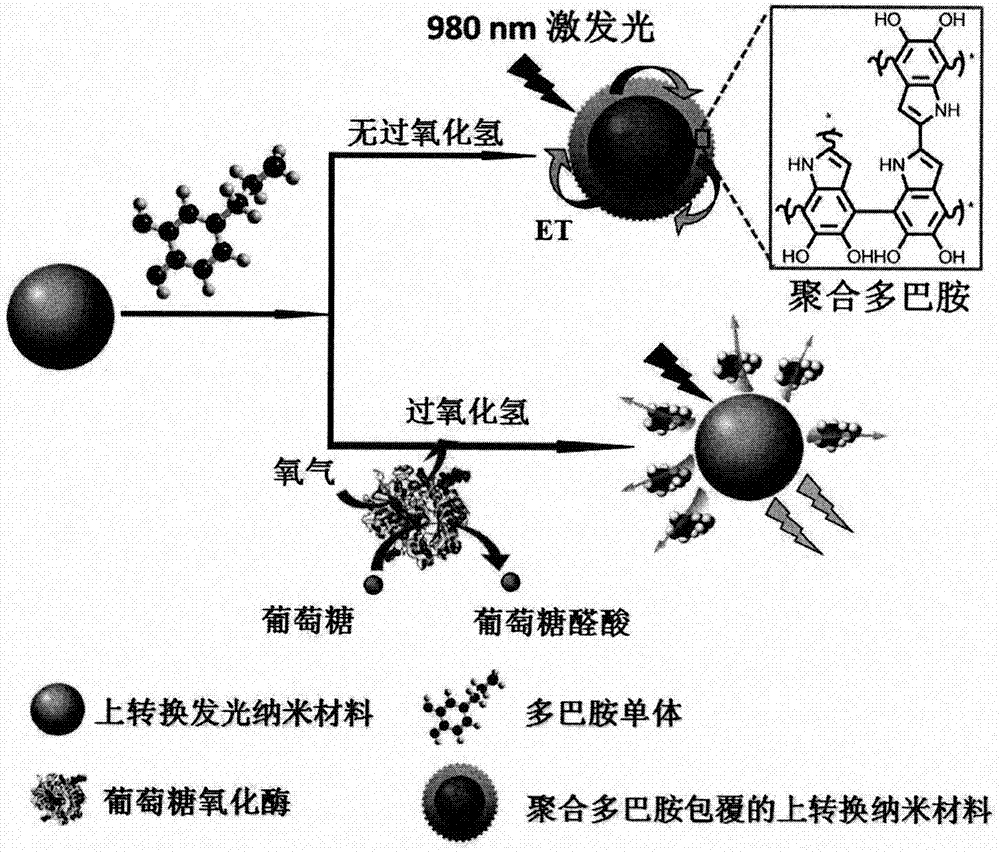
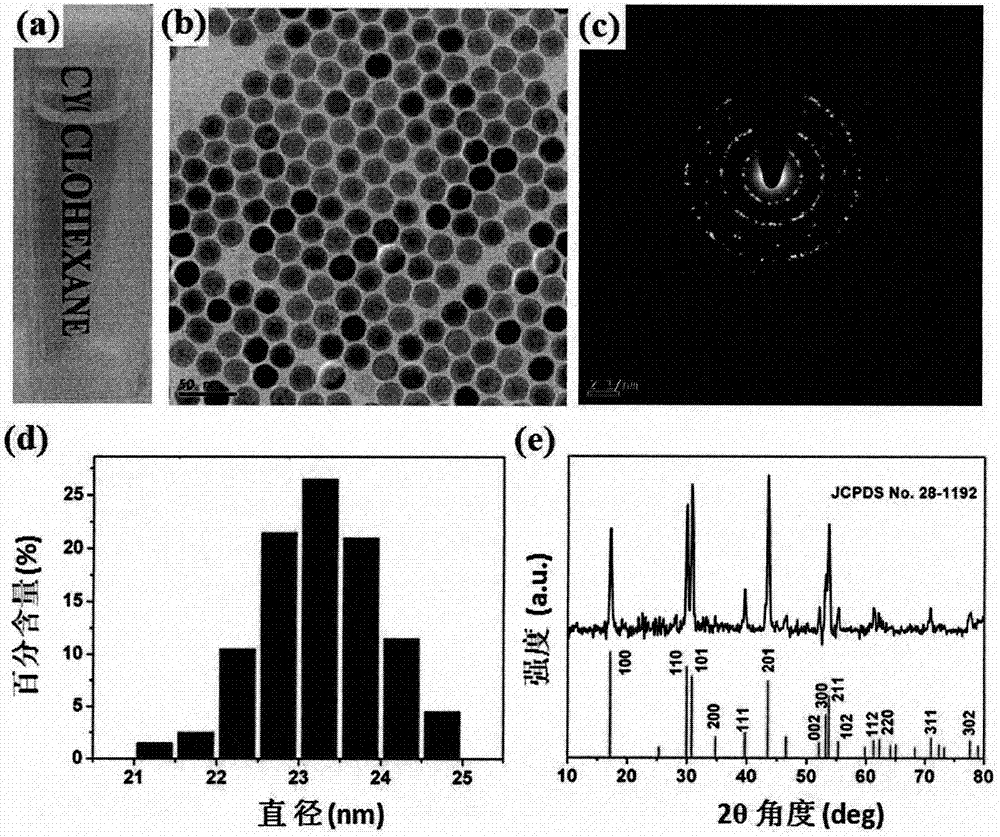
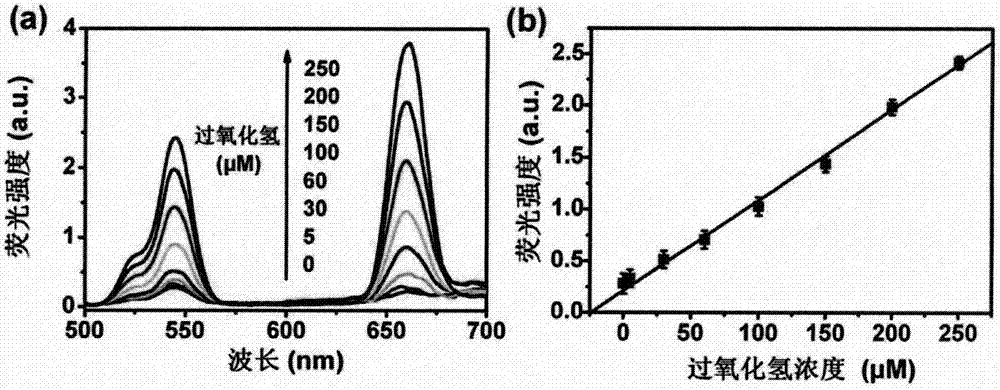
Examples
preparation example 1
[0067] Preparation of Rare Earth Doped NaYF by High Temperature Co-precipitation 4 Upconversion Fluorescent Nanomaterials
[0068] Using rare earth acetate, ammonium fluoride, sodium hydroxide, oleic acid (OA) and 1-octadecene (ODE) as raw materials, the preparation method is as follows:
[0069] The weighed 1mmol rare earth acetate: 0.8mmol Y(CH 3 COO) 3 , 0.18mmol Yb(CH 3 COO) 3 , 0.02mmol Er(CH 3 COO) 3 , into a 100mL round-bottom three-necked flask, and then add 6mL of oleic acid and 15mL of octadecene. Under the protection of nitrogen, stir the above reaction materials evenly to form an emulsion, then heat to 150°C for 30 minutes to form a clear and transparent homogeneous solution, and then lower the reaction temperature to room temperature;
[0070] Dissolve the previously prepared solution with 0.1 g NaOH and 0.148 g NH 4 The methanol solution of F was added dropwise to the reaction flask, stirred at room temperature for 30 minutes to ensure uniform dispersion ...
preparation example 2
[0073] Preparation of water-soluble upconversion fluorescent nanomaterials without oleic acid ligands by acid washing
[0074]Take 15 mL of absolute ethanol solution, add an appropriate amount of hydrochloric acid dropwise to make it pH = 1; dissolve the oil-soluble up-converting nanoparticles prepared in Preparation Example 1 in the above ethanol solution, and sonicate for 30 min; wash with absolute ethanol and distilled water several times after centrifugation ; The cleaning process was centrifuged at a speed of 15000rpm for 10 minutes. The finally obtained nanoparticles after pickling were transparent, indicating that the cleaning effect was good. Finally, the ligand-free upconversion nanomaterials were dissolved in 4mL of deionized water, ultrasonically dispersed, and the concentration was obtained. An aqueous solution of nanoparticles at approximately 5.0 mg / mL.
Embodiment 1
[0076] The present embodiment is used for the detection of hydrogen peroxide concentration, and concrete operation process is as follows:
[0077] (1) The carrier used in the detection is a polystyrene 96-well plate, and 100 μL of the up-converting fluorescent nanomaterial (UCNPs) aqueous solution prepared in Preparation Example 2, 80 μL of the dopamine monomer aqueous solution, and 100 mM Tris -HCl buffer solution (pH=8.5) to dilute the mixed solution to 200 μL to obtain 8 groups of mixed solutions, respectively measure the up-conversion fluorescence intensity of the 8 groups of mixed solutions, and calculate the fluorescence quenching efficiency of the dopamine monomer aqueous solution; when the fluorescence When the quenching efficiency is maximum, the concentration of UCNPs corresponding to the mixture is 0.4 mg / mL, and the concentration of dopamine monomer is 500 μM; and this is used as the standard concentration; the concentration-dependent curve of hydrogen peroxide is d...
PUM
| Property | Measurement | Unit |
|---|---|---|
| particle diameter | aaaaa | aaaaa |
| diameter | aaaaa | aaaaa |
Abstract
Description
Claims
Application Information
 Login to View More