PCR fluorescence detection kit of clostridium difficile toxin B and application of kit
A Clostridium difficile toxin and fluorescence detection technology, which is applied in the determination/testing of microorganisms, DNA/RNA fragments, recombinant DNA technology, etc., can solve the problem of unbalanced sensitivity and specificity
- Summary
- Abstract
- Description
- Claims
- Application Information
AI Technical Summary
Problems solved by technology
Method used
Image



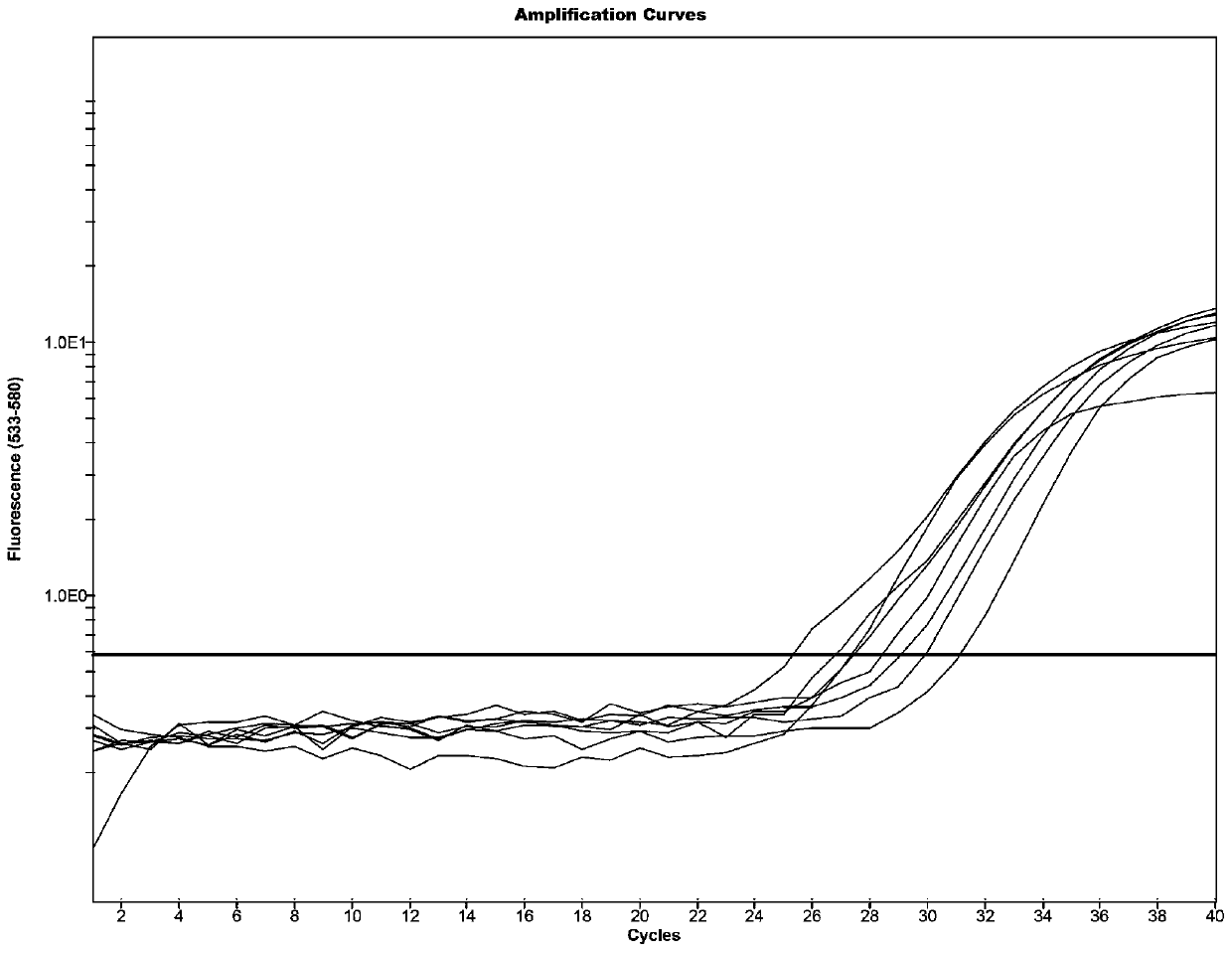
Examples
Embodiment 1
[0081] Screening of Primers for PCR Fluorescent Detection Kit of Clostridium difficile Toxin B
[0082] 1. Sample Collection
[0083] Take diarrhea feces and send them for inspection in time. 16 samples were collected, all clinical samples were from Shenzhen Children's Hospital.
[0084] 2. Sample extraction
[0085] (1) Take internal reference fragments (2×10 4 Copes / mL) 10 μl was added to 500 μl sample treatment solution (10 mM Tris-HCl, pH=8.0; 6M guanidine hydrochloride; 25 mM NaOH; 1% TritonX-100; 1% NP-40; 1 mM EDTA);
[0086] (2) Take 100-200 mg of feces sample. If the sample is liquid, draw 0.15-0.20 ml of sample, add 500 μl of sample treatment solution, shake and mix, and treat at 100°C for 10 minutes;
[0087] (3) Centrifuge at 12,000g for 5 minutes;
[0088] (4) Take 400 μl supernatant, add 200 μl absolute ethanol, and mix well;
[0089] (5) Transfer the suspension to a spin column, centrifuge at 12,000g for 1 minute, and install the spin column into a new col...
Embodiment 2
[0130] Specificity and Sensitivity Evaluation of PCR Fluorescence Detection Kit for Clostridium difficile Toxin B
[0131] 1. Sample preparation:
[0132] (1) Positive sample: Cultivate and clone the engineering bacteria of Clostridium difficile toxin B gene and extract the plasmid, measure the concentration with Qubit, then calculate its concentration, and dilute the plasmid with AE buffer to 1.0×10 5 copies / mL~1.0×10 2 copies / mL four concentration gradients.
[0133] (2) Negative samples: physiological saline and nucleic acids of Escherichia coli, Salmonella, Enterococcus faecium, and Enterococcus faecalis (confirmed by mass spectrometry and Sanger sequencing for bacteria obtained from feces culture).
[0134] 2. Sample adding system:
[0135] The PCR reaction solution includes PCR reaction solution A and PCR reaction solution B. Wherein the reaction solution A includes 12.5mM Tris-HCl, pH9.0, 50mM KCl, 0.125% X-100, 3.125mM MgCl 2 , 0.44625mM dATP, 0.44625mMdGTP, 0.4...
Embodiment 3
[0153] The PCR fluorescence detection kit of Clostridium difficile toxin B of the present invention and Comparison experiment of Clostridium difficile glutamate dehydrogenase antigen and toxin detection kit (enzyme-linked immunochromatography)
[0154] 1. Sample Collection
[0155] Take diarrhea feces and send them for inspection in time. A total of 97 samples were collected, all clinical samples were from Shenzhen Children's Hospital.
[0156] 2. Clostridium difficile glutamate dehydrogenase antigen and toxin detection kit (ELISA) (National Food and Drug Administration (Jin) Zi 2014 No. 3403929) operation process:
[0157] (1) Before use, place all reagents and corresponding number of reaction plates at room temperature.
[0158] (2) Prepare a small test tube for each sample and mark it. If necessary, it can be used as an external quality control.
[0159] (3) Take the diluent (bottle with a black dropper cap), and add 750 μL (the second scale from the tip) of the dilu...
PUM
 Login to View More
 Abstract
Description
Claims
Application Information
 Login to View More