Check patentability & draft patents in minutes with Patsnap Eureka AI!

Reductive aminase and application thereof in secondary amine synthesis

A reductive amination enzyme and reductive amination enzyme catalyst technology, applied in the field of bioengineering, can solve the problems of poor operational stability and inactivation of reductive amination enzymes, and achieve increased industrial application value, high-efficiency synthesis, and reductive amination enzyme activity high effect

Active Publication Date: 2021-11-02
EAST CHINA UNIV OF SCI & TECH
View PDF2 Cites 0 Cited by
  • Summary
  • Abstract
  • Description
  • Claims
  • Application Information

AI Technical Summary

Problems solved by technology

They predicted the key active sites through site-directed mutagenesis combined with crystal structure analysis, and then obtained mutants with significantly improved conversion rates through molecular modification. In the application of catalytic synthesis of amine compounds, the researchers found that the reductive amination enzyme RsRedAm has a stable operation Poor inactivity, rapidly inactivated within a few hours at a reaction temperature higher than 30°C

Method used

the structure of the environmentally friendly knitted fabric provided by the present invention; figure 2 Flow chart of the yarn wrapping machine for environmentally friendly knitted fabrics and storage devices; image 3 Is the parameter map of the yarn covering machine
View more

Image

Smart Image Click on the blue labels to locate them in the text.
Viewing Examples
Smart Image
  • Reductive aminase and application thereof in secondary amine synthesis
  • Reductive aminase and application thereof in secondary amine synthesis
  • Reductive aminase and application thereof in secondary amine synthesis

Examples

Experimental program
Comparison scheme
Effect test

Embodiment 1

[0057] The cultivation of the Rhizobium genus whose strain preservation number of embodiment 1 is ACCC 19914

[0058] Rhizobia with strain preservation number ACCC 19914 was inoculated into 50 ml of LB medium (peptone 10 g / L, yeast extract 5 g / L, sodium chloride 10 g / L), and cultured at 37° C. for 2-4 days. The culture solution was centrifuged at 8000rpm to collect the bacterial cells. The collected bacterial pellets were used immediately, or stored in a 4°C refrigerator for use.

Embodiment 2

[0059] Example 2 Gene Cloning of Reductive Aminase RsRedAm

[0060] The invention adopts the genome extraction method of phenol-chloroform method to extract the complete genome of the bacteria. The bacterial cell precipitates collected in Example 1 were placed in a mortar respectively, and an appropriate amount of liquid nitrogen was added for quick-freezing, rapid grinding, and the freeze-dried bacterial cells were ground to whitish powder. Transfer the powdered bacteria to a 2mL centrifuge tube, add 700μL TE buffer to resuspend the bacteria, add 700μL phenol: chloroform: isoamyl alcohol (25:24:1), gently invert and mix for 10min, centrifuge at 10000rpm for 10min, draw Transfer the supernatant to another clean 1.5ml centrifuge tube. Add 700 μL of phenol:chloroform:isoamyl alcohol (25:24:1) again, mix gently by inversion for 10 minutes, centrifuge at 10,000 rpm for 10 minutes, and pipette the supernatant into another clean 1.5ml Eppendorf tube with the tip of a pipette cut of...

Embodiment 3

[0065] Example 3 Preparation of Reductive Aminase RsRedAm Recombinant Expression Transformant

[0066] The target fragment of the reductive aminase RsRedAm amplified by PCR in Example 2 and the pET 28a empty plasmid were double-digested overnight with restriction endonucleases Nde I and Xho I at the same time; then purified by agarose gel electrophoresis, DNA reagent box recycling. The recovered target fragment and the empty vector were ligated under the action of T4 DNA ligase at 16° C. for 12 hours to obtain the recombinant plasmid pET28a-(RsRedAm).

[0067] Transform the obtained recombinant plasmid into E.coli BL21(DH3), spread it on the LB medium plate containing 50 μg / ml kanamycin, and cultivate it at 37°C for 8 hours, carry out colony PCR verification on the grown colonies, pick Colony PCR amplified positive clones with a target band of about 1000 bp in length. After sequencing and verification, the corresponding plasmids were extracted, further transformed into E.col...

the structure of the environmentally friendly knitted fabric provided by the present invention; figure 2 Flow chart of the yarn wrapping machine for environmentally friendly knitted fabrics and storage devices; image 3 Is the parameter map of the yarn covering machine
Login to View More

PUM

No PUM Login to View More

Abstract

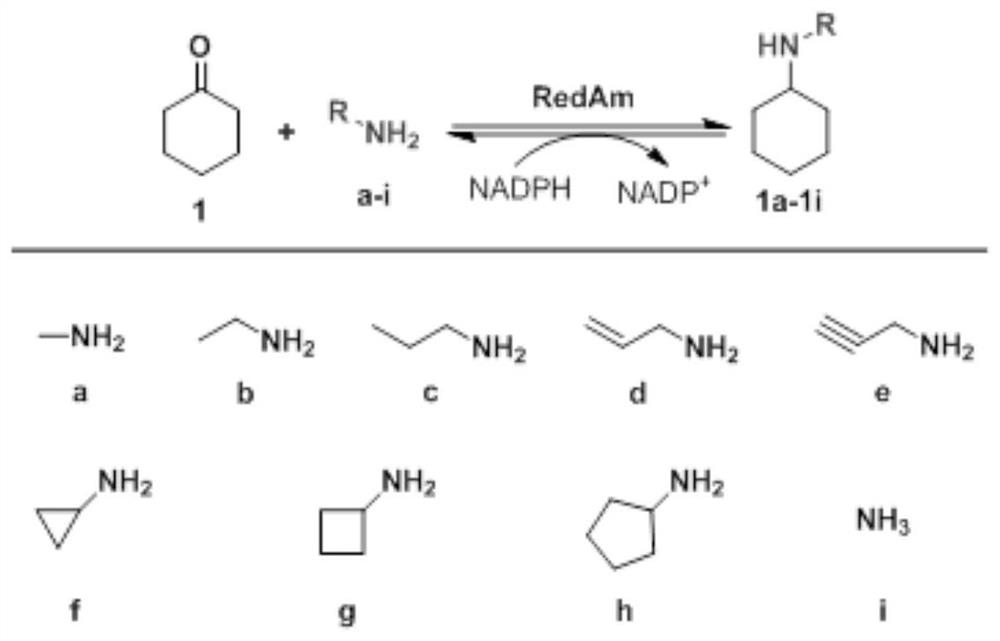
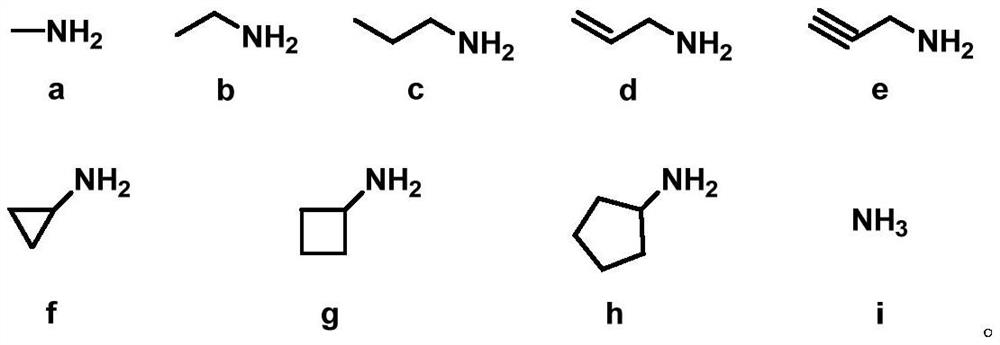
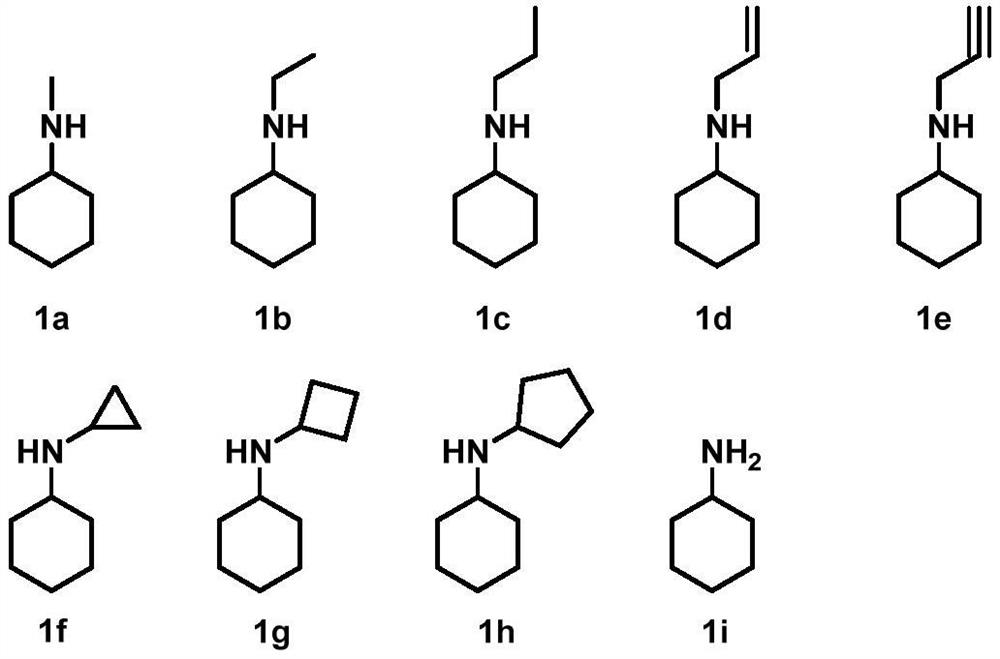
The invention relates to the technical field of bioengineering, in particular to reductive aminase and application thereof in secondary amine synthesis. In the reductive amination reaction of ketone, the catalytic performance of reductive aminase and reductive aminase belonging to the subfamily of the reductive aminase needs to be further improved, so that some high-performance reductive aminase is urgently needed. The invention discloses a reductive aminase coding gene derived from Rhizobium sophora, an amino acid sequence of the reductive aminase coding gene, and application of the reductive aminase for reductive amination of cyclohexanone and various amino donors so as to synthesize secondary amine. Compared with a traditional chemical synthesis method, the method has the advantages of being easy to operate, mild in reaction condition and environmentally friendly, and has a good application prospect in preparation of amine compounds.

Description

technical field [0001] The invention relates to the technical field of bioengineering, in particular to a reductive aminase, its gene, a recombinant expression vector containing the gene and a recombinant expression transformant, and the use of the recombinant reductive aminase or the recombinant expression transformant as a catalyst, not Application of symmetric reduction to prepare secondary amine compounds. Background technique [0002] Amine compounds are an important class of chemical structural building blocks, which widely exist in natural products and drug molecules, and are also widely used in the synthesis of fine chemicals, agricultural chemicals, polymers, dyes, etc. Compared with chemical methods, biocatalysis has the advantages of mild reaction conditions, environmental friendliness, safety and efficiency, and high selectivity, so it has been widely used in the synthesis of organic compounds in recent years. Reductive amination enzymes can use primary, seconda...

Claims

the structure of the environmentally friendly knitted fabric provided by the present invention; figure 2 Flow chart of the yarn wrapping machine for environmentally friendly knitted fabrics and storage devices; image 3 Is the parameter map of the yarn covering machine
Login to View More

Application Information

Patent Timeline
no application Login to View More
IPC IPC(8): C12N9/10C12N15/54C12N15/70C12N1/21C12P13/00C12R1/19
CPCC12N9/1096C12N15/70C12P13/001C12Y206/01Y02P20/584
Inventor 郑高伟张静李薄薄潘江许建和
Owner EAST CHINA UNIV OF SCI & TECH
Features
  • R&D
  • Intellectual Property
  • Life Sciences
  • Materials
  • Tech Scout
Why Patsnap Eureka
  • Unparalleled Data Quality
  • Higher Quality Content
  • 60% Fewer Hallucinations
Social media
Patsnap Eureka Blog
Learn More