Flexible composite electrode material and preparation method and application thereof
A composite electrode and flexible technology, which is applied in the field of flexible composite electrode materials and its preparation, can solve the problems of limited capacitance performance and low electronic conductivity of pure MoS2, and achieve the effect of improving capacity performance, low preparation cost, and good degradation
- Summary
- Abstract
- Description
- Claims
- Application Information
AI Technical Summary
Problems solved by technology
Method used
Image

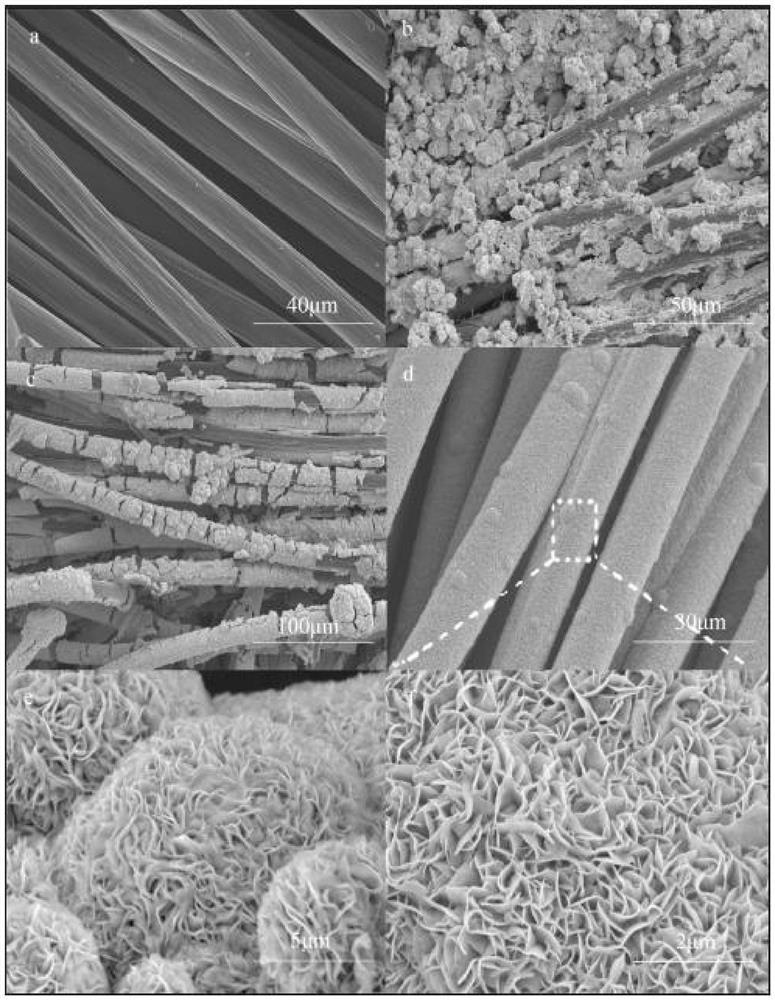


Examples
Embodiment 1
[0043] This embodiment provides a method for preparing a flexible composite electrode material, comprising the following steps:
[0044] Soak the carbon cloth in nitric acid with a mass concentration of 65% for 12 hours to make the carbon cloth hydrophilic, then wash it alternately with ethanol and acetone for 3 times, and dry the cleaned carbon cloth in a vacuum oven at 60°C 8h, standby.
[0045] Take 0.29g sodium molybdate (1mmol) and 0.26g thiourea (3mmol), pour them into a polytetrafluoroethylene inner sleeve with a volume of 25mL, add deionized water to 60% of the total volume, and fully dissolve the solids. Add 0.025 g cobalt nitrate hexahydrate (0.086 mmol) and 0.025 g urea CH 4 N 2 O (0.42mmol), and it was ultrasonically mixed under 100W for 10min to make it evenly mixed, and then put into the pre-treated carbon cloth. Place the inner sleeve in the stainless steel outer sleeve and seal it. Heat to 200°C and keep warm for 24h.
[0046] After the reaction was complete...
Embodiment 2
[0048] This embodiment provides a method for preparing a flexible composite electrode material, comprising the following steps:
[0049] Soak the carbon cloth in nitric acid with a mass concentration of 60% for 12 hours to make the carbon cloth reach the hydrophilic effect, then wash it alternately with ethanol and acetone for 3 times, and dry the cleaned carbon cloth in a vacuum oven at 60°C 8h, standby.
[0050] Weigh potassium molybdate and thioacetamide respectively according to the molar ratio of 1:2, and take the corresponding volume of deionized water according to the dosage ratio of 10L deionized water per mole of potassium molybdate. The mol ratio of 1:1 takes by weighing the cobalt acetate of corresponding quality, and takes by weighing corresponding ammoniacal liquor according to the mol ratio of ammoniacal liquor and cobaltous acetate 0.4:1, for subsequent use.
[0051] Evenly disperse the weighed potassium molybdate and thioacetamide in deionized water, then add ...
Embodiment 3
[0054] This embodiment provides a method for preparing a flexible composite electrode material, comprising the following steps:
[0055] Soak the carbon cloth in nitric acid with a mass concentration of 60% for 12 hours to make the carbon cloth reach the hydrophilic effect, then wash it alternately with ethanol and acetone for 3 times, and dry the cleaned carbon cloth in a vacuum oven at 60°C 8h, standby.
[0056] Take by weighing ammonium molybdate tetrahydrate and L-cysteine respectively according to the molar ratio of 1:2, and take the corresponding volume of deionized water according to the dosage ratio of 12L deionized water per mole of ammonium molybdate tetrahydrate. The molar ratio of cobalt chloride and ammonium molybdate tetrahydrate is 0.1:1, and the corresponding mass of cobalt chloride is weighed, and the corresponding melamine is weighed according to the molar ratio of melamine and cobalt acetate of 0.4, and set aside.
[0057] Disperse the weighed ammonium mo...
PUM
| Property | Measurement | Unit |
|---|---|---|
| Specific capacitance | aaaaa | aaaaa |
Abstract
Description
Claims
Application Information
 Login to View More