

High surface area tetragonal zirconia and processes for synthesizing same
a technology of tetragonal zirconia and high surface area, which is applied in the direction of zirconium oxides, chemistry apparatuses and processes, and oxygen/ozone/oxide/hydroxide, etc., can solve the problems of fuel cells, lack of efficient wgs catalysts, and catalysts with slow kinetics
- Summary
- Abstract
- Description
- Claims
- Application Information
AI Technical Summary
Benefits of technology
Problems solved by technology
Method used
Image

Examples
example 1
1. Example 1
Synthesis of a-ZrO2
[0134]This example illustrates the production of a 20g batch of a high surface area amorphous zirconia (ZrO2) composition by precipitation of a zirconyl nitrate zirconium precursor with ammonium hydroxide followed by the digestion of zirconia hydroxide. 55 g of zirconyl nitrate (ZrO(NO3)2) was dissolved in 454 ml deionized water to obtain solution A. Solution B was prepared by mixing 100 ml deionized water and 100 ml 30 wt % ammonium hydroxide (NH4OH). Solution A was added dropwise into Solution B under vigorous stirring at room temperature to form a first precipitant. The pH was continuously monitored with a pH meter and found to decrease from 12 initially to about 9.8 at the end of precipitation. Solution C containing the above first precipitant, zirconia hydroxide, was then digested at a constant temperature of 96° C. for 192 hours to form high surface area amorphous zirconia. Additional 30 wt % NH4OH was added throughout digestion at a rate of 1.5...
examples 2-7
2. Examples 2-7
Calcination to Form t-ZrO2
[0135]In Examples 2-7, the amorphous ZrO2 from Example 1 was heat treated in a furnace at 1° C. / min from room temperature to 500° C. (Example 2), 600° C. (Example 3), 700° C. (Example 4), 800° C. (Example 5), 900° C. (Example 6) and 1000° C. (Example 7).
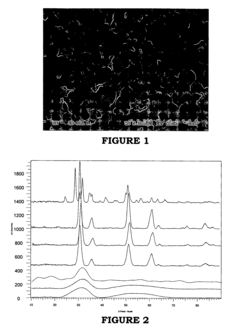
[0136]FIG. 2 presents XRD profiles for Examples 1-7. Example 1 is the bottom-most profile and Example 7 is the upper-most profile, and the profiles for Examples 2-6 are arranged therebetween. This figure shows broad curves for Examples 1-3 indicating that the zirconia formed in these examples comprise amorphous zirconia. In contrast, the XRD profiles for Example 4-6 show very sharp peaks at about 30, about 35, about 50 and about 60 (2-theta). These sharp peaks indicate that the zirconia compositions formed in Examples 4-6 comprise nearly 100 percent tetragonal zirconia. The zirconia composition formed in Example 7 comprised 91% m—ZrO2 and 9% t—ZrO2.
[0137]The surface areas for the zirconia com...
examples 8-10
3. Examples 8-10
Spray Pyrolysis to Form t-ZrO2
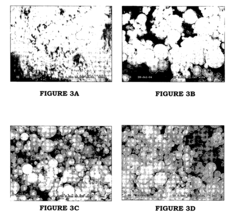
[0140]In Examples 8-10, the amorphous ZrO2 formed in Example 1, before filtration and drying, was processed by spray pyrolysis to form zirconia-containing compositions having a very high surface area and a substantially spherical morphology. The spray pyrolysis was carried out at furnace temperatures of 500° C., 600° C. and 700° C., respectively. FIGS. 3A-3D present scanning electron micrographs of the zirconia-containing compositions formed in Examples 1 and 8-10, respectively.
[0141]The surface areas for the zirconia compositions formed in Examples 9 and 10 were 163.8 and 223.5 m2 / g, respectively. The average pore volumes for the zirconia compositions formed in Examples 9 and 10 were 0.27 and 0.34 cm3 / g. The average pore diameters for the zirconia compositions formed in Examples 9 and 10 were 6.2 and 6.0 nm. These characteristics of the zirconia compositions formed in Examples 1, 9 and 10 are presented below in Table 3.
[0142]
TABLE 3PHY...
PUM
| Property | Measurement | Unit |
|---|---|---|
| temperature | aaaaa | aaaaa |
| particle crystallite size | aaaaa | aaaaa |
| temperature | aaaaa | aaaaa |
Abstract
Description
Claims
Application Information
 Login to View More