Check patentability & draft patents in minutes with Patsnap Eureka AI!

Method for constructing porous tantalum on surface of titanium-tantalum alloy by means of electrochemistry

A porous tantalum, electrochemical technology, applied in the field of biomedical materials, can solve the problems of lack of bone-promoting activity, stimulation of osteoblast proliferation and differentiation, lack of antibacterial ability, etc., to improve biocompatibility and biological activity, good The ability to induce bone regeneration and the effect of improving implant safety

Active Publication Date: 2022-01-25
NORTHWEST INSTITUTE FOR NON-FERROUS METAL RESEARCH
View PDF6 Cites 0 Cited by
  • Summary
  • Abstract
  • Description
  • Claims
  • Application Information

AI Technical Summary

Problems solved by technology

[0003] At present, the most important factor limiting the application of titanium-tantalum alloys is the lack of surface biological activity, which lacks both antibacterial ability and bone-promoting activity. Through surface treatment processes such as micro-arc oxidation and anodic oxidation, micro-particles are prepared on the surface of titanium-tantalum alloys. The bioactivity endowed by the nanoporous structure is a current research hotspot, but there are still three main problems in this type of functional coating: (1) The coating is not firmly bonded to the substrate, and it is easy to fall off, causing potential risks
For example, the structure of titanium nanotubes formed by anodic oxidation is often used to carry small bioactive molecules. Once the titanium nanotubes are peeled off during the implantation process, not only will not achieve the desired therapeutic effect, but will increase the risk of implantation; (2) there is no obvious The effect of osteogenic activity or osseointegration is not good. On the one hand, the micro-nano porous structure on the surface increases the osteogenic activity, and at the same time increases the specific surface area of ​​the titanium alloy, which accelerates corrosion, that is, the battery effect and ion dissolution. On the other hand, the titanium-tantalum alloy The elastic modulus is low, and the wear resistance is poor. Long-term friction with bone tissue after implantation will lead to the generation of debris, which is not only not conducive to osseointegration, but also may lead to inflammation and even implant failure in severe cases; (3) bacteria Adhesion on the surface leads to implant failure: the micro-nanoporous structure on the surface of titanium alloy not only stimulates the proliferation and differentiation of osteoblasts, but also facilitates the colonization of bacteria on the surface and the formation of biofilm, which requires the surface to have anti-bacterial adhesion. attached ability
[0004] The current porous tantalum preparation process includes random and coarse porous tantalum implants with a pore size of 100 μm to 650 μm, prepared by chemical vapor deposition of tantalum on a porous preform, and periodic and coarse porous tantalum implants with a pore size of 1 μm ~2μm is manufactured by metal 3D printing, which has the problems of poor mechanical properties of the matrix, high cost and lack of secondary micro-nano pores
[0005] To sum up, the current commonly used techniques for improving the surface activity of titanium-tantalum alloys, including anodic oxidation, micro-arc oxidation, and hydrothermal treatment, have the following problems that limit their application: (1) There is an obvious gap between the coating and the substrate. (2) Insufficient ability to actively induce osteoblast differentiation and bone ingrowth; (3) Cannot effectively inhibit the adhesion of bacteria on the surface

Method used

the structure of the environmentally friendly knitted fabric provided by the present invention; figure 2 Flow chart of the yarn wrapping machine for environmentally friendly knitted fabrics and storage devices; image 3 Is the parameter map of the yarn covering machine
View more

Image

Smart Image Click on the blue labels to locate them in the text.
Viewing Examples
Smart Image
  • Method for constructing porous tantalum on surface of titanium-tantalum alloy by means of electrochemistry
  • Method for constructing porous tantalum on surface of titanium-tantalum alloy by means of electrochemistry
  • Method for constructing porous tantalum on surface of titanium-tantalum alloy by means of electrochemistry

Examples

Experimental program
Comparison scheme
Effect test

Embodiment 1

[0052] This embodiment includes the following steps:

[0053] Step 1, mixing concentrated nitric acid, hydrogen peroxide and water to obtain an electrolyte; the mass fraction of the concentrated nitric acid is 68%, and the mass fraction of the hydrogen peroxide is 30%; the volume fraction of the concentrated nitric acid in the electrolyte is 2 %, the volume fraction of hydrogen peroxide is 1%;

[0054] Step 2, polishing, cleaning and drying the titanium-tantalum alloy in sequence to obtain a sample; the titanium-tantalum alloy is a titanium-tantalum alloy sheet, and the mass fraction of tantalum in the titanium-tantalum alloy is 30%; the polishing is Carry out grinding treatment, the process of described grinding treatment is: carry out grinding treatment with 800#, 1000#, 1500# and 2000# sandpaper successively; The process of described cleaning is: successively in acetone, ethanol and deionized water ultrasonic cleaning; The drying conditions are: keep warm for 30 minutes at...

Embodiment 2

[0060] This embodiment includes the following steps:

[0061] Step 1, mixing concentrated nitric acid, hydrogen peroxide and water to obtain an electrolyte; the mass fraction of the concentrated nitric acid is 68%, and the mass fraction of the hydrogen peroxide is 30%; the volume fraction of the concentrated nitric acid in the electrolyte is 0.5% %, the volume fraction of hydrogen peroxide is 0.5%;

[0062] Step 2, polishing, cleaning and drying the titanium-tantalum alloy in sequence to obtain a sample; the titanium-tantalum alloy is a titanium-tantalum alloy sheet, and the mass fraction of tantalum in the titanium-tantalum alloy is 30%; the polishing is Carry out grinding treatment, the process of described grinding treatment is: carry out grinding treatment with 800#, 1000#, 1500# and 2000# sandpaper successively; The process of described cleaning is: successively in acetone, ethanol and deionized water ultrasonic cleaning; The drying conditions are: keep warm for 20 minut...

Embodiment 3

[0068] This embodiment includes the following steps:

[0069] Step 1, mixing concentrated nitric acid, hydrogen peroxide and water to obtain an electrolyte; the mass fraction of the concentrated nitric acid is 68%, and the mass fraction of the hydrogen peroxide is 30%; the volume fraction of the concentrated nitric acid in the electrolyte is 1 %, the volume fraction of hydrogen peroxide is 0.8%;

[0070] Step 2, polishing, cleaning and drying the titanium-tantalum alloy in sequence to obtain a sample; the titanium-tantalum alloy is a titanium-tantalum alloy sheet, and the mass fraction of tantalum in the titanium-tantalum alloy is 30%; the polishing is Carry out grinding treatment, the process of described grinding treatment is: carry out grinding treatment with 800#, 1000#, 1500# and 2000# sandpaper successively; The process of described cleaning is: successively in acetone, ethanol and deionized water ultrasonic cleaning; The drying conditions are: at 80°C, keep warm for 40...

the structure of the environmentally friendly knitted fabric provided by the present invention; figure 2 Flow chart of the yarn wrapping machine for environmentally friendly knitted fabrics and storage devices; image 3 Is the parameter map of the yarn covering machine
Login to View More

PUM

PropertyMeasurementUnit
Thicknessaaaaaaaaaa
Apertureaaaaaaaaaa
Thicknessaaaaaaaaaa
Login to View More

Abstract

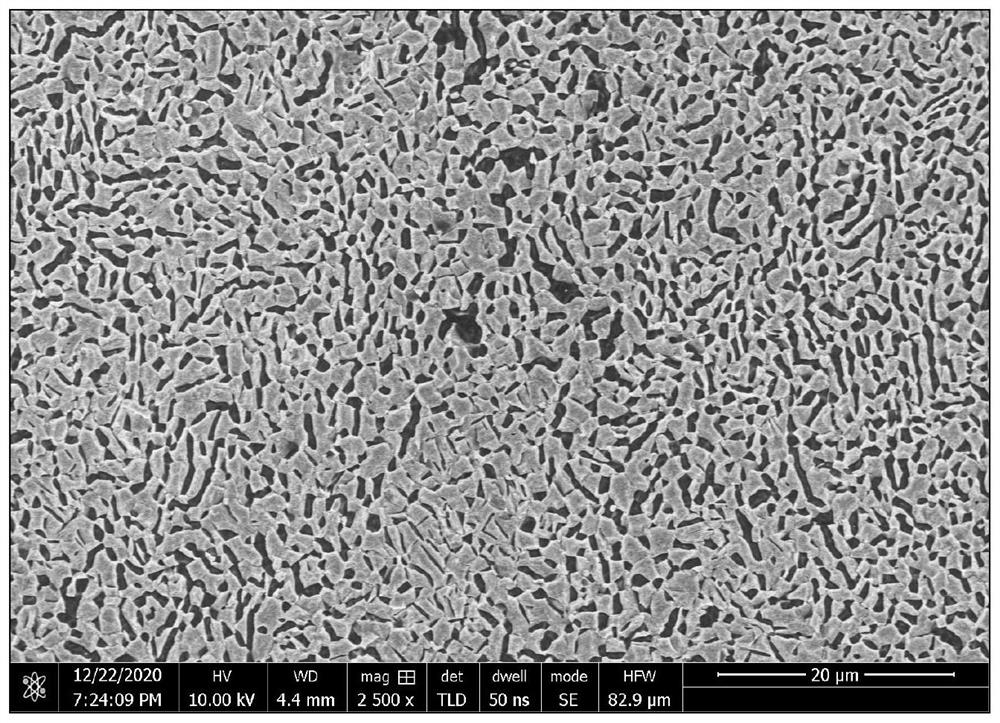
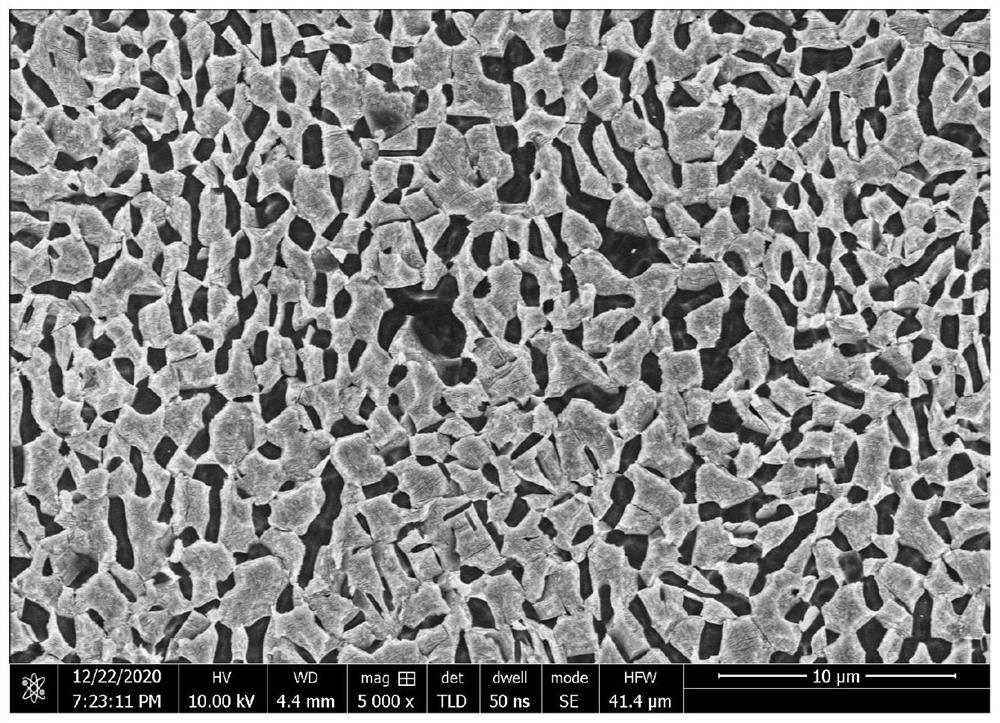
The invention discloses a method for constructing porous tantalum on the surface of a titanium-tantalum alloy by means of electrochemistry. The method comprises the following steps that firstly, concentrated nitric acid, hydrogen peroxide and water are mixed; secondly, the titanium-tantalum alloy is sequentially subjected to polishing, cleaning and drying treatment; thirdly, dealloying treatment is conducted on a sample in an electrolyte by means of electrochemistry; and fourthly, the treated sample is cleaned and dried, and a micron order porous tantalum layer is obtained on the surface of the titanium-tantalum alloy. According to the method, the titanium-tantalum alloy is subjected to dealloying treatment in the electrolyte formed by the concentrated nitric acid, the hydrogen peroxide and the water by means of electrochemistry, the micron order porous tantalum layer firmly combined with a titanium-tantalum substrate is obtained on the surface of the titanium-tantalum alloy, and tantalum oxide can be formed on the surface of the formed porous tantalum layer through the hydrogen peroxide, so that the biocompatibility and the biological activity of the alloy are further improved; and the micron order porous tantalum has the capabilities of resisting bacterial infection and inducing cell osteogenic differentiation, so that the titanium-tantalum alloy is endowed with the capabilities of resisting bacteria and promoting osteogenesis on the surface.

Description

technical field [0001] The invention belongs to the technical field of biomedical materials, in particular to a method for constructing porous tantalum on the surface of a titanium-tantalum alloy by means of electrochemistry. Background technique [0002] The development history and clinical follow-up research results of medical titanium alloys fully show that the research and development of medical titanium alloys should simultaneously consider its biocompatibility, mechanical compatibility and implant safety, that is, medical titanium alloys need to have better Better biomechanical adaptability, better corrosion resistance and better biocompatibility, and even have certain biological activity. However, the currently commonly used titanium alloy implants are difficult to meet the above performance requirements at the same time. At the same time, tantalum has the ability to simultaneously enhance the strength and reduce the elastic modulus of titanium alloys. Compared with ...

Claims

the structure of the environmentally friendly knitted fabric provided by the present invention; figure 2 Flow chart of the yarn wrapping machine for environmentally friendly knitted fabrics and storage devices; image 3 Is the parameter map of the yarn covering machine
Login to View More

Application Information

Patent Timeline
no application Login to View More
IPC IPC(8): C25F3/08
CPCC25F3/08
Inventor 余森周文昊白天荆磊李小成赵曦
Owner NORTHWEST INSTITUTE FOR NON-FERROUS METAL RESEARCH
Features
  • R&D
  • Intellectual Property
  • Life Sciences
  • Materials
  • Tech Scout
Why Patsnap Eureka
  • Unparalleled Data Quality
  • Higher Quality Content
  • 60% Fewer Hallucinations
Social media
Patsnap Eureka Blog
Learn More