

Process for preparing and use of hard-carbon containing materials
a technology of hard carbon and containing materials, which is applied in the field of preparation and use of hardcarbon containing materials, can solve the problems of high cost of sodium-ion batteries, limited sodium-ion cell intercalation between graphene layers in graphite anodes, and large work to be done before sodium-ion batteries
- Summary
- Abstract
- Description
- Claims
- Application Information
AI Technical Summary
Benefits of technology
Problems solved by technology
Method used
Image

Examples
example 1
Hard Carbon-Containing Material Prepared According to the Process of the Present Invention Using Chicken Manure-Derived Material
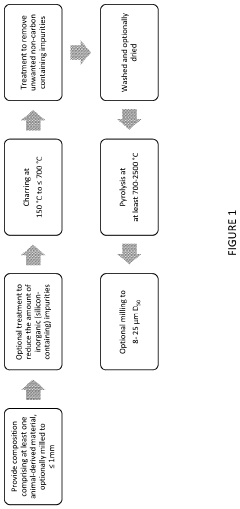
[0081]Obtained pelleted chicken manure is milled down to <1 mm and dispersed in water at a volume ratio of 1:6. The aqueous dispersion is agitated by stirring on a stirring plate and the inorganic impurities (e.g. primary silicates) were at least partially separated from the mixture by sedimentation due to the density of the rock-forming inorganic compounds commonly found in the chicken manure being higher than either the water or the biomass (heavy media separation). The biomass-rich supernatant is then extracted in a separate container by the means of reduced pressure to yield powdered chicken manure with reduced inorganic impurities.
[0082]The powdered reduced inorganic impurity chicken manure with is then rinsed with an organic solvent, e.g. acetone, and dried at 100° C. overnight. The organic solvent is used to accelerate the drying and reduce the foul ...
example 2
Hard Carbon-Containing Material Prepared According to the Process of the Present Invention Using Human-Derived Waste Material (Sewage Sludge)
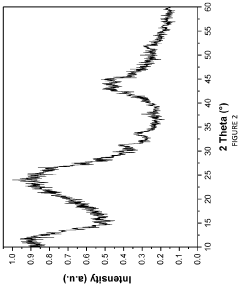
[0092]In a typical recycling process, wet sewage sludge is dewatered, dried and carbonised to obtain a biochar rich in phosphorous and minerals which can be directly used as phosphorous-rich fertilizer. To obtain a suitable biochar precursor for hard carbon synthesis, further treatment is required. De-mineralisation and de-phosphorisation of sewage sludge biochar is carried out in a molten alkali bath. During this process, dried sewage sludge biochar is mixed in equal weight proportion with NaOH powder in a glass container. The mixture is then heated at 500° C. for 3 hours in an oven under atmospheric air. The product collected after molten alkali digestion is rinsed multiple times with deionised water to remove the digested metal-containing impurities and all the residual NaOH. An x-ray diffraction pattern of the purified carbon obtained after...
example 3
Comparative Hard Carbon Material with a High Specific Surface Area (Above 580 m2 / g)
[0106]A biaochar sample was mixed with sodium hydroxide and heated up to 650° C. This was followed by a neutralisation step which resulted in a hard carbon-containing material with a high specific surface area of 500-1000 m2 / g.
[0107]As shown in FIG. 9A, the resulting hard carbon material exhibits sodiation and desodiation behaviour of this material with a large irreversible capacity; the first cycle coulombic efficiency is only 23.3%.
[0108]By contrast, the first cycle coulombic efficiency for hard carbon material produced according to the present invention (i.e. with a much lower surface area), as shown in FIG. 9B, is 80.9%. FCCE is of particular importance in the case of secondary batteries with fixed inventory of charge carriers.
[0109]It is believed that the poor first cycle coulombic efficiency results are due to the produced material having an excessively high surface area (500-1000 m2 / g) resultin...
PUM
 Login to View More
 Abstract
Description
Claims
Application Information
 Login to View More