
Metal microarc oxidation electrolyte and method for forming black ceramic coating on metal surface by microarc oxidation
A technology of micro-arc oxidation and electrolyte, which is applied in the field of metal surface treatment, can solve the problems of brittle oxide ceramics, low film density, thin ceramic film, etc., achieve good bonding strength, meet actual use requirements, The effect of large thickness values
- Summary
- Abstract
- Description
- Claims
- Application Information
AI Technical Summary
Problems solved by technology
Method used
Image

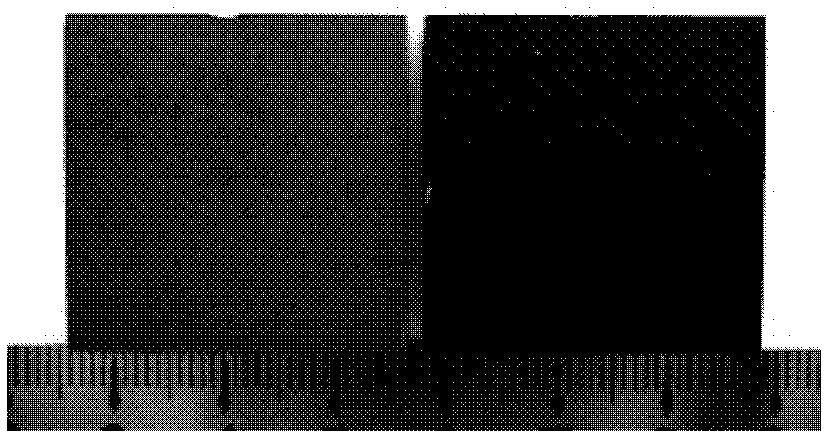

Examples
Embodiment 1
[0023] The sample selected is AZ91D magnesium alloy, and its shape is a sheet of 30mm×30mm×5mm. The specific preparation process conditions and operation steps are as follows:
[0024] 1. Sample pretreatment: The surface of the magnesium alloy sample is polished smoothly with 400#, 600#, 800# and 1000# sandpaper, then degreasing in acetone, rinsed with deionized water, and dried for later use;
[0025] 2. Electrolyte preparation: prepare 2L of electrolyte solution, the concentration of each component in the electrolyte is 6.0g / L sodium silicate, 2.0g / L potassium hydroxide, 2.0g / L sodium fluoride, 2.0g / sodium tungstate / L. Sodium citrate 0.5g / L, carbon ink 25.0mL / L;
[0026] 3. Electric parameter setting: adopt constant current mode, current density 2A / dm 2 , Frequency 600Hz, duty ratio 20%, cathode and anode current density ratio 1.0, reaction time 20min;
[0027] 4. Micro-arc oxidation: turn on the circulating cooling water device, connect the magnesium alloy sample to the conductive...
Embodiment 2
[0033] The sample selected is AZ91D magnesium alloy, and its shape is a sheet of 30mm×30mm×5mm. The specific preparation process conditions and operation steps are as follows:
[0034] 1. Sample pretreatment: same as Example 1;
[0035] 2. Electrolyte preparation: prepare 2L of electrolyte solution, the concentration of each component in the electrolyte is sodium silicate 8.0g / L, potassium hydroxide 2.0g / L, sodium fluoride 2.0g / L, sodium tungstate 1.0g / L. Sodium citrate 0.3g / L, carbon ink 20.0mL / L;
[0036] 3. Electric parameter setting: adopt constant current mode, current density 1A / dm 2 , Frequency 600Hz, duty ratio 20%, cathode and anode current density ratio 1.0, reaction time 15min;
[0037] 4. Micro-arc oxidation: same as Example 1;
[0038] 5. Post-processing: the same as in Example 1.
[0039] The prepared samples were evaluated and characterized, and it was found that the surface of the ceramic film of the sample was smooth and the whole body was jet-black, and the blackness ...
Embodiment 3
[0041] The sample selected is AZ91D magnesium alloy, and its shape is a sheet of 30mm×15mm×5mm. The specific preparation process conditions and operation steps are as follows:
[0042] 1. Sample pretreatment: same as Example 1;
[0043] 2. Electrolyte preparation: prepare 2L of electrolyte solution, the concentration of each component in the electrolyte is sodium silicate 10.0g / L, potassium hydroxide 2.0g / L, sodium fluoride 3.0g / L, sodium tungstate 1.5g / L. Sodium citrate 0.9g / L, carbon ink 15.0mL / L;
[0044] 3. Electric parameter setting: adopt constant current mode, current density 3A / dm 2 , Frequency 600Hz, duty ratio 20%, cathode and anode current density ratio 1.0, reaction time 15min;
[0045] 4. Micro-arc oxidation: same as Example 1;
[0046] 5. Post-processing: the same as in Example 1.
[0047] The prepared samples were evaluated and characterized, and it was found that the surface of the ceramic film of the sample was smooth and the whole body was jet black, and the blackness...
PUM
| Property | Measurement | Unit |
|---|---|---|
| thickness | aaaaa | aaaaa |
| thickness | aaaaa | aaaaa |
| thickness | aaaaa | aaaaa |
Abstract
Description
Claims
Application Information
 Login to View More