
Stem cell preparation for treating diabetes mellitus and preparation method of preparation
A stem cell preparation and diabetes technology, applied in the field of stem cell regenerative medicine, can solve the problems of limited treatment effect of diabetic vascular disease, necrosis, stem cell apoptosis, etc. Effect
- Summary
- Abstract
- Description
- Claims
- Application Information
AI Technical Summary
Problems solved by technology
Method used
Image



Examples
specific Embodiment 1
[0041] Specific embodiment 1: a kind of preparation method of the stem cell preparation for treating diabetes comprises the following steps:
[0042] Step 1) Preparation of normal saline: first prepare normal saline, then add oligosaccharides, albumin, cholesterol, sodium chloride, propylene glycol and ammonium bicarbonate to make the concentrations 50g / L, 50g / L, 0.3g / L respectively , 9g / L, 5%, 20g / L;
[0043] Step 2) Preparation of bone marrow pluripotent stem cell suspension: including the separation and extraction of bone marrow pluripotent stem cells, collecting bone marrow pluripotent stem cells and mixing with the normal saline prepared in step 1) to prepare a concentration of 1×10 7 ~1×10 8 Individual / ml bone marrow pluripotent stem cell suspension;
[0044] Step 3) Preparation of bone marrow pluripotent stem cell-derived islet-like cell suspension: including collecting the bone marrow pluripotent stem cells prepared in step 2), inducing differentiation of bone marr...
specific Embodiment 2
[0053] Specific Example 2: Flow cytometric detection and identification of bone marrow pluripotent stem cells
[0054] Flow cytometry identification steps are as follows: collect the third to fifth generation bone marrow pluripotent stem cells, transfer the cell suspension to a centrifuge tube, and centrifuge at 1000r / min for 5min. Discard the supernatant, add pre-cooled PBS, resuspend the cells, mix well, and centrifuge again. Repeat this 3 times. Then add PBS solution to mix the cells well to make 1×10 6 / ml of the cell suspension was added to the special test tube for flow cytometry. CD29, CD34, CD44, CD45 monoclonal antibodies were added sequentially, and incubated at 4°C for 60 min. Then rinse with PBS three times, add fluorescein isothiocyanate (FITC)-labeled secondary antibody working solution 1:50, and incubate at 4°C for 60 min. Rinse with PBS solution 3 times. Perform flow cytometry detection, and use PBS as the primary antibody to set up a negative control. ...
specific Embodiment 3
[0056] Specific Example 3: Identification of Islet-like Cells by Dithizone Staining
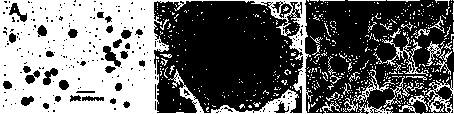
[0057] After the induced cells were washed with buffer, 1 mg / L dithizone solution was added, incubated in a 37°C incubator for 20 min, and the cells were observed with an inverted microscope. The induced cells were stained with dithizone, and observed under an inverted microscope, most of the cell clusters were bright red, such as image 3 As shown, it indicates that the cytoplasm of the induced cells contains zinc ions, and the dithizone staining of the uninduced bone marrow pluripotent stem cells is negative.
PUM
 Login to View More
 Abstract
Description
Claims
Application Information
 Login to View More