A kind of method for preparing parecoxib

A parecoxib and dioxo technology, applied in organic chemistry and other directions, can solve the problems of unstable storage, high equipment requirements, and very high safety requirements, achieve high product yield and purity, easy post-processing operations, Reaction conditions require low effect

A parecoxib and dioxo technology, applied in organic chemistry and other directions, can solve the problems of unstable storage, high equipment requirements, and very high safety requirements, achieve high product yield and purity, easy post-processing operations, Reaction conditions require low effect

CN105085425BActive Publication Date: 2018-01-30KPC PHARM INC

Image

Smart Image Click on the blue labels to locate them in the text.
Viewing Examples
Smart Image
  • A kind of method for preparing parecoxib
  • A kind of method for preparing parecoxib
  • A kind of method for preparing parecoxib

Examples

Experimental program
Comparison scheme
Effect test

preparation example Construction

[0050] F, the preparation of parecoxib:

[0051] The N-(4-(5-hydroxyl-5-methyl-3-phenyl-4,5-dihydroisoxazol-4-yl)phenylsulfonyl)propionamide prepared in step E was prepared in -5 Add it into an acidic solvent with a solid-to-liquid volume ratio of 1:2 to 1:3 under ice-bath conditions at ~5°C, and keep stirring at a temperature of 0~30°C for 4~12 hours to obtain the target product parecoxib.

[0052] The organic solvent described in step A is one of benzene, toluene, tetrahydrofuran, ethyl acetate, dichloromethane, chloroform or acetonitrile.

[0053] The Lewis acid catalyst described in step A is one of aluminum trichloride, titanium tetrachloride, boron trifluoride, ferric chloride, zinc chloride, niobium pentoxide, trisulphonate, p-toluenesulfonic acid species, the amount added is 5-20% of the molar weight of the raw material.

[0054] The sulfonating reagent described in step B is a kind of in chlorosulfonic acid, concentrated sulfuric acid, oleum, sulfur trioxide.

[00...

Embodiment 1

[0076] Preparation of 1,2-diphenylbutane-1,3-dione (III)

[0077] Weigh 4.0 g (20.4 mmol, 1e.q) of 3-oxo-2-phenylbutyryl chloride and dissolve it in 40 mL of benzene solution, add 150 mg of aluminum trichloride solid, heat and reflux for 12 hours, until TLC shows that the raw material After the reaction was complete, stop the reaction, wash once with saturated aqueous sodium bicarbonate solution, wash once with saturated brine, dry the organic phase with anhydrous sodium sulfate, and spin dry the solvent to obtain about 4.0 g of solid product with a yield of 84%. 1 H NMR (500 MHz, CDCl 3 ): δ = 7.6-7.1 (m, 10H), 5.40 (s, 1H), 2.26 (s, 3H).

Embodiment 2

[0079] Preparation of 4-(1,3-dioxo-1-phenylbut-2-yl)benzene-1-sulfonyl chloride (IV)

[0080] Weigh 2.4 grams of 1,2-diphenylbutane-1,3-dione, add the above raw materials in batches to 5 ml of chlorosulfonic acid under stirring under ice bath conditions, and keep stirring at 0°C After 6 hours, after stopping the reaction, the reaction mixture was poured into 10 g of crushed ice, and a white solid precipitated out. The white solid was collected by filtration, washed with a small amount of ice water, and the dried white solid product was 3.1 g, with a yield of 91%. 1 H NMR (500 MHz, CDCl 3 ): δ = 7.70 (dd, J= 8.1 Hz, 2H), 7.60(dd, J = 8.1 Hz, 2H), 7.53-7.41 (m, 5H), 5.48 (s, 1H), 2.26 (s, 3H).

the structure of the environmentally friendly knitted fabric provided by the present invention; figure 2 Flow chart of the yarn wrapping machine for environmentally friendly knitted fabrics and storage devices; image 3 Is the parameter map of the yarn covering machine
Login to View More

PUM

No PUM Login to View More

Abstract

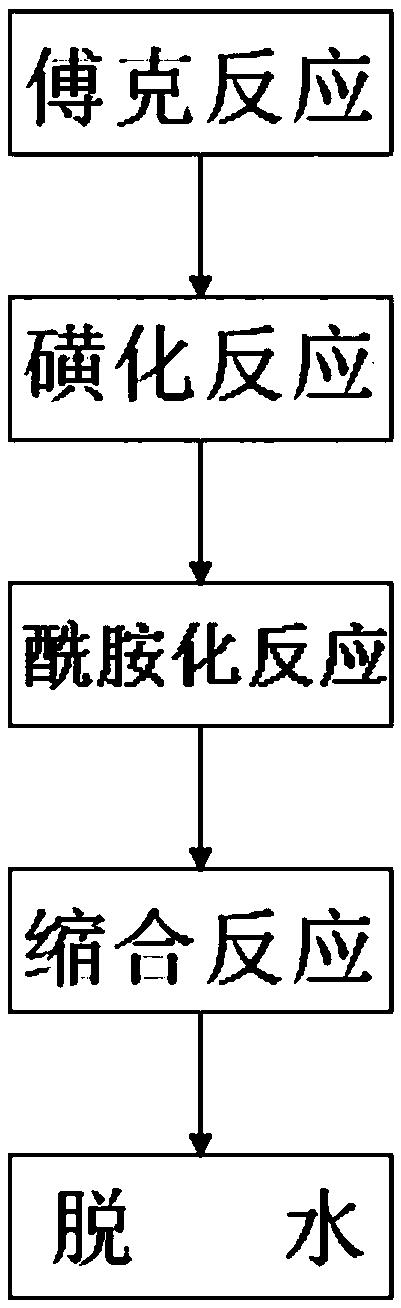
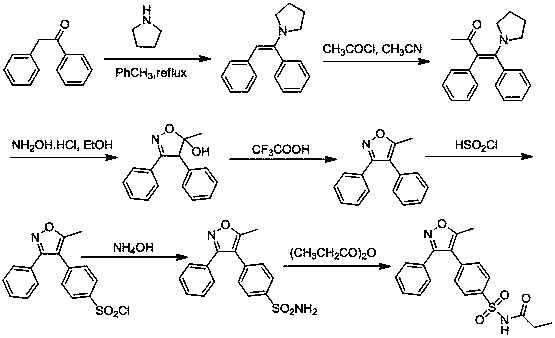
The invention discloses a method for preparing parecoxib. The method comprises the following steps: an initial raw material 3-oxo-2-phenylbutanoyl chloride and benzene undergo a Friedel-Crafts reaction to generate 1,2-diphenylbutane-1,3-dione, 1,2-diphenylbutane-1,3-dione is sulfonated by chlorosulfonic acid or concentrated sulfuric acid / acetyl chloride to obtain 4-(1,3-dioxo-1-phenylbutyl-2-yl)-1-sulfonyl chloride, 4-(1,3-dioxo-1-phenylbutyl-2-yl)-1-sulfonyl chloride is acted by ammonia water to generate 4-(1,3-dioxo-1-phenylbutyl-2-yl)-1-sulfonamide, and 4-(1,3-dioxo-1-phenylbutyl-2-yl)-1-sulfonamide reacts with propionic anhydride or propionyl chloride to obtain N-(4-(1,3-dioxo-1-phenylbutyl-2-yl)phenylsulfonyl)propionamide, N-(4-(1,3-dioxo-1-phenylbutyl-2-yl)phenylsulfonyl)propionamide undergoes condensation by using hydroxylamine hydrochloride to synthesize a ring, and dehydration is carried out under an acidic condition to obtain parecoxib. The parecoxib is prepared from 3-oxo-2-phenylbutanoyl chloride as the initial raw material through the Friedel-Crafts reaction, a sulfonation reaction, an amidation reaction and a condensation reaction. The method has the advantages of low cost of the initial raw material, simple process, low requirements of reaction conditions, simple post-treatment operation, high product yield and purity, and realization of large-scale production.

Description

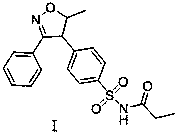
technical field [0001] The invention belongs to the technical field of medicine preparation, and in particular relates to a method for preparing parecoxib. Background technique [0002] In recent years, non-steroidal anti-inflammatory drugs have shown a variety of medicinal activities, especially as selective inhibitors of cyclooxygenase-2 (COX-2), and parecoxib is one of the representatives. [0003] [0004] Parecoxib, clinically used is its sodium salt form Parecoxib sodium, English name: ParecoxibSodium, chemical name: N-[[4-(5-methyl-3-phenyl-4-isoxan Azolyl)phenyl]sulfonyl]propionamide sodium salt. Molecular formula: C 19 h 17 N 2 o 4 SNa. Indications: For short-term treatment of pain after surgery. Parecoxib sodium is a highly selective inhibitor. Clinical studies have shown that in the short-term treatment of postoperative pain, it can reduce the need for anesthetics and adverse reactions in patients. Studies have shown that parecoxib sodium has a preempti...

Claims

the structure of the environmentally friendly knitted fabric provided by the present invention; figure 2 Flow chart of the yarn wrapping machine for environmentally friendly knitted fabrics and storage devices; image 3 Is the parameter map of the yarn covering machine
Login to View More

Application Information

Patent Timeline
30 Jan 2018
Publication
CN105085425B
IPC
C07D261/08
CPC
C07D261/08
Inventors
金毅; 张伟