
Immobilization method of sucrose isomerase
A sucrose isomerase, sucrose technology, applied in the directions of isomerase, microorganism-based methods, biochemical equipment and methods, etc., can solve the problems of complex methods, high cost of carriers, and difficulty in large-scale industrial application.
- Summary
- Abstract
- Description
- Claims
- Application Information
AI Technical Summary
Problems solved by technology
Method used
Image



Examples
Embodiment 1
[0034] Example 1 B.brevis / pNY 326-pal I LSP build
[0035] At the 5' and 3' ends of the sucrose isomerase gene (pal I) (see SEQ ID NO.1 for the gene sequence), the restriction sites Nde I and Hind III were designed and introduced, and finally provided by Shanghai Jierui Bioengineering Co., Ltd. Synthesized to obtain pUC57-palI.
[0036] The plasmid pUC57-palI carrying pal I and the expression vector pET-24a(+) were digested with restriction endonucleases NdeI and Hind III respectively, and the target fragment was recovered and ligated to obtain the recombinant plasmid pET-24a-palI.
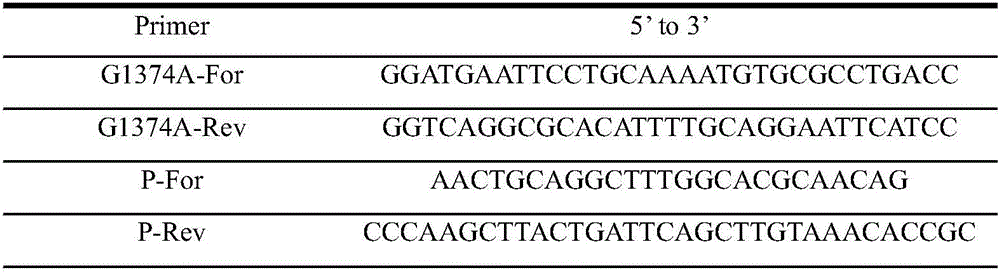
[0037]Using pET-24a(+)-pal I as a template, design the PCR primers shown in Table 1G1374A-For and G1374A-Rev, and use one-step PCR to perform site-directed mutation at the G1347 site of the sucrose isomerase gene, and remove the inner part of pal I by mutation The pst I site; then use primers P-For, P-Rev PCR amplification to obtain the target gene fragment palI with Pst I and Hind III restricti...
Embodiment 2
[0041] The impact of embodiment 2 shake flask culture medium on fermented liquid enzyme activity
[0042] Bacillus pumilus B.brevis / pNY 326-pal I LSP As the starting strain, after cultured in the seed medium, it was inserted into different shake flask medium:
[0043] (1) Single nitrogen source
[0044] With glucose as the carbon source, industrial yeast powder, industrial peptone, soybean peptone, beef extract, casein, cottonseed powder cake, poly-peptone, tryptone, beef peptone, angel peptone, etc. were used as nitrogen on TM medium. source, the content of each nitrogen source is 15g L -1 , the inoculum size was 1%, and the enzyme activity was determined after culturing on a shaker at 200r / min and 30°C for 48h.
[0045] (2) Compound nitrogen source
[0046] On the basis of a single nitrogen source, two better nitrogen sources were selected, mixed and prepared according to a certain ratio, the inoculum amount was 1%, and the enzyme activity was measured after culturing on...
Embodiment 3
[0060] Embodiment 3 Preparation of immobilized sucrose isomerase
[0061] (1) Bacillus pumilus (B.brevis / pNY 326-palI LSP ) is the starting strain, and the fermentation medium finally determined in Example 2 is used to ferment and prepare the sucrose isomerase enzyme liquid. After the fermentation is completed, the bacteria are removed by centrifugation to obtain the enzyme liquid.
[0062] (2) Using 4% acetic acid solution as a solvent, prepare a chitosan colloid solution with a final concentration of 2%-5%, and vacuumize to remove air bubbles.
[0063] (3) Slowly drop the fully dissolved chitosan colloid solution into 4M sodium hydroxide solution with a syringe, stir at a constant speed, and form chitosan microspheres with a diameter of about 1.5 mm. After the microspheres are completely formed, pour off the hydroxide Sodium solution, the prepared microspheres were washed with deionized water until neutral.
[0064] (4) Add the chitosan microspheres that have been washed t...
PUM
 Login to View More
 Abstract
Description
Claims
Application Information
 Login to View More