
Nonlinear optical crystal silver gallium phosphide sulfide and its preparation and application
A technology of crystallization and crystallization temperature, applied in the field of nonlinear optical materials and their synthesis, to achieve the effects of strong nonlinear optical effects, high crystallinity, and high thermal stability
- Summary
- Abstract
- Description
- Claims
- Application Information
AI Technical Summary
Problems solved by technology
Method used
Image

Examples
Embodiment 1
[0036] Embodiment 1 adopts vacuum high temperature solid state method to synthesize inorganic compound AgGa 2 P.S. 6 the crystal
[0037] Put the raw material mixture obtained by mixing the raw materials in a certain proportion into a quartz tube with a diameter of 10.0 mm, and vacuum the vacuum line to about 10 -3 At Pa, the tube is sealed with an oxyhydrogen flame. Put the sealed quartz tube into a high-temperature resistance furnace, crystallize at the crystallization temperature for a period of time, then slowly cool down, filter, wash, and dry to obtain a yellow transparent AgGa 2 P.S. 6 crystals. The types of raw materials contained in the raw material mixture, the ratio of each raw material, the crystallization temperature, the relationship between the crystallization time and the sample number are shown in Table 1.
[0038] Table 1 AgGa 2 P.S. 6 The relationship between synthesis conditions and sample numbers
[0039]
Embodiment 2
[0040] Embodiment 2 inorganic compound K 2 Au(IO 3 ) 5 Analysis of the crystal structure of
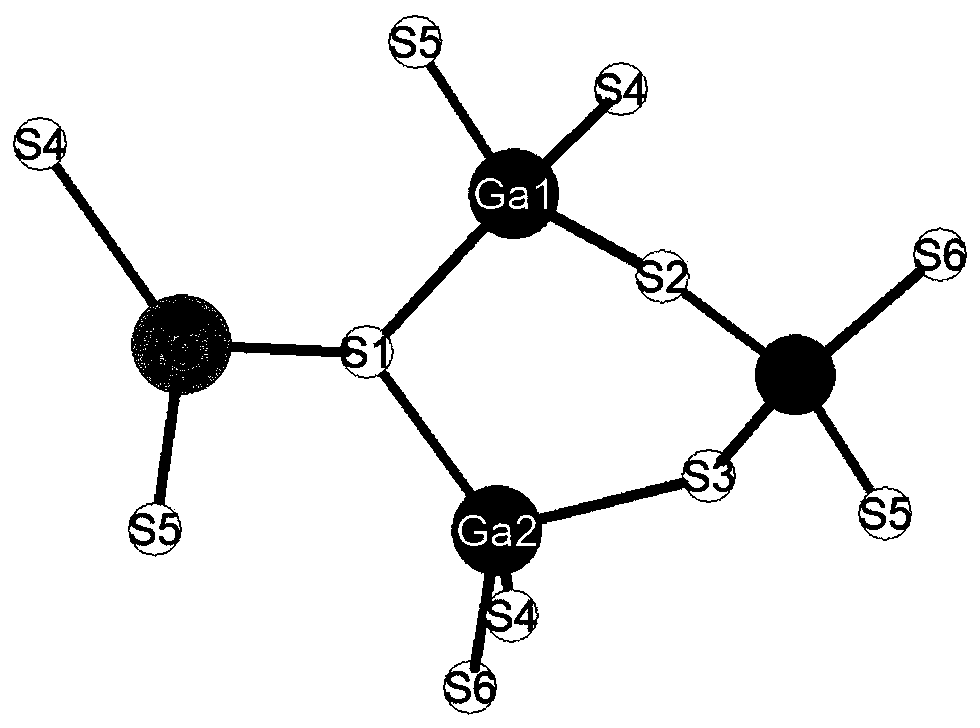
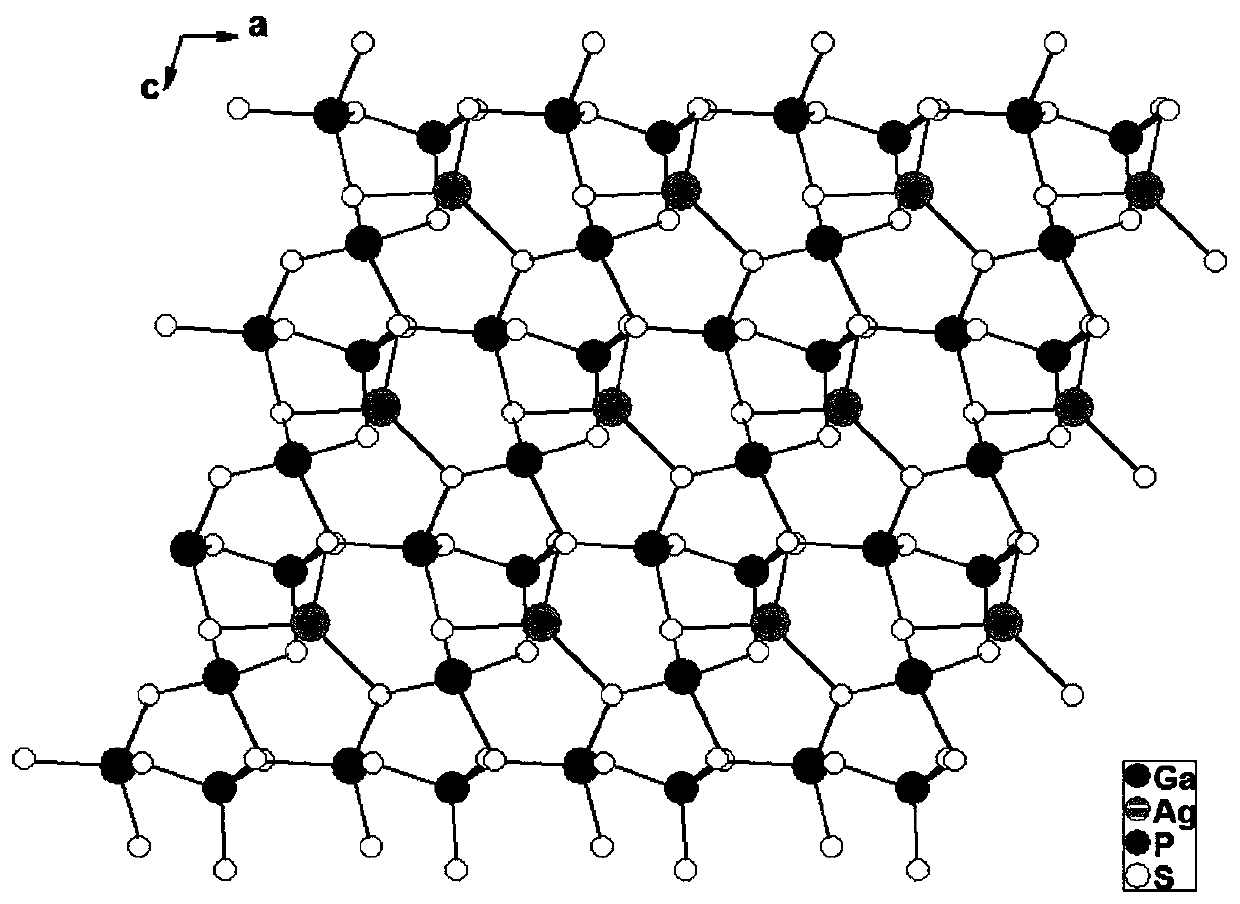
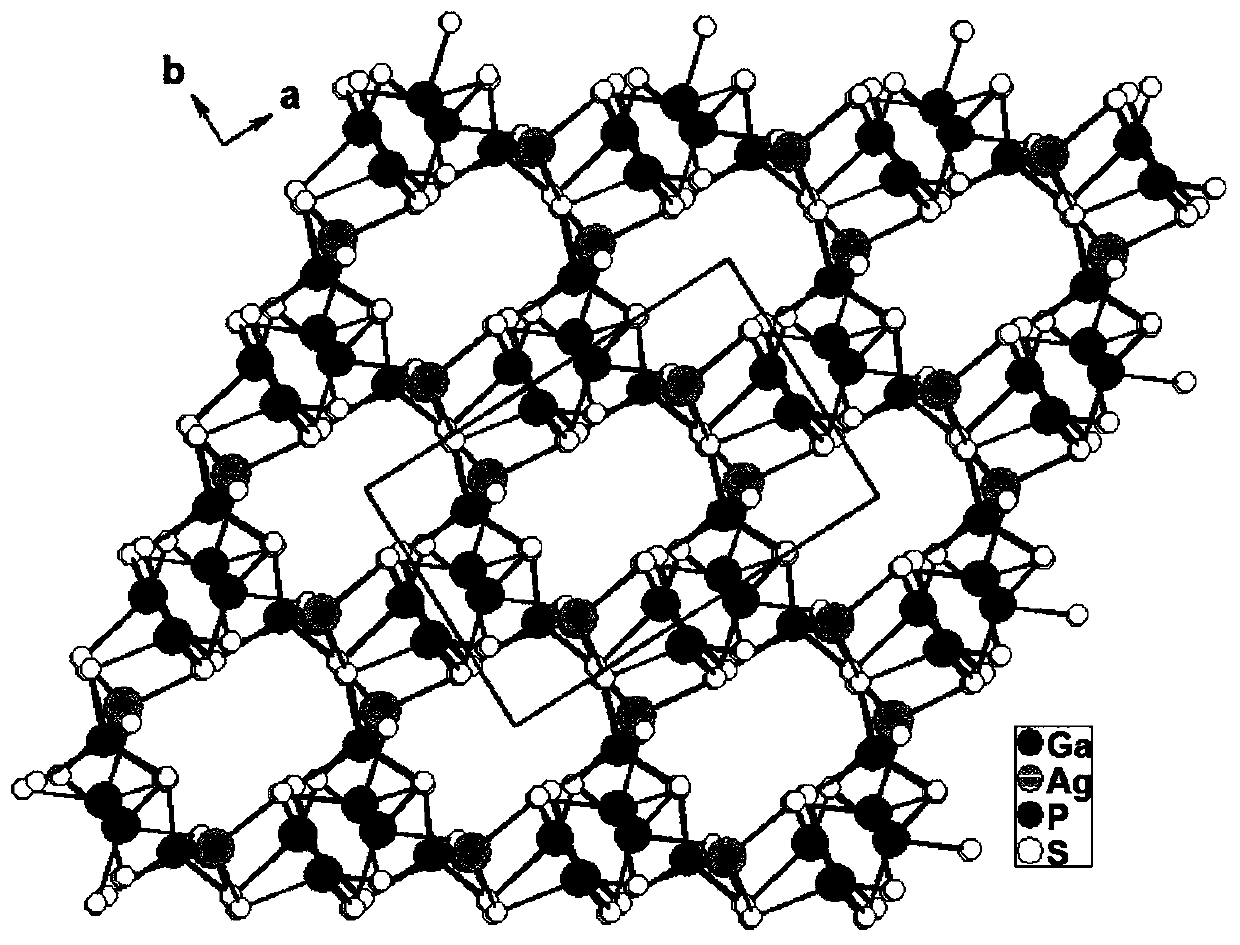
[0041] The structures of samples 1# to 5# were analyzed by single crystal X-ray diffraction and powder X-ray diffraction.
[0042] Wherein, the single crystal X-ray diffraction was performed on a SuperNova Dual Wavelength CCD type X-ray single crystal diffractometer of Agilent Company. The crystal size is 0.06×0.13×0.09mm 3 ; The data collection temperature is 295K, and the diffraction light source is monochromatic Mo-Kα rays The data were processed with absorption correction using the Multi-Scan method. Structural analysis was completed using the SHELXTL-97 program package; the position of the heavy atom was determined by the direct method, and the coordinates of the remaining atoms were obtained by the difference Fourier synthesis method; 2 The full-matrix least-squares method was used to refine all atomic coordinates and anisotropic thermal parameters.
[0043] Powder X-ray...
Embodiment 3
[0050] Embodiment 3 frequency doubling test experiment and result
[0051] The frequency doubling test experiment of sample 1# is as follows: use the laser with a wavelength of 2.05 μm generated by a Q-switched Nd:YAG solid-state laser with a frequency converter as the fundamental frequency light, irradiate the crystal powder to be tested, and use a photomultiplier tube to detect the The generated second harmonic is displayed with an oscilloscope. The crystal sample to be tested and the standard sample AgGaS 2 The crystals are ground separately, and the crystals with different particle sizes are screened out with a standard sieve, and the particle sizes are 53-62 μm, 62-75 μm, 75-90 μm, 90-109 μm, 109-150 μm, 150-212 μm, and 210-270 μm. Observe the change trend of the multiplier signal with the particle size, and judge whether it can achieve phase matching. Under the same test conditions, compare the intensity of the second harmonic generated by the sample to be tested with ...
PUM
| Property | Measurement | Unit |
|---|---|---|
| wavelength | aaaaa | aaaaa |
Abstract
Description
Claims
Application Information
 Login to View More