Check patentability & draft patents in minutes with Patsnap Eureka AI!

Preparation method of 2, 2-dimethyl cyclopentanone

A technology of dimethyl cyclopentanone and methyl cyclopentanone is applied in the field of preparation of 2,2-dimethyl cyclopentanone, and can solve the problems of low yield, difficulty in realizing industrialized production, and difficulty in controlling reaction conditions and the like , to achieve the effect of improving the total yield, easy availability of raw materials and safe operation

Active Publication Date: 2021-06-22
九江德思光电材料有限公司
View PDF9 Cites 0 Cited by
  • Summary
  • Abstract
  • Description
  • Claims
  • Application Information

AI Technical Summary

Problems solved by technology

[0004] Among the various synthetic routes of metconazole that have been reported, whether it is 2,2-dimethyl-5-(4-chlorobenzyl)cyclopentanone or 5-(4-chlorobenzylidene)- 2,2-Dimethylcyclopentanone is the key intermediate to prepare metconazole, the intermediate 2,2-dimethylcyclopentanone will be used directly, but the industrialization of 2,2-dimethylcyclopentanone The preparation method is rarely reported. Li Bolin et al. reported the synthesis process of the compound 2,2-dimethylcyclopentanone in "Popular Science and Technology" 2019, 21, 42-43. The author started with dimethyl adipate as the raw material. After condensation, methylation and decarboxylation, 2-methylcyclopentanone is obtained, and 2-methylcyclopentanone is reacted with dimethyl sulfate to obtain 2,2-dimethylcyclopentanone. The obvious disadvantage of this process route When the second methyl group is on the 2-position, it is very easy to produce mono- or polymethylated products at the 5-position, and the reaction conditions are difficult to control for methylation at the 2-position, which leads to low yield and is difficult to realize industrial production ; Seb Caille et al. in J. Org. Chem. 2011, 76 , 5198-5206 reported that isopropyl cyanide was used as the starting material, reacted with 1-bromo-3-chloropropane at -70 ° C, and then carried out halogen exchange with sodium iodide, and finally reacted with n-butyl at -20 ° C Lithium-based reaction, the final product 2,2-dimethylcyclopentanone was obtained with a yield of 32%. Although the reaction route of this method is relatively short, the first and third steps need to be heated at -70°C and -20°C respectively. Under low temperature conditions, and the yield of the last step is very low, it is difficult to realize industrial production

Method used

the structure of the environmentally friendly knitted fabric provided by the present invention; figure 2 Flow chart of the yarn wrapping machine for environmentally friendly knitted fabrics and storage devices; image 3 Is the parameter map of the yarn covering machine
View more

Image

Smart Image Click on the blue labels to locate them in the text.
Viewing Examples
Smart Image
  • Preparation method of 2, 2-dimethyl cyclopentanone

Examples

Experimental program
Comparison scheme
Effect test

Embodiment 1

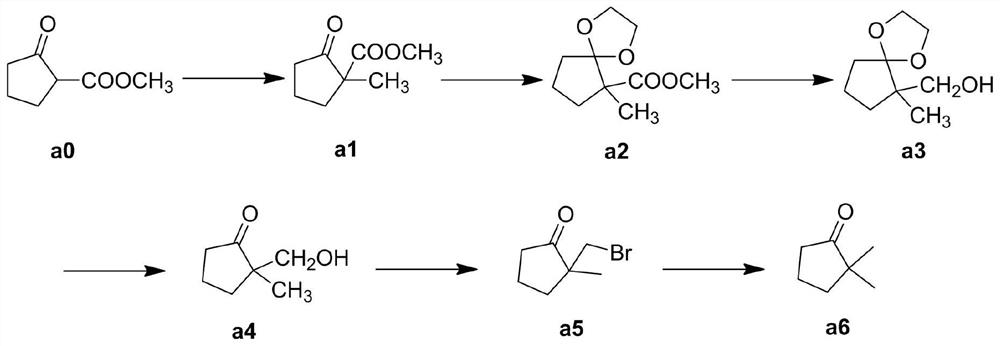
[0039] Example 1: Preparation of 2-methyl-2-methoxycarbonylcyclopentanone (a1)

[0040] Add 2-methoxycarbonylcyclopentanone (390 g, 2.75 mol) and tetrahydrofuran (2 L) into a 5 L three-neck reaction flask, and lower the temperature to 0 °C under mechanical stirring. Potassium hydroxide (168 g, 3 mol) was added in batches, stirring was continued for 30 min after the addition was complete, methyl bromide (262 g, 2.75 mol) was added dropwise to the system, and the dropwise temperature was controlled at 0°C. After the dropwise addition was completed, stirring was continued for 12 hours. Pour the reaction solution into water, add dichloromethane to extract three times, combine the organic phases, and wash once with water and saturated salt. Dry over anhydrous sodium sulfate, and remove the solvent under reduced pressure to obtain 412 g of light yellow 2-methyl-2-methoxycarbonylcyclopentanone. The product does not need further purification, and the yield is 97%.

Embodiment 2

[0041] Example 2: Preparation of 2-methyl-2-methoxycarbonylcyclopentanone vinyl ketal (a2)

[0042]Add 2-methyl-2-methoxycarbonylcyclopentanone (390 g, 2.5 mol), ethylene glycol (465 g, 7.5 mol), p-toluenesulfonic acid (43 g, 10%), and 2 L of methylcyclohexane, heated up to 100°C and stirred and refluxed for 4-5 h. After the reaction, add water to the reaction system, separate the liquids, extract the water phase with methylcyclohexane for 3 times, combine the organic phases, and wash with water. Wash with saturated saline. Dry over anhydrous sodium sulfate, and remove the solvent under reduced pressure to obtain 495 g of 2-methyl-2-methoxycarbonylcyclopentanone ethylene ketal. The product does not need further purification, and the yield is 99%.

Embodiment 3

[0043] Example 3: Preparation of 2-hydroxymethyl-2-methylcyclopentanone vinyl ketal (a3)

[0044] Add 2-methyl-2-methoxycarbonylcyclopentanone ethylene ketal (200 g, 1mol) and 2-methylbutanol (2 L) successively into a 5 L three-neck round bottom flask, raise the temperature to 75°C, and Metal sodium block (46 g, 2 mol) was cut into flakes and added to the reaction flask in batches, and the reaction was continued at this temperature for 1 h after addition. After the reaction is over, slowly add 1 L of ethanol to the system at 0°C to quench the unreacted sodium metal, slowly pour the reaction solution into water, add ethyl acetate to extract three times, combine the organic phases, wash with water, and wash with saturated salt Wash with water. Dry over anhydrous sodium sulfate, and remove the solvent under reduced pressure to obtain 160 g of 2-hydroxymethyl-2-methylcyclopentanone vinyl ketal. The product does not need further purification, and the yield is 93%.

the structure of the environmentally friendly knitted fabric provided by the present invention; figure 2 Flow chart of the yarn wrapping machine for environmentally friendly knitted fabrics and storage devices; image 3 Is the parameter map of the yarn covering machine
Login to View More

PUM

No PUM Login to View More

Abstract

The invention discloses a preparation method of 2, 2-dimethyl cyclopentanone, which comprises the following steps: methylating 2-methoxycarbonyl cyclopentanone to obtain a methylated product 2-methyl-2-methoxycarbonyl cyclopentanone, carrying out keto-carbonyl protection on the methylated product to obtain a protected product 2-methyl-2-methoxycarbonyl cyclopentanone ketal, carrying out ester group reduction on the protection product to obtain an alcohol product 2-hydroxymethyl-2-methyl cyclopentanone ketal, carrying out deprotection on the alcohol product under an acidic condition to obtain a deprotection product 2-hydroxymethyl-2-methyl cyclopentanone, and brominating the deprotection product to obtain 2-bromomethyl-2-methyl cyclopentanone. All raw materials adopted by the method are low in cost and easy to obtain in the market, and reactions in all steps are conventional reactions and easy to implement; the process is simple, mild in reaction condition and easy to operate; the reaction time is short, control is easy, the yield of each step is 90% or above, and industrial large-scale production is easy to achieve.

Description

technical field [0001] The invention relates to the technical field of organic intermediates, in particular to a preparation method of 2,2-dimethylcyclopentanone. Background technique [0002] Meconazole, chemical name (1RS,5RS; 1RS,5SR)-5-(4-chlorobenzyl)-2,2-dimethyl-1-(1H-1,2,4,-triazole -1-methyl)cyclopentanol. It is a new type of triazole fungicide developed by Kureha Chemical Company in Japan in the early 1990s and jointly developed with Nitrile Ammonium Corporation (now BASF) of the United States. It has the same antibacterial spectrum as other triazole fungicides. It has the characteristics of strong systemic absorption and excellent activity. The main mechanism of action is to inhibit the C-14 demethylation reaction, hinder the synthesis of sterols, thereby destroying the synthesis function of bacteria, and belongs to the inhibitor of C-14 demethylase. Field application of metconazole has excellent effects on the plant diseases of Septoria, Fusarium and Puccinia ...

Claims

the structure of the environmentally friendly knitted fabric provided by the present invention; figure 2 Flow chart of the yarn wrapping machine for environmentally friendly knitted fabrics and storage devices; image 3 Is the parameter map of the yarn covering machine
Login to View More

Application Information

Patent Timeline
no application Login to View More
Patent Type & Authority Applications(China)
IPC IPC(8): C07C45/65C07C49/395
CPCC07C67/343C07C45/59C07C45/63C07C45/65C07D317/72C07C2601/08C07C69/757C07C49/493C07C49/395Y02P20/55
Inventor 范云龙罗佳
Owner 九江德思光电材料有限公司
Features
  • R&D
  • Intellectual Property
  • Life Sciences
  • Materials
  • Tech Scout
Why Patsnap Eureka
  • Unparalleled Data Quality
  • Higher Quality Content
  • 60% Fewer Hallucinations
Social media
Patsnap Eureka Blog
Learn More