Method for enhancing L-phenylalanine exocytosis of escherichia coli
Active Publication Date: 2014-08-27
JIANGNAN UNIV
View PDF7 Cites 0 Cited by
Summary
Abstract
Description
Claims
Application Information
AI Technical Summary
This helps you quickly interpret patents by identifying the three key elements:
Problems solved by technology
Method used
Benefits of technology
Problems solved by technology
[0003] The microbial strains with acid-producing ability screened from nature generally have limited amino acid accumulation; although the mutant strains selected through special modification can improve the production efficiency of L-phenylalanine, they are blind and have a heavy workload , the production cost is high, and the mutant strains generally carry nutritional deficiencies, which limit the further improvement of yield
The release of metabolic regulatory sites by means of genecloning to promote the synthesis of target products has been successfully applied to the fermentation production of various metabolites such as citric acid, lactic acid, and succinic acid, which is an inevitable trend in the industrial production of L-phenylalanine. However, L -The metabolic regulation of phenylalanine is limited by multi-level and different levels of feedback control such as genetranscription initiation, transcription process, translation initiation, translation process, enzyme amount, and enzyme activity, and because the size of the plasmid vector is limited, It is difficult to remove all the regulatory sites by overexpressing multiple consecutive genes. In addition, E. coli will accumulate a by-product during the fermentation process - acetic acid, which can limit the growth of the bacteria and the synthesis of the target product, reducing the yield
In conclusion, genetically engineered strains capable of high-yield L-phenylalanine and low fermentation cost have not been reported so far, and it is difficult to form industrialization
Method used
the structure of the environmentally friendly knitted fabric provided by the present invention; figure 2 Flow chart of the yarn wrapping machine for environmentally friendly knitted fabrics and storage devices; image 3 Is the parameter map of the yarn covering machine
View more
Image
Smart Image Click on the blue labels to locate them in the text.
Viewing Examples
Smart Image
Click on the blue label to locate the original text in one second.
Reading with bidirectional positioning of images and text.
Smart Image
Examples
Experimental program
Comparison scheme
Effect test
Embodiment 1
[0023] Example 1 Construction of the plasmid pR15ABK overexpressing AroG, PheA, AroK and YdiB
[0025]Using the fitted DNA of Escherichia coli as a template, the upstream primer aroG15_F146 (base sequence shown in SEQ ID NO: 2) and the downstream primer aroG_HindⅢ_RV (base sequence shown in SEQ ID NO: 3) were used for PCR amplification to obtain gene fragments A, using Escherichia coli nucleoid DNA as a template, PCR amplification was performed with upstream primer aroG_Kpn Ⅰ_FW (base sequence shown in SEQ ID NO:4) and downstream primer aroG15_R146 (base sequence shown in SEQ ID NO:5) Obtain gene fragment B.
[0026] Using gene fragments A and B as templates, by overlapping PCR (according to the PCR site-directed mutagenesis technique, the references are as follows: Ho, S.N., H.D. Hunt, R.M. Horton, J.K. Pullen, and L.R. Pease (1989) Site-directed mutagenesis by overlap extens...
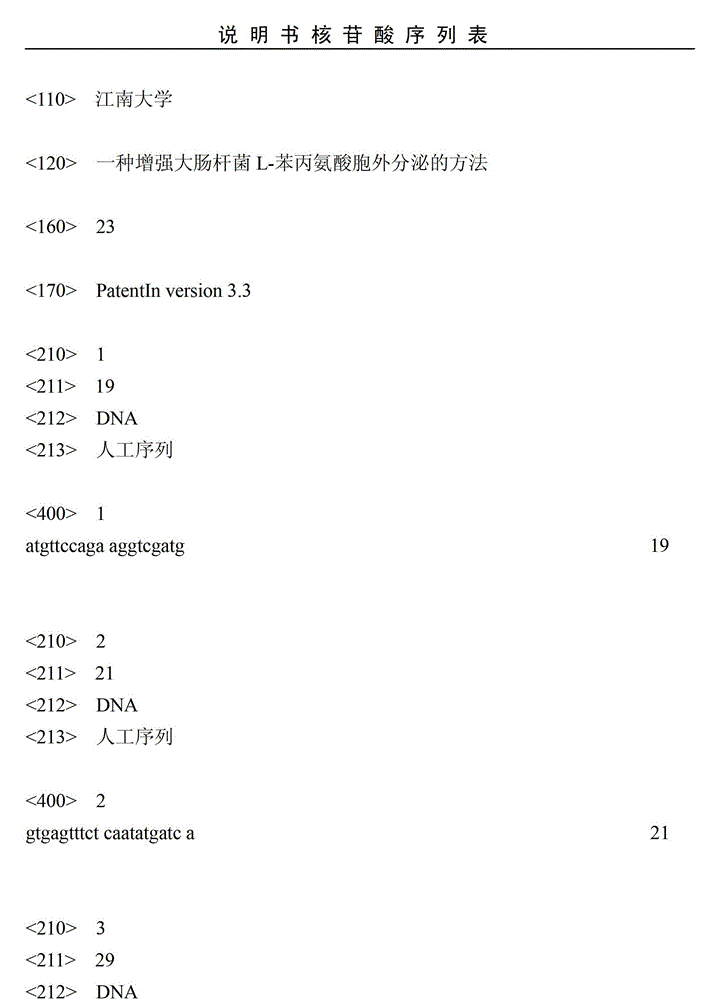
[0033] The tyrB coding gene was obtained by PCR amplification using the fitted DNA of Escherichia coli as a template, and the primers were designed as follows: the base sequence of the upstream primer tyrB_EcoRV_SD_SB_FW is shown in SEQ ID NO:14, and the base sequence of the downstream primer tyrB_AflⅡ_EcoRI_RV is shown in SEQ ID NO:15 , wherein, the SD sequence AAGGAGGAACAGAC is the ribosomebinding site, and the SB sequence ATGTTCCAGAAGGTCGATG (as shown in SEQ ID NO: 1) is the starting base sequence of the coding frame of the tyrB gene after replacement.
[0034] The amplified TyrB coding gene was connected to the pMD 18T-simple Vector, sequenced and identified correctly by Shanghai Sangon Bioengineering Co., Ltd., and then ligated by enzymedigestion (for specific methods, please refer to the corresponding restriction endonuclease or ligase instructions) and The plasmid pR15ABK constructed in E...
Embodiment 3
[0040] Example 3 Release of metabolic regulation of methyl viologenefflux pump (YddG)
[0041] The yddG coding gene was obtained by PCR amplification using E. coli fitting DNA as a template, and the primers were designed as follows: the base sequence of the upstream primer yddG_EcoRV_SD_FW is shown in SEQ ID NO:16, and the base sequence of the downstream primer yddG_NcoI_KpnI_RV is shown in SEQ ID NO:17 , wherein, the SD sequence AAGGAGGAACAGAC is the ribosomebinding site.
[0042] Ligate the amplified yddG-encoding gene to pMD 18T-simple Vector, after sequenced and identified correctly by Shanghai Sangon Bioengineering Co., Ltd., carry out an enzyme digestionligation reaction (see the corresponding restriction enzyme or ligase instructions for specific methods) Connect with the plasmid constructed in Example 2, place the yddG coding gene in the strong promoter P L Later, a recombinant expression plasmid that can overexpress YddG, TyrB, AroG, PheA, AroK and YdiB at the sam...
the structure of the environmentally friendly knitted fabric provided by the present invention; figure 2 Flow chart of the yarn wrapping machine for environmentally friendly knitted fabrics and storage devices; image 3 Is the parameter map of the yarn covering machine
Login to View More
PUM
Login to View More
Abstract
The invention discloses a method for enhancing the L-phenylalanineexocytosis of escherichia coli. The method comprises the steps of transforming host escherichia coli through recombinant plasmids capable of simultaneously overexpressing tyrosine aminotransferase TyrB, methyl viologen exo transport protein YddG, 3-deoxy-D-arabino-heptulosonate-7-phosphate synthase AroG, chorismate mutase and prephenate dehydratase PheA, shikimate kinase AroK and shikimate dehydrogenase YdiB and producing L-phenylalanine through liquid fermentation, wherein artificial modification is carried out on TyrB, YddG, AroG, PheA, AroK and YdiB encoding genes from the escherichia coli resource so as to get release from the metabolic regulation and vectors are inserted, thus constructing the recombinant plasmids. The method disclosed by the invention has the advantages that the L-phenylalanineexocytosis level of the escherichia coli can be obviously enhanced, the L-phenylalanine yield is high, the concentration of harmful by-product acetic acid is low, the fermentation cost is low and the process is simple; and therefore, the method is suitable for industrial production.
Description
technical field [0001] The invention belongs to the technical field of bioengineering, and in particular relates to a method for enhancing the extracellularsecretion of E. coli L-phenylalanine by means of genetic engineering technology and fermentation. Background technique [0002] L-phenylalanine (L-phenylalanine) is a physiologically active aromatic amino acid that is necessary for the human body but cannot be synthesized by itself. It is also an important pharmaceutical and food chemical intermediate. It is mainly used in the pharmaceutical industry to produce Tumor drugs and amino acid infusion preparations are mainly used in the food industry to synthesize aspartame, a dipeptide sweetener, and have good application prospects. There are mainly four methods for producing L-phenylalanine: hydrolysis extraction, chemical synthesis, enzymatic method and fermentation method. Among them, the raw materials used in the microbial fermentation method are cheap and easy to obtain...
Claims
the structure of the environmentally friendly knitted fabric provided by the present invention; figure 2 Flow chart of the yarn wrapping machine for environmentally friendly knitted fabrics and storage devices; image 3 Is the parameter map of the yarn covering machine
Login to View More
Application Information
Patent Timeline
Application Date:The date an application was filed.
Publication Date:The date a patent or application was officially published.
First Publication Date:The earliest publication date of a patent with the same application number.
Issue Date:Publication date of the patent grant document.
PCT Entry Date:The Entry date of PCT National Phase.
Estimated Expiry Date:The statutory expiry date of a patent right according to the Patent Law, and it is the longest term of protection that the patent right can achieve without the termination of the patent right due to other reasons(Term extension factor has been taken into account ).
Invalid Date:Actual expiry date is based on effective date or publication date of legal transaction data of invalid patent.


 Login to View More
  Login to View More