Check patentability & draft patents in minutes with Patsnap Eureka AI!

Method for recovering polyol from wastewater

A polyol and wastewater technology, applied in chemical instruments and methods, preparation of organic compounds, production of bulk chemicals, etc., can solve the problems of high energy consumption, large energy consumption, inconspicuousness, etc., and achieves pollution reduction and high added value. , the effect of simple operation

Inactive Publication Date: 2014-03-26
TIANJIN UNIV
View PDF3 Cites 11 Cited by
  • Summary
  • Abstract
  • Description
  • Claims
  • Application Information

AI Technical Summary

Problems solved by technology

Although the dividing wall column can integrate the separation process, it still needs to distill a large amount of water, which requires a lot of energy (US20050250965A1); the azeotropic distillation technology using benzene as an entrainer, although the azeotropy of benzene and water can make The energy of rectification is reduced, but the reduced energy is not significant; and the process of combining membrane separation technology and azeotropic technology will inevitably consume a lot of energy, and there is still a big gap from industrial application ( Wang Sheng. Study on separation scheme of water, propylene glycol and propylene glycol monomethyl ether mixture [D]. Dalian University of Technology, 2003.)

Method used

the structure of the environmentally friendly knitted fabric provided by the present invention; figure 2 Flow chart of the yarn wrapping machine for environmentally friendly knitted fabrics and storage devices; image 3 Is the parameter map of the yarn covering machine
View more

Image

Smart Image Click on the blue labels to locate them in the text.
Viewing Examples
Smart Image
  • Method for recovering polyol from wastewater
  • Method for recovering polyol from wastewater
  • Method for recovering polyol from wastewater

Examples

Experimental program
Comparison scheme
Effect test

Embodiment 1

[0037] The wastewater comes from the process of hydrogen peroxide oxidation to produce propylene oxide, that is, the HPPO process, which contains propylene glycol with a mass fraction of 4.3%.

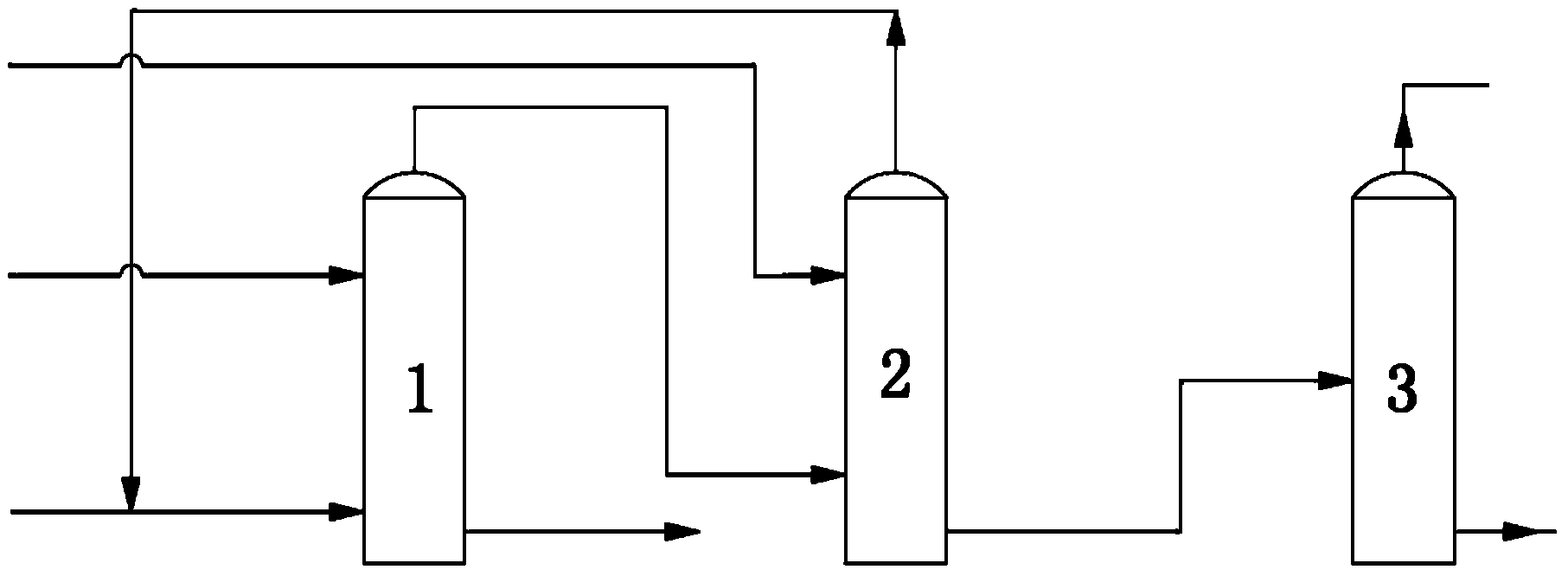
[0038] The equipment includes three packed towers: reactive distillation tower, hydrolysis tower and refining tower.

[0039] The reactive distillation column has 30 trays, and acetaldehyde is fed from the 27th tray, and the feed rate is 6221Kg / h (wherein the supplementary acetaldehyde feed is 40Kg / h, and the recycled acetaldehyde is 6181Kg / h) , the wastewater containing propylene glycol is fed from the third tray (feed composition: hydrogen peroxide H2O20.4866Kg / h, H2O57999.886Kg / h, propylene glycol C3H8O22622.4743Kg / h, propylene glycol monomethyl ether C4H10O345.0981Kg / h), reflux The ratio is 1.05, the output of the reactive distillation tower is 10694.317Kg / h, the operating pressure is 0.99atm, and the pressure drop of each layer is 0.02KPa.

[0040] The strongly acidic cationic re...

the structure of the environmentally friendly knitted fabric provided by the present invention; figure 2 Flow chart of the yarn wrapping machine for environmentally friendly knitted fabrics and storage devices; image 3 Is the parameter map of the yarn covering machine
Login to View More

PUM

No PUM Login to View More

Abstract

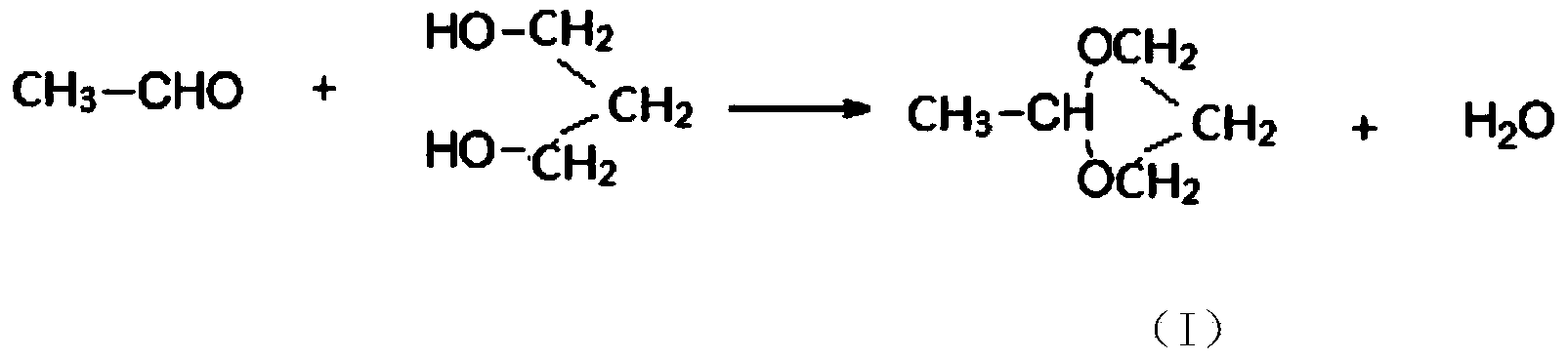
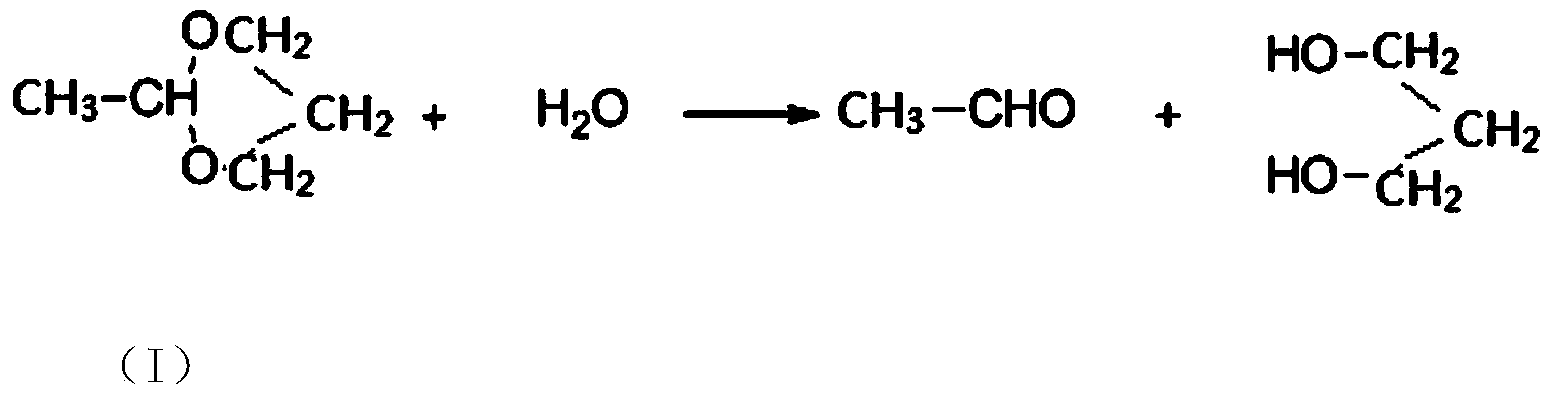
The invention discloses a method for recovering polyol from wastewater. The method comprises the following steps: introducing wastewater containing a low concentration of polyol from the upper portion of a reaction rectifying tower (1), introducing aldehyde from the lower portion of the reaction rectifying tower, and carrying out a reaction of polyol and aldehyde under the catalysis of a strongly acidic cation resin to generate acetal; discharging an azeotropic mixture of acetal and water from the top of the reaction rectifying tower, allowing the azeotropic mixture to enter a hydrolysis tower from the lower portion of the hydrolysis tower, allowing water to enter the hydrolysis from the upper portion of the hydrolysis tower, discharging aldehyde obtained after the hydrolysis from the top of the hydrolysis tower to the reaction rectifying tower, discharging the polyol from the bottom of the hydolysis tower to a refining tower (3), and discharging a stream from the bottom of the refining tower to obtain highly-pure polyol. The disadvantages of large energy consumption and difficult industrialization of traditional separating methods are overcome in the invention. The purity of the above obtained product is high and can be adjusted as needed. Aldehyde can be recycled, so the pollution of wastewater to the environment is reduced. The recovered polyol has high added values, and the operation is simple. The purity of the polyol can reach 99%.

Description

technical field [0001] The invention belongs to the field of polyol wastewater treatment and recovery, and in particular relates to a method for recovering polyol from wastewater. Background technique [0002] Polyol is an important chemical raw material, an important intermediate of alkyd resin, varnish, polyester resin, and explosives, and an important basic raw material for polyurethane, adhesive, plasticizer, and surfactant. Among them, ethylene glycol can be used as a solvent, an antifreeze agent, and a raw material for polyester synthesis, and polyethylene glycol (PEG), a high polymer of ethylene glycol, is an important phase transfer catalyst. 1,3-Propanediol (1,3-PD) is widely used in polyester fibers, polyurethanes, hot melt adhesives, powder coatings, antifreeze agents, packaging materials and organic synthesis intermediates, among which high-performance Polyester fiber PTT is currently the main application. 1,2 Propylene Glycol can be used as a solvent, humectan...

Claims

the structure of the environmentally friendly knitted fabric provided by the present invention; figure 2 Flow chart of the yarn wrapping machine for environmentally friendly knitted fabrics and storage devices; image 3 Is the parameter map of the yarn covering machine
Login to View More

Application Information

Patent Timeline
no application Login to View More
IPC IPC(8): C07C29/92C07C29/82C07C31/20
CPCY02P20/52C07C29/92
Inventor 刘训志段兆阳李敬楠沈国强温嘉玮王亚权
Owner TIANJIN UNIV
Features
  • R&D
  • Intellectual Property
  • Life Sciences
  • Materials
  • Tech Scout
Why Patsnap Eureka
  • Unparalleled Data Quality
  • Higher Quality Content
  • 60% Fewer Hallucinations
Social media
Patsnap Eureka Blog
Learn More