Three-dimensional microstructural self-supporting flexible porous carbon film as well as preparation method and application thereof
A microstructure, self-supporting technology, applied in the field of porous carbon materials, can solve the problems of hindering electrolyte ions from entering the internal pores, specific surface area cannot participate in charge storage, capacitive performance limitations, etc., and achieves controllable carbon network density, small network diameter, The effect of high specific surface area
- Summary
- Abstract
- Description
- Claims
- Application Information
AI Technical Summary
Problems solved by technology
Method used
Image

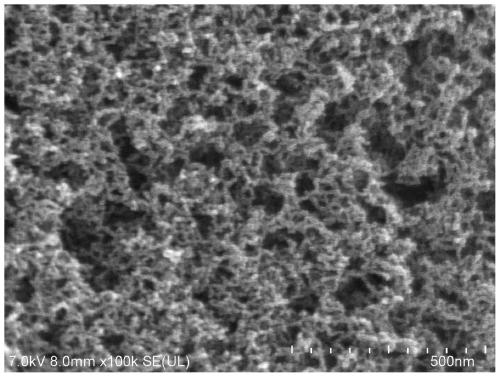


Examples
Embodiment 1
[0035] 1. According to the molar ratio of resorcinol: formaldehyde: sodium carbonate is 50:100:1, and the mass ratio of resorcinol: water is 1:20, mix resorcinol, formaldehyde, sodium carbonate and water After stirring for 1 minute, react at 45°C for 1 hour to obtain a prepolymer solution;
[0036] 2. Add 20 milliliters of 1.8 g / L iminodiacetic acid solution to the pre-polymerization liquid, and after standing at room temperature for 20 minutes, the filter paper absorbs water until the dehydration is 80%, and puts it into an autoclave at 115° C. for 0.5 days to obtain the reaction intermediate product A.
[0037] 3. Put the reaction intermediate product A in tert-butanol, soak it at 25°C for 1 day to obtain the reaction product B, freeze-dry the reaction product B at -20°C for 1 day, and then pre-carbonize the obtained product B at 600°C for 1 hour , after soaking in nickel nitrate-tert-butanol solution (mass ratio of nickel nitrate and tert-butanol 1:20) solution and freeze-d...
Embodiment 2
[0040] 1. According to the molar ratio of resorcinol: formaldehyde: sodium carbonate is 50:100:1, and the mass ratio of resorcinol: water is 1:20, mix resorcinol, formaldehyde, sodium carbonate and water Stir for 1 minute after mixing, and react for 1 hour at 45°C to obtain a prepolymer solution;
[0041] 2. Add 20 milliliters of 1.8 g / L iminodiacetic acid solution to the pre-polymerization solution, dehydrate it by 90%, put it in an autoclave at 115° C. for 0.5 days, and obtain the reaction intermediate product A.
[0042] 3. After the reaction product A is frozen in liquid nitrogen, freeze-dry at -20°C for 1 day, and the resulting product is pre-carbonized at 600°C for 1 hour, soaked in nickel nitrate-tert-butanol (the mass ratio of nickel nitrate and tert-butanol is 1 :10) solution and freeze-drying at -20°C to obtain product B, which is carbonized at 950°C to obtain a three-dimensional microstructure self-supporting flexible porous carbon film.
[0043] Figure 4 Scannin...
Embodiment 3
[0045] 1. According to the molar ratio of resorcinol: formaldehyde: sodium carbonate is 50:100:1, the mass ratio of phenolic monomer: water is 1:20, the resorcinol, formaldehyde, sodium carbonate and water After mixing, stir for 1 minute, and react at 45°C for 2 hours to obtain a prepolymer solution;
[0046] 2. Add 40 ml of 1.8 g / L iminodiacetic acid solution to the pre-polymerization solution, dehydrate it by 90%, put it in an autoclave at 115°C for 0.5 days, and obtain the reaction intermediate product A;
[0047] 3. Put the reaction intermediate product A into tert-butanol containing 20 wt% of water (after mixing water and tert-butanol, water accounts for 20% in the solution), soak at 25°C for 1 day to obtain reaction product B;
[0048] 4. The reaction product B was freeze-dried at -20°C for 1 day after being frozen in liquid nitrogen, and the resulting product was pre-carbonized at 600°C for 1 hour, soaked in nickel nitrate-tert-butanol (mass ratio 1:10) solution and Afte...
PUM
| Property | Measurement | Unit |
|---|---|---|
| Diameter | aaaaa | aaaaa |
Abstract
Description
Claims
Application Information
 Login to View More