

Condensed benzamide compounds and inhibitors of vanilloid receptor subtype 1 (VR1) activity
a vanilloid receptor and condensed benzamide technology, applied in the field of condensed benzamide compounds, can solve the problems of no effective analgesic agent found and severely restricted and achieve the effects of less side effects, increased analgesic effect, and reduced use of narcotic analgesics
- Summary
- Abstract
- Description
- Claims
- Application Information
AI Technical Summary
Benefits of technology
Problems solved by technology
Method used
Image

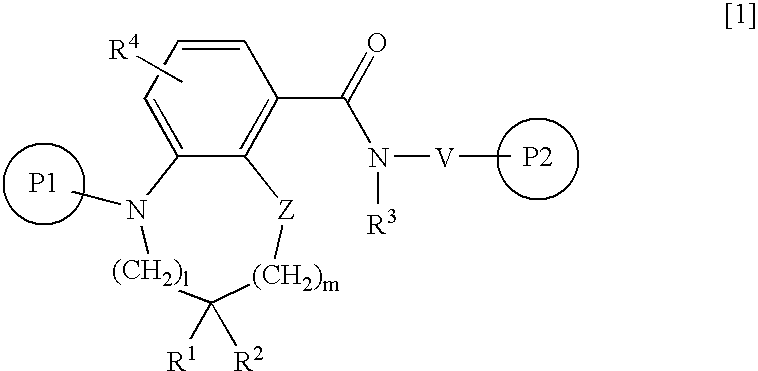
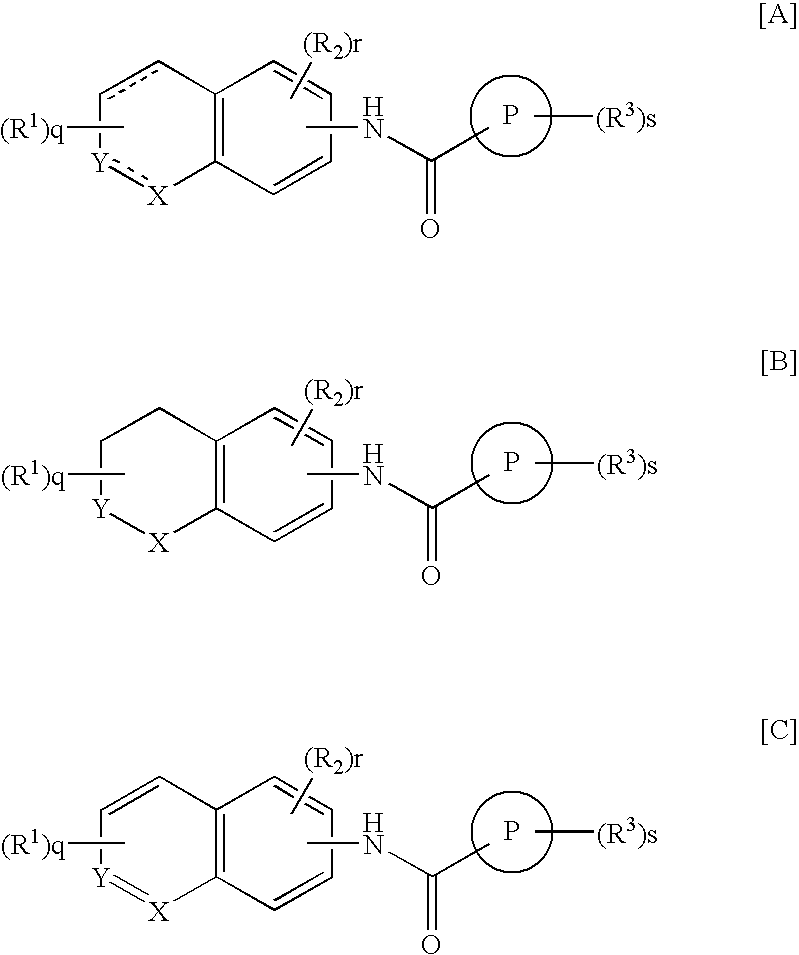
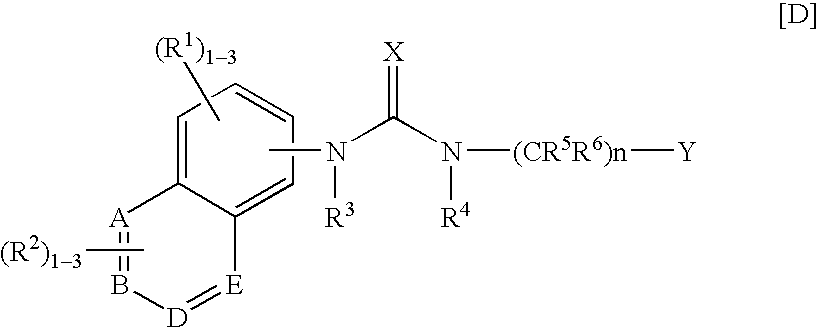
Examples
example 1
EXAMPLE 1-001
Production of N-(4-tert-butylphenyl)-4-(3-chloropyridin-2-yl)-3,4-dihydro-2H-benzo[1,4]oxazine-8 -carboxamide
[0760] First Step
[0761] Production of methyl 3-nitrosalicylate:
[0762] 3-Nitrosalycylic acid (7.5 g) was dissolved in methanol (75 ml), concentrated sulfuric acid (2 ml) was added, and the mixture was refluxed for 24 hours. Reaction mixture was left cool to and the precipitated pale yellowish solid was collected by filtration, washed with water and dried in vacuo to obtain the title compound (7.19 g).
[0763] Second Step
[0764] Production of methyl 3-aminosalicylate:
[0765] 3-Nitrosalicylate (7.19 g) obtained in the First Step was dissolved in tetrahydrofuran (100 ml) and ethyl acetate (50 ml), 5% palladium-carbon (water content 50%) (0.70 g) was added, and the mixture was stirred at room temperature for 2 hours under hydrogen atmosphere. Palladium-carbon was filtered off from the reaction suspension, the filtrate was concentrated, and n-hexane was added. The p...
example 1-002
Production of 8-(4-tert-butylphenyl)carbamoyl-4-(3-chloropyridin-2-yl)-3,4-dihydro-2H-benzo[1,4]oxazine-2-carboxylic acid
[0785] First Step
[0786] Production of N-(4-tert-butylphenyl)-3-nitro-2-hydroxybenzamide:
[0787] 3-Nitrosalysilic acid (10.0 g) was dissolved in methylene chloride (100 ml), oxalyl chloride (6.2 ml) and N,N-dimethylformamide (0.1 ml) were added, and the mixture was stirred at room temperature for 2 hours. The reaction mixture was concentrated, and the concentrate was added to a solution of 4-tert-butylaniline (5.2 g) and triethylamine (5.1 ml) in acetonitrile (100 ml), then the mixture was stirred at room temperature for 3 hours. After concentrating the reaction mixture, the reaction mixture was partitioned between chloroform and water. The obtained chloroform layer was washed with water, dried over anhydrous sodium sulfate and then concentrated. The thus obtained residue was purified by the use of silica gel chromatography (hexane—ethyl acetate=1:1) to obtain th...
example 1-003
Production of N-(4-tert-butylphenyl)-4-(3-chloropyridin-2-yl)-3-methyl-3,4-dihydro-2H-benzo[1,4]oxazine-8-carboxamide
[0801] First Step
[0802] Production of methyl 3-nitro-2-(2-oxopropoxy)benzoate:
[0803] Methyl 3-nitrosalycilate (1.95 g) obtained in the First Step of Example 1-001 was dissolved in N,N-dimethylformamide (20 ml), potassium carbonate (2.73 g) and bromoacetone (1.1 ml) were added, and the mixture was stirred at room temperature overnight. The reaction mixture was partitioned between water and ethyl acetate, and the ethyl acetate layer was washed twice with saturated sodium chloride solution, dried over anhydrous sodium sulfate and concentrated to obtain brownish oily compound in the title (2.46 g).
[0804] Second Step
[0805] Production of methyl 3-methyl-3,4-dihydro-2H-benzo[1,4]oxazine-8-carboxylate:
[0806] Methyl 3-nitro-2-(2-oxopropoxy)benzoate (2.46 g) obtained in the First Step was dissolved in tetrahydrofuran (25 ml), 10% palladium carbon (containing 50% water) (0...
PUM
 Login to View More
 Abstract
Description
Claims
Application Information
 Login to View More