

Tetrapeptides for brightening the skin
a technology of tetrapeptides and skin brightening, which is applied in the field of tetrapeptide pkek, can solve the problems of pigment disorders that are local hyperpigmentation or even natural skin pigmentation are often perceived as cosmetic flaws, and achieve tight skin, alleviate inflammation, and smooth skin wrinkles
- Summary
- Abstract
- Description
- Claims
- Application Information
AI Technical Summary
Benefits of technology
Problems solved by technology
Method used
Image

Examples
example 1
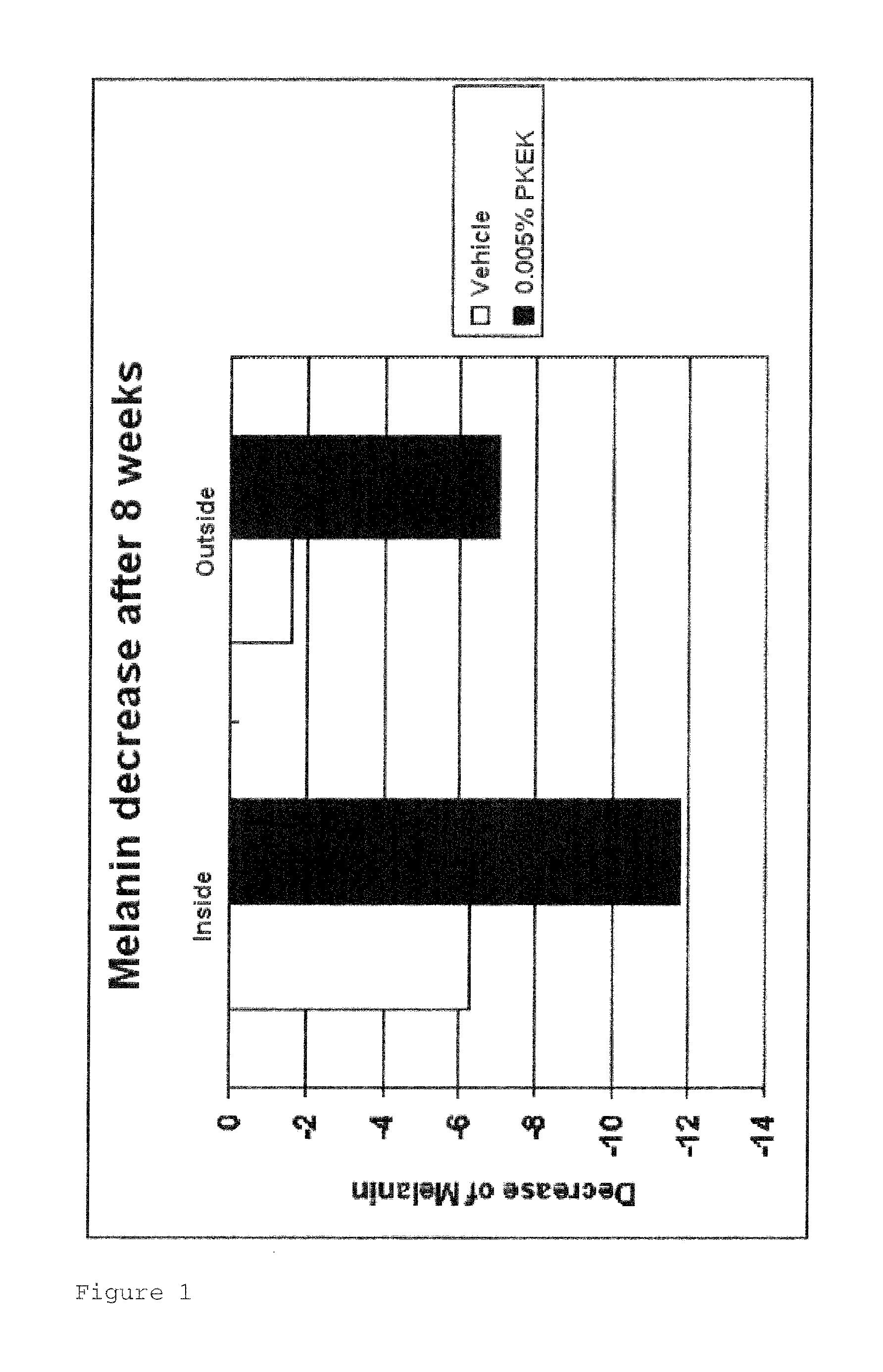
In Vivo Lightening (2-Month Study)
[0070]20 subjects wore a test formulation without peptide or with 0.005% PKEK over a period of 8 weeks on one forearm in each case. Prior to the start of the study, and also after 8 weeks, a Mexameter probe (Courage & Khazaka, Cologne) was used to measure the melanin concentration both on the inside and also on the outside of the forearm.
[0071]The measurement of the melanin concentration in the skin is based on the principle of absorption / reflection. The
[0072]Mexameter probe emits light of a specific wavelength which is in agreement with the absorption maxima of the melanin in the skin. The light reflected by the skin is measured and placed relative to the emitted amount of light. The resulting measurement values are given as index numbers.
Test Formulation:
[0073]
0.005% H1410VehiclePolyglyceryl-3 Methylglucose3.0%3.0%DistearateGlyceryl Stearate2.0%2.0%Stearyl Alcohol1.0%1.0%PPG-3 Myristyl Ether9.5%9.5%Caprylic / Capric Triglyceride9.5%9.5%PKEK0.005% —W...
example 2
Example Formulations
[0075]Example formulations are described below. The stated percentages are percentages by mass and refer to the total mass of the example formulation. To produce the formulations, customary formulation processes known to the person skilled in the art were used.
O / W Formulation
[0076]
Phase APolyglyceryl-3 Methylglucose Distearate3.0%Glyceryl Stearate2.0%Stearyl Alcohol1.0%Decyl Cocoate10.0% Cetearyl Ethylhexanoate9.0%Phase BGlycerin3.0%PKEK0.001% Water71.999% Phase ZPreservative, perfumeq.s.
W / O Formulation
[0077]
Phase APolyglyceryl-4 Isostearate1.5%Cetyl PEG / PPG-10 / 1 Dimethicone1.0%Ethylhexyl Palmitate11.0% Decyl Oleate10.5% Hydrogenated Castor Oil0.8%Microcrystalline Wax1.2%Phase BGlycerin3.0%Magnesium Sulfate Heptahydrate0.6%PKEK0.002% Water70.398% Phase ZPreservative, perfumeq.s.
Shower Gel
[0078]
Water50.248% PKEK0.002% Polyquaternium-100.3%Sodium Laureth Sulfate, 28%36.0% Disodium Cocoamphodiacetate, 39%6.0%Cocamidopropylbetaine; Glyceryl Laurate5.0%PEG-7 Glycer...
example 3
Reduction of Age Spots on the Face
[0081]Age spots (Latin: Lentigines seniles, Lentigines solares) are pigment disorders in the skin. They are produced by increased, chronic exposure to ultraviolet radiation, e.g. sunlight. This results in local, sharply delimited pale brown spot formations (“maculae”) with increase in the melanin-producing melanocytes, predominantly in the area of the backs of the hands, forearms and facial skin.
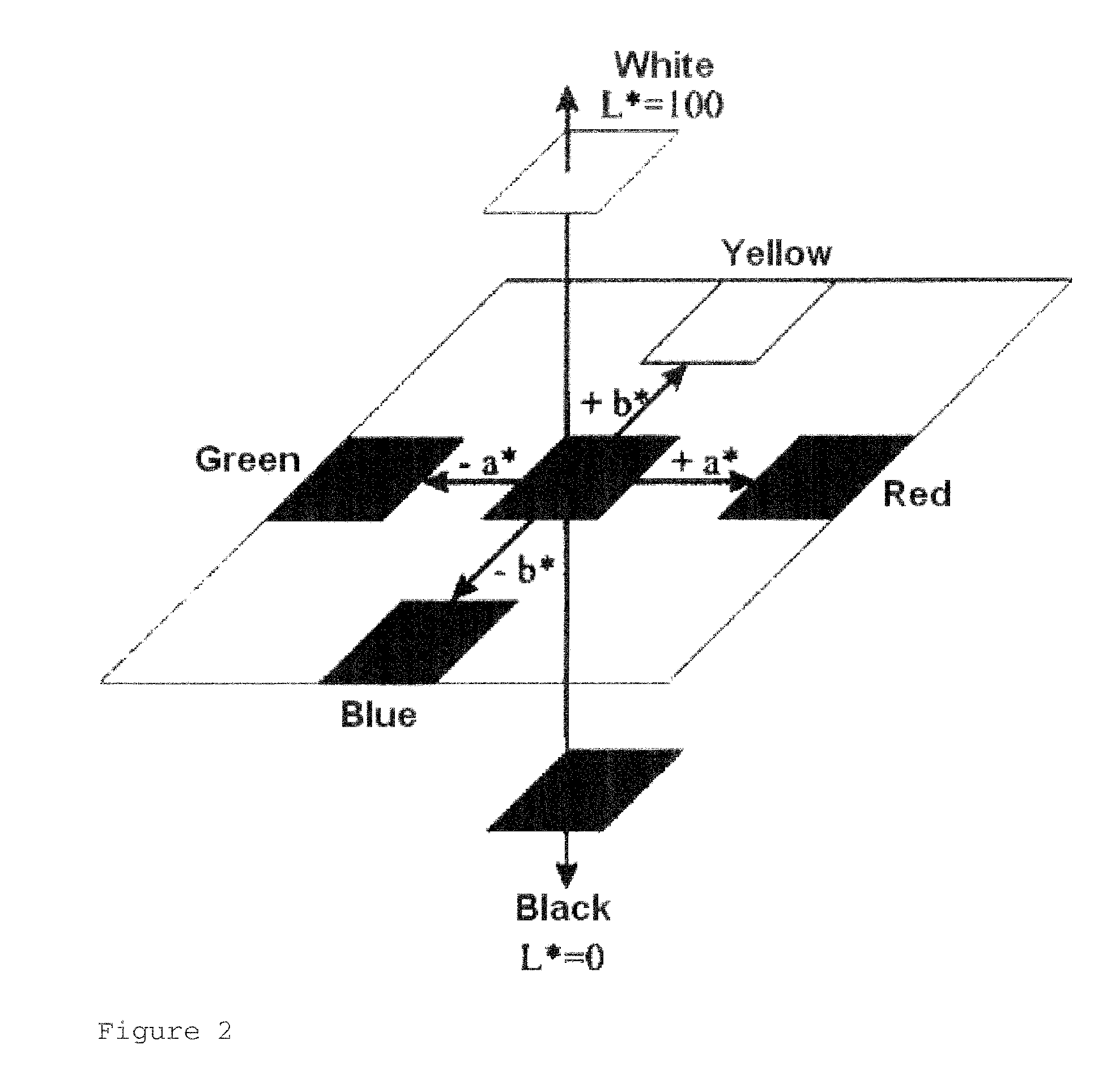
[0082]In order to quantify such age spots, color measurements of the skin are carried out. For this purpose, chromameters are used. The chromameter measures the color values L*, a* and b*. These describe a three-dimensional color space, with the help of which every perceivable color can be described, cf. FIG. 2.
[0083]On the a*-axis the opposite colors green and red face each other, and on the b*-axis the opposite colors blue and yellow face each other. The axis L* gives the lightness.
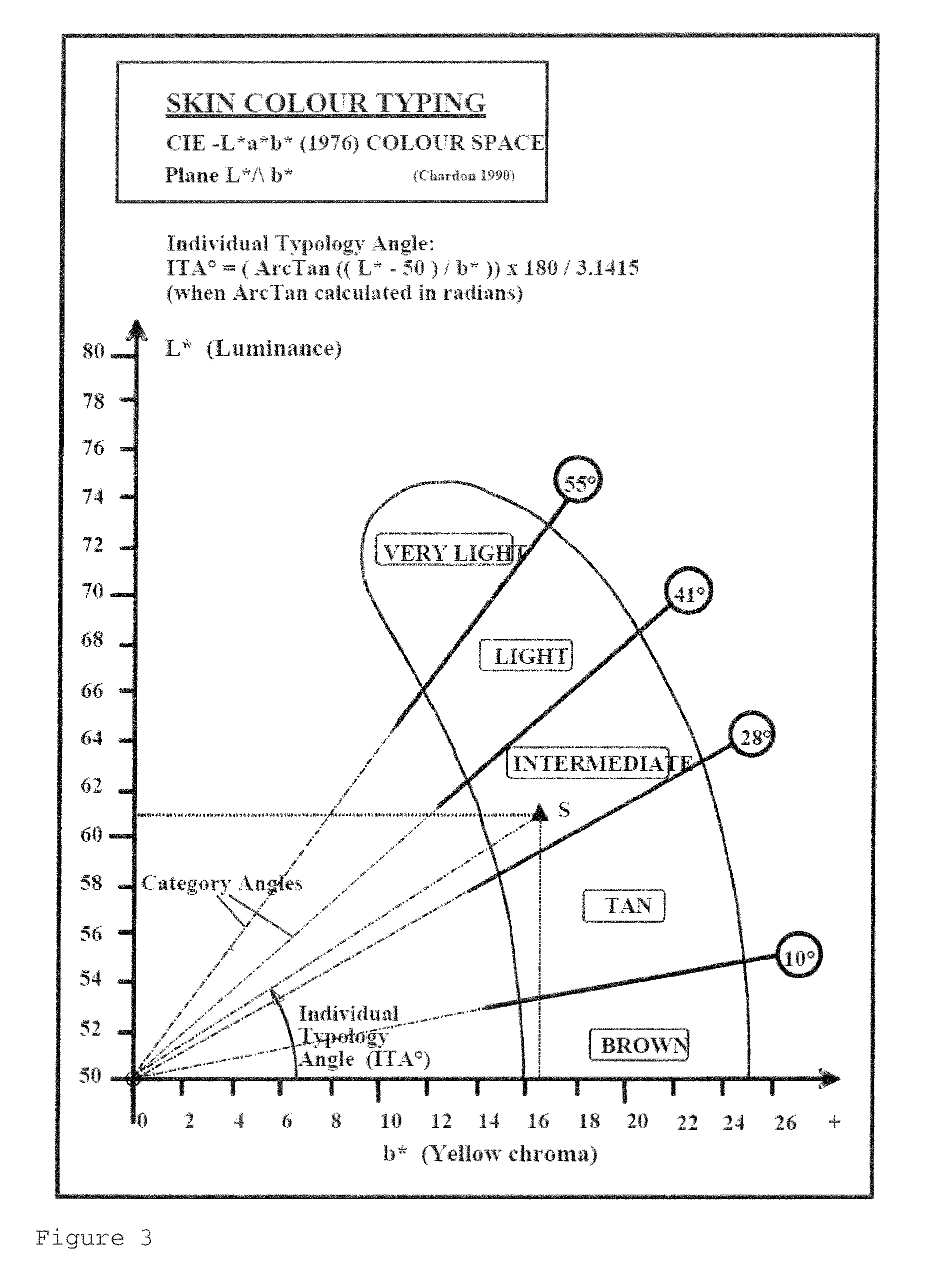
[0084]The end points are black (L=0) and white (L=100). In order to be able...
PUM
| Property | Measurement | Unit |
|---|---|---|
| total mass | aaaaa | aaaaa |
| viscosity | aaaaa | aaaaa |
| color | aaaaa | aaaaa |
Abstract
Description
Claims
Application Information
 Login to View More