
Conductive polymer composition, coated product and patterning process
a technology of conductive polymer composition and coated product, applied in the direction of conductors, instruments, photomechanical equipment, etc., can solve the problems of lithography sensitivity fluctuation, pattern failure, and significant reduction of picture accuracy, and achieve high conductivity, improve positional precision of electron beam writing, and improve the effect of efficiency
- Summary
- Abstract
- Description
- Claims
- Application Information
AI Technical Summary
Benefits of technology
Problems solved by technology
Method used
Image

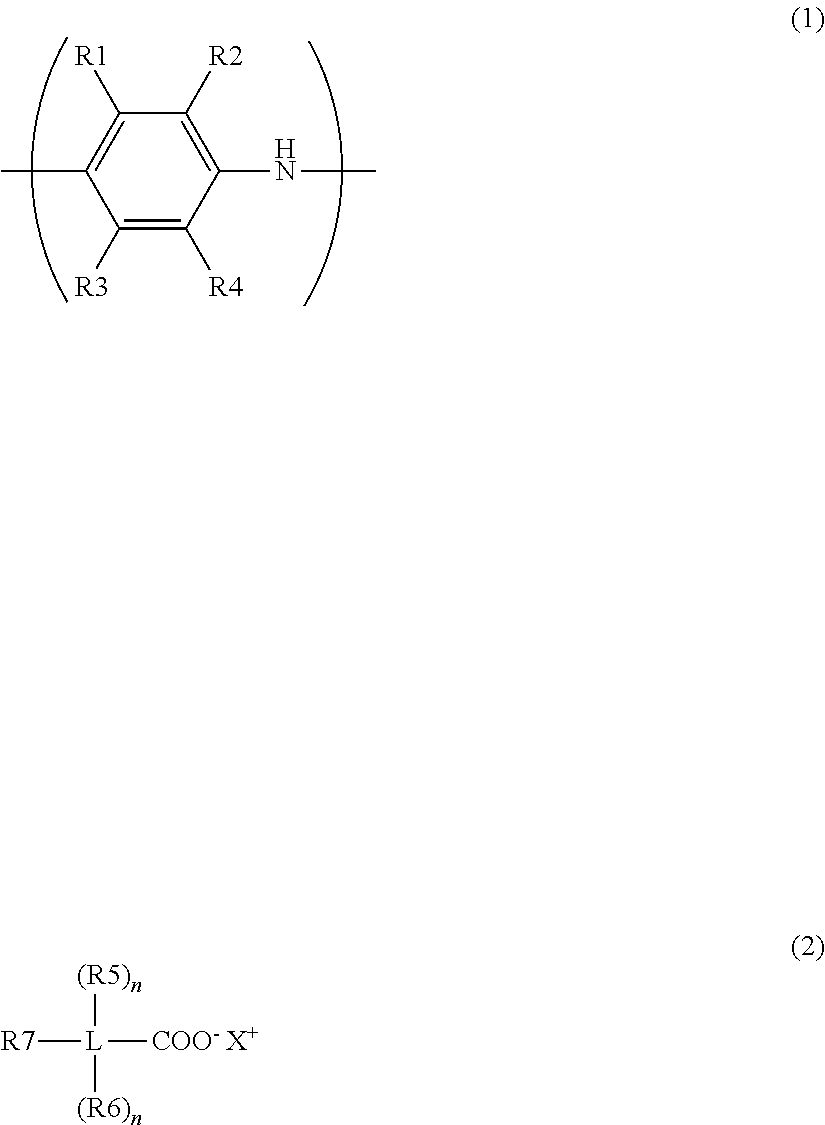
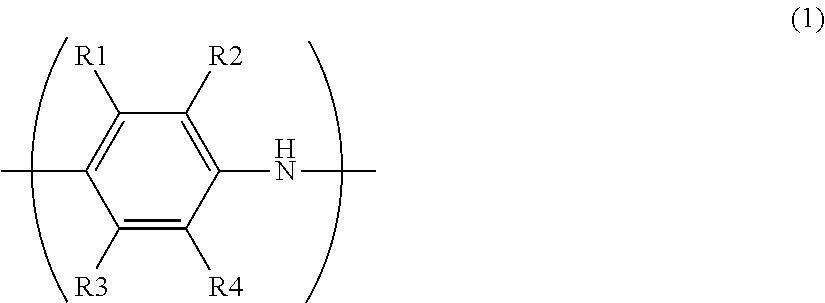
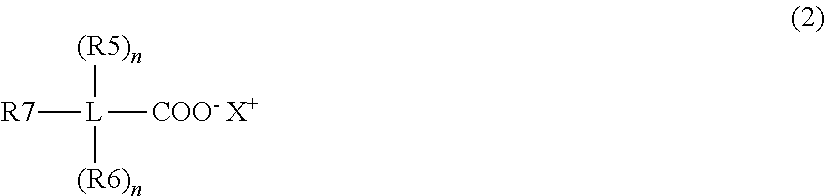
Examples
example
[0116]Hereinafter, the present invention will be explained in more detail by referring to Production Examples, Examples and Comparative Examples, but the present invention is not limited by these.
[Synthesis of Self-Doping Type Polyaniline-Based Conductive Polymer]
[0117]In the polyaniline-based conductive polymer material of Component (A) to be used in the present invention, among the above-mentioned repeating units, from the viewpoints of solubility, conductivity and a cost of the raw materials, methoxyaminobenzenesulfonic acids, and further among these, polymerization of 3-amino 4-methoxybenzenesulfonic acid alone is particularly preferable. Further, the coexisting base at the time of polymerization is preferably pyridine from the viewpoints of handling, a cost, basicity and harmlessness to the resist constitutional elements. Even after polymerization and formation, it is contained in the polymer as residual ions, and when the composition is coated onto an electron beam resist, the...
production example
Synthesis of Polyaniline-Based Conductive Polymer
[0118]In 400 ml of acetonitrile / H2O mixed liquid (acetonitrile / H2O=1 / 1) was dissolved 114.1 g of ammonium peroxodisulfate and to the mixture in the cooled state at 0° C. was added dropwise a liquid in which 101.6 g of 3-amino 4-methoxybenzenesulfonic acid was completely dissolved in 300 ml of an acetonitrile / H2O mixed liquid (acetonitrile / H2O=1 / 1) containing 2 mol / L of pyridine and cooled to 0° C. with a dropping rate of 1.5 ml / min. After completion of the whole amount dropwise addition, the reaction system was raised the temperature to 25° C. and stirred for 12 hours. After stirring, the precipitated material was collected by a Kiriyama funnel, washed with methanol and then dried to obtain 45 g of a powder state conductive polymer. The conductive polymer thus obtained was dissolved again in H2O so that the concentration became 1.0 wt %, and purification was carried out by ultrafiltration (hollow fiber type, MWCO=1000) until NH4+ and ...
example 1
[0124]In ultrapure water in which 0.051 g of ammonium acetate had been dissolved was dissolved 1.00 g of brown powder of the polyaniline-based conductive polymer obtained in Production Example, and a concentration of the solid content of the polymer was adjusted so as to be 0.20 wt % and after stirring the mixture at room temperature for 2 hours, the mixture was filtered through a polyethylene filter subjected to hydrophilic treatment to make it as Example 1.
PUM
| Property | Measurement | Unit |
|---|---|---|
| thickness | aaaaa | aaaaa |
| temperature | aaaaa | aaaaa |
| diameter | aaaaa | aaaaa |
Abstract
Description
Claims
Application Information
 Login to View More