Unlock instant, AI-driven research and patent intelligence for your innovation.

Α-oxoacyl amino-caprolactam

a technology of oxoacyl amino and caprolactam, which is applied in the field of -oxoacyl amino-caprolactam, can solve the problems of drug composition, drug effect, drug safety, side effects, etc., and achieves low level of cyp3a4 inhibitory activity, substantial bone resorption, and high cathepsin k inhibitory activity.

Active Publication Date: 2017-02-07
SEIKAGAKU KOGYO CO LTD
View PDF16 Cites 0 Cited by
  • Summary
  • Abstract
  • Description
  • Claims
  • Application Information

AI Technical Summary

Benefits of technology

The patent describes a new chemical compound that can be used as an active ingredient in pharmaceutical drugs to treat diseases caused by accelerated bone resorption such as osteoporosis, hypercalcemia, and rheumatoid arthritis. This compound has high activity in inhibiting cathepsin K, which is an enzyme involved in bone resorption, but low activity in inhibiting CYP3A4, which can cause serious side-effects when used in combination with other drugs. Therefore, this compound is safer and practical for use in elderly people who may take many drugs in combination. Overall, this patent provides a new and effective treatment for diseases caused by accelerated bone resorption.

Problems solved by technology

Among them, osteoporosis is a serious problem, which often occurs in women, particularly, postmenopausal women.
However, bone resorption-inhibiting drugs being used currently, such as calcitonin preparations, estrogen preparations, vitamin K preparations, and bisphosphonate preparations, have problems with their therapeutic efficacy, immediate effectivity, side effects, dose compliance, or the like, and there has been a demand for the development of bone resorption inhibitors having the potential to become more effective drugs for treating or preventing osteoporosis.
Unfortunately, these derivatives are known to have low selectivity and to inhibit not only cathepsin K but also other cysteine proteases strongly (see Non Patent Literatures 8 to 10).
The presence of a drug capable of inhibiting a drug metabolism enzyme may incur the risk of causing or enhancing side effects by preventing the enzyme from metabolizing another drug used in combination and increasing the blood concentration of the drug used in combination (see Non Patent Literatures 16 and 17).
In particular, it is considered that drugs for treating osteoporosis must have low CYP3A4 inhibitory activity because elderly people, who are to be given the drugs, often take a combination of drugs and often have decreased drug metabolism.

Method used

the structure of the environmentally friendly knitted fabric provided by the present invention; figure 2 Flow chart of the yarn wrapping machine for environmentally friendly knitted fabrics and storage devices; image 3 Is the parameter map of the yarn covering machine
View more

Image

Smart Image Click on the blue labels to locate them in the text.
Viewing Examples
Smart Image
  • Α-oxoacyl amino-caprolactam
  • Α-oxoacyl amino-caprolactam
  • Α-oxoacyl amino-caprolactam

Examples

Experimental program
Comparison scheme
Effect test

production example 1

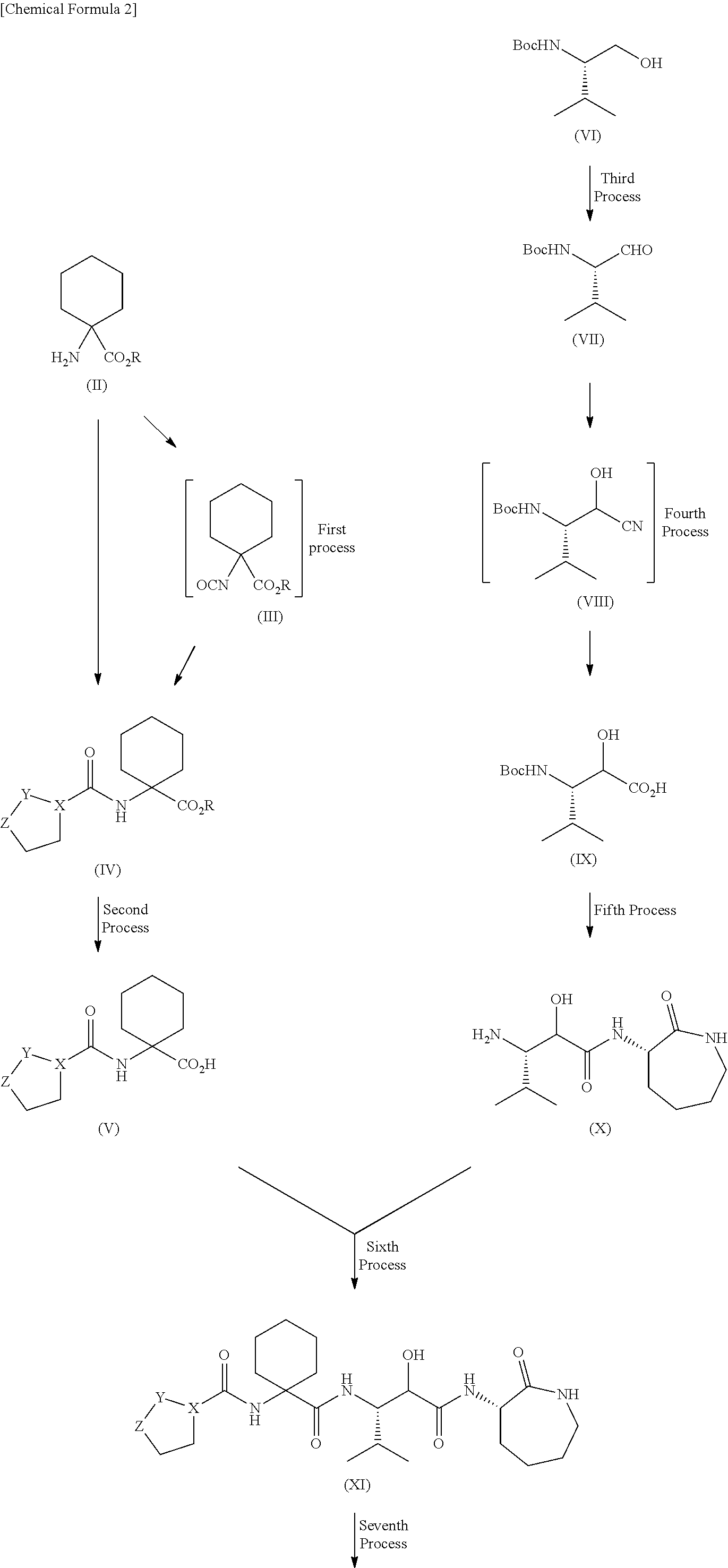
Production of 1-[(3-thiazolidinylcarbonyl)amino]cyclohexanecarboxylic acid

[0178]

(1) Production of 1-[(3-thiazolidinylcarbonyl)amino]cyclohexanecarboxylic acid benzyl ester

[0179]

[0180]At room temperature, 4-dimethylaminopyridine (1.90 g, 15.6 mmol) was added to a dichloromethane solution of benzyl 1-aminocyclohexanecarboxylate (36.48 g, 156 mmol) and di-tert-butyl dicarbonate (32.24 g, 148 mmol) and stirred for 40 minutes. Triethylamine (44.0 mL, 315 mmol) and thiazolidine (13.5 mL, 171 mmol) were added to the reaction mixture and further stirred at room temperature for 19 hours. The solvent was removed from the resulting reaction mixture by distillation in vacuo. After ethyl acetate was added to the residue, the mixture was washed with a saturated sodium hydrogen carbonate aqueous solution and brine. After the organic layer was dried over anhydrous sodium sulfate, the solvent was removed by distillation in vacuo. The resulting solid was washed with diethyl ether to give 49.60 g (91%...

production example 2

Production of (2R,3S)-3-amino-N-[(3S)-hexahydro-2-oxo-1H-azepin-3-yl]-2-hydroxy-4-methylpentanamide and (2S,3S)-3-amino-N-[(3S)-hexahydro-2-oxo-1H-azepin-3-yl]-2-hydroxy-4-methylpentanamide

[0189]

(1) Production of Boc-L-valinal

[0190]

[0191]Di-tert-butyl dicarbonate (211.6 g, 0.97 mol) was gradually added to a dichloromethane solution of L-valinol (100.0 g, 0.97 mol). The reaction mixture was stirred at room temperature overnight and then concentrated in vacuo. To the residue (crude Boc-L-valinol) were added N,N-diisopropylethylamine (51.7 g, 0.4 mol), 1 L of dry dimethyl sulfoxide, and 200 ml of dry dichloromethane. Under ice cooling, sulfur trioxide-pyridine (63.7 g, 0.4 mol) was gradually added to the liquid mixture and stirred at the same temperature for 1 hour. The reaction mixture was poured into ice-water and then extracted twice with ethyl acetate. The organic layer was washed with a 20% citric acid aqueous solution, a saturated sodium hydrogen carbonate aqueous solution, and b...

production example 3

Production of N-[1-[[[(1S,2S)-3-[[(3S)-hexahydro-2-oxo-1H-azepin-3-yl]amino]-2-hydroxy-1-(1-methylethyl)-3-oxopropyl]amino]carbonyl]cyclohexyl]-3-thiazolidinecarboxamide

[0212]

[0213]Under ice cooling, 1-ethyl-3-(3-dimethylaminopropyl)carbodiimide hydrochloride (47 g, 247 mmol) was added to an N,N-dimethylformamide solution of 1-[(3-thiazolidinylcarbonyl)amino]cyclohexanecarboxylic acid (55 g, 215 mmol), (2S,3S)-3-amino-N-[(3S)-hexahydro-2-oxo-1H-azepin-3-yl]-2-hydroxy-4-methylpentanamide (55 g, 215 mmol), triethylamine (109 g, 1.07 mol), and 1-hydroxybenzotriazole (36 g, 236 mmol). The liquid mixture was returned to room temperature and stirred overnight. The reaction mixture was diluted with dichloromethane. The dilution was washed with a 10% potassium hydrogen sulfate aqueous solution, a saturated sodium hydrogen carbonate aqueous solution, and brine. After the organic layer was dried over anhydrous sodium sulfate, the solvent was removed by distillation in vacuo, so that 78.8 g (7...

the structure of the environmentally friendly knitted fabric provided by the present invention; figure 2 Flow chart of the yarn wrapping machine for environmentally friendly knitted fabrics and storage devices; image 3 Is the parameter map of the yarn covering machine
Login to View More

PUM

PropertyMeasurementUnit
temperatureaaaaaaaaaa
Login to View More

Abstract

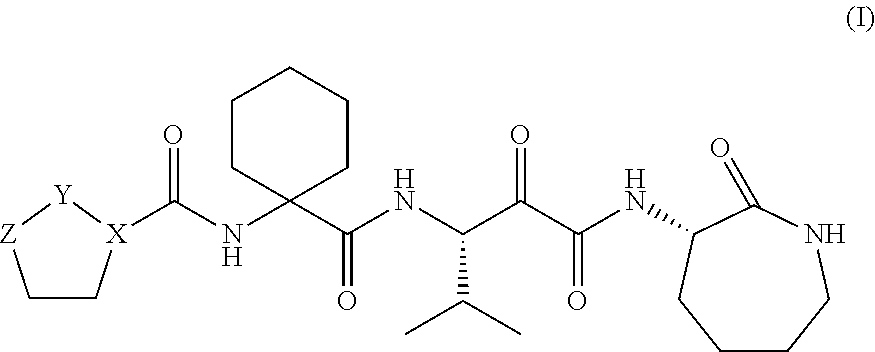
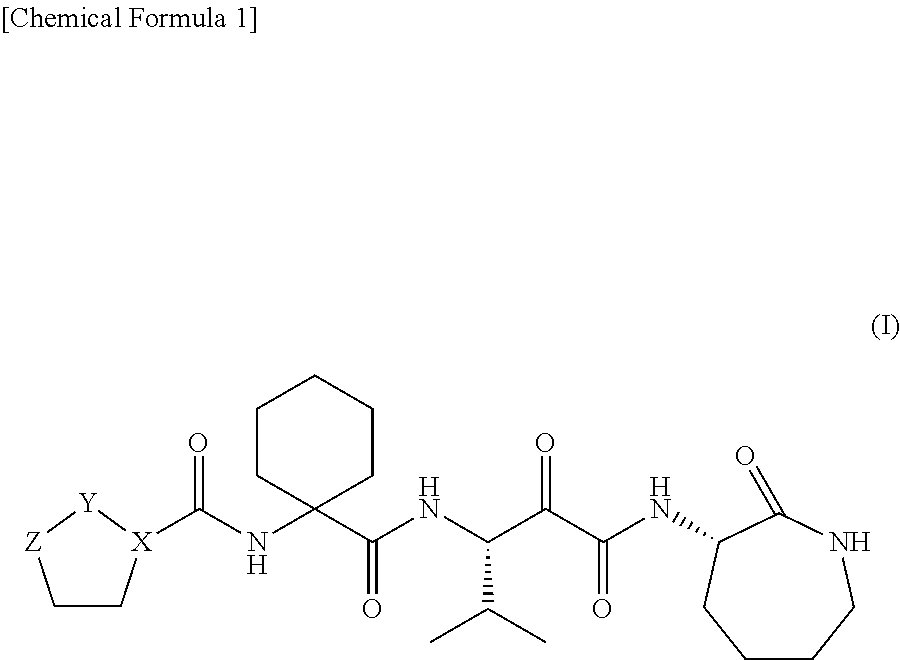
The purpose of the present invention is to provide a pharmaceutical composition that is useful for the treatment of diseases that are caused by an increase in bone resorption and that does not cause serious side effects even when used in combination with another drug. The present invention relates to: an α-oxoacyl amino-caprolactam that is represented by formula (I)(in formula (I), X represents N or CH, Y represents O or CH2, and Z represents S or CH2); and a bone resorption inhibitor containing the α-oxoacyl amino-caprolactam.

Description

RELATED APPLICATIONS[0001]This application is the U.S. national stage pursuant to 35 U.S.C. §371, of Japanese international application Ser. No. PCT / JP2014 / 003160, filed Jun. 13, 2014 and published in Japanese on Dec. 18, 2014 as publication WO2014 / 199645 A1, which claims the benefit of priority of Japanese Application No. 2013-125202, filed Jun. 14, 2013, which are hereby expressly incorporated by reference in their entirety.TECHNICAL FIELD[0002]The present invention relates to a novel α-oxoacylaminocaprolactam. Specifically, the present invention relates to an α-oxoacylaminocaprolactam having the effect of selectively inhibiting cathepsin K, which is the principal cysteine protease particularly involved in bone resorption.BACKGROUND ART[0003]In recent years, as the aging society rapidly develops, the number of patients with senile diseases, particularly, the number of patients with bone diseases has been steadily increasing. Among them, osteoporosis is a serious problem, which oft...

Claims

the structure of the environmentally friendly knitted fabric provided by the present invention; figure 2 Flow chart of the yarn wrapping machine for environmentally friendly knitted fabrics and storage devices; image 3 Is the parameter map of the yarn covering machine
Login to View More

Application Information

Patent Timeline
no application Login to View More
Patent Type & Authority Patents(United States)
IPC IPC(8): C07D417/12C07D405/12A61K31/55C07D223/12
CPCC07D417/12A61K31/55C07D223/12C07D405/12A61P3/04A61P3/12A61P3/14A61P19/00A61P19/02A61P19/08A61P19/10A61P25/00A61P29/00A61P35/00A61P35/04A61P43/00
Inventor KOBAYASHI, NOBUOKOJI, TSUNEOKUNII, HISATOMOISHIKAWA, MIZUHOMORITA, DAISUKE
Owner SEIKAGAKU KOGYO CO LTD