
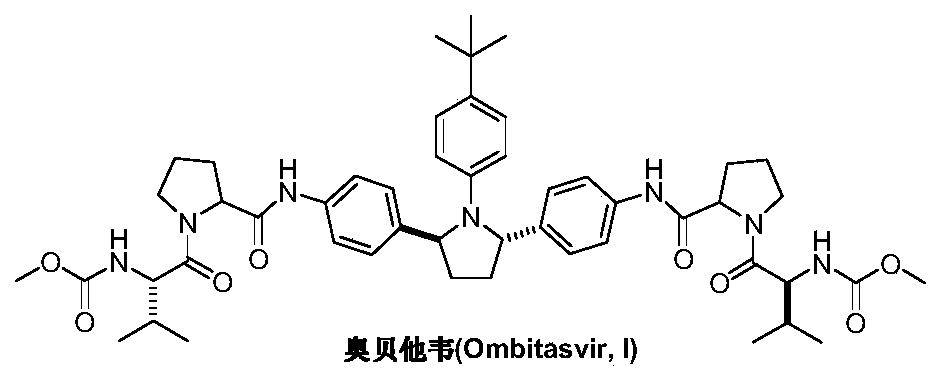
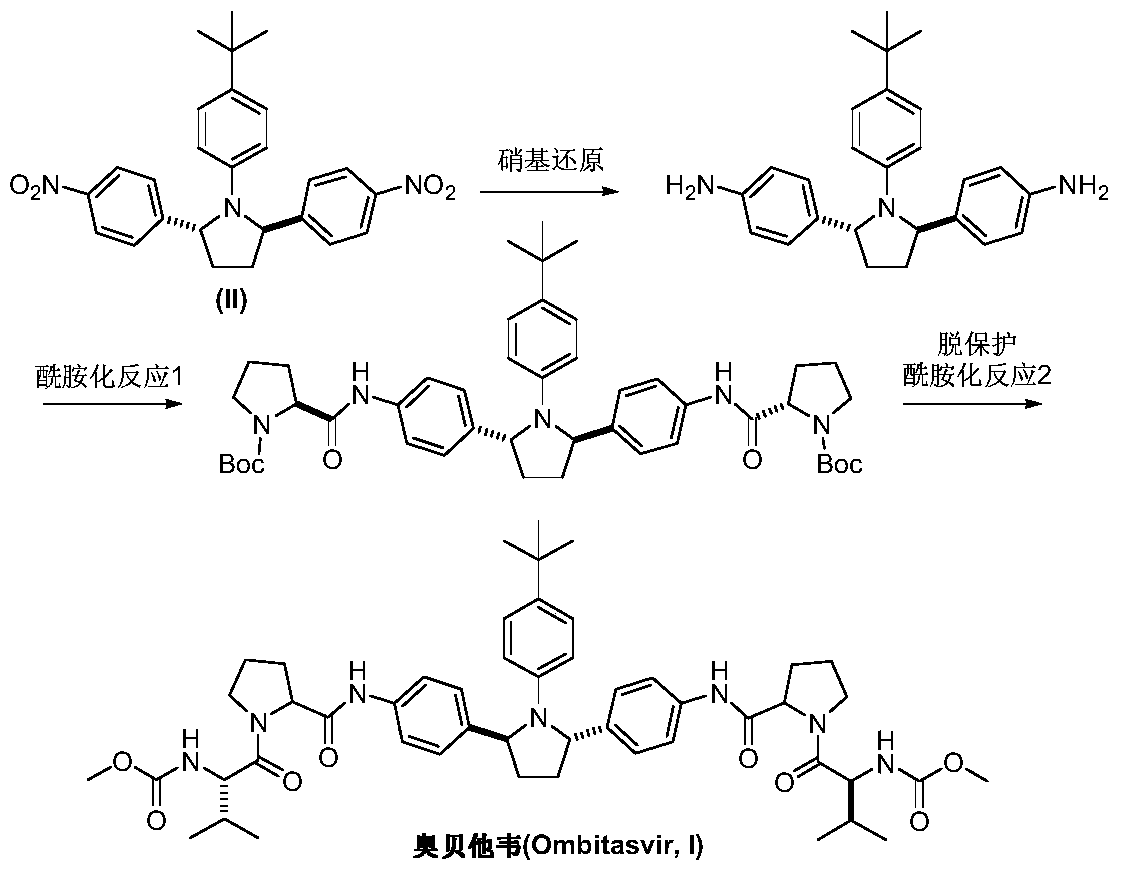
The preparation method of obetasvir
A technology for obettavir and preparation steps, which is applied in the field of preparation of a hepatitis C drug obettavir, can solve the problems of expensive chiral catalysts and chiral ligands, unfavorable industrialization and the like, and achieves the goal of promoting development and raw materials Easy to obtain, simple process effect
- Summary
- Abstract
- Description
- Claims
- Application Information
AI Technical Summary
Problems solved by technology
Method used
Image


Examples
Embodiment 1
[0045] Under nitrogen atmosphere, add (1R,3S,6S)-1-phenyl-3-(1-benzotriazolyl)-1H,6H-naphtho[1,2-e]pyrrole into a dry reaction flask Cyclo[2,1-b][1,3]oxazine (A) (4.2g, 10mmol) and 80mL of dry tetrahydrofuran were cooled to -10°C, and 4-nitrophenylmagnesium bromide (2.1 g, 40mmol) in tetrahydrofuran solution 20mL. The reaction was stirred at this temperature for 2-3 hours. The temperature was raised to 35-40° C., and the stirring reaction was continued for 3-4 hours. TLC detected that the reaction was complete. The reaction was quenched with 25 mL of saturated ammonium chloride, extracted three times with dichloromethane, the organic phases were combined, washed successively with 5% by mass sodium hydroxide solution and saturated brine, and dried over anhydrous magnesium sulfate. After concentration, the residue was recrystallized from ethanol to obtain off-white solid (R)-1-[α-(2S,5S)-bis(4-nitrophenyl)pyrrolidinyl)benzyl]-2-naphthol ( II) 4.6g, yield 84.4%, FAB-MS m / z: 54...
Embodiment 2
[0047] Add (R)-1-[α-(2S,5S)-bis(4-nitrophenyl)pyrrolidinyl)benzyl]-2-naphthol (II) (4.0g, 7.34mmol ), ceric ammonium nitrate (10.0g, 18.3mmol) and acetonitrile / water (volume ratio 2 / 1) mixed solvent 120mL, stirred at room temperature for 5-7 hours, TLC detection reaction ended. After filtering, the filtrate was adjusted to pH 8-9 with 10% sodium bicarbonate solution by mass percentage, extracted three times with dichloromethane, combined the organic phases, and dried over anhydrous sodium sulfate. Concentrate under reduced pressure, and recrystallize the residue with ethyl acetate / n-hexane (volume ratio 1 / 1) to obtain 2.0 g of yellow solid (2S, 5S)-bis(4-nitrophenyl)pyrrolidine (III). Yield 87.0%, EI-MS m / z: 314[M+H] + .
Embodiment 3
[0049] Under a nitrogen atmosphere, (2S, 5S)-bis(4-nitrophenyl)pyrrolidine(III) (1.6g, 5mmol), palladium acetate (28mg, 0.125mmol), tert-butyl Potassium alkoxide (0.84g, 7.5mmol) and dimethyl sulfoxide 25mL, stirred at room temperature for 30 minutes, added 4-tert-butylbromobenzene (1.17g, 5.5mmol), raised the temperature to 120°C, kept the temperature for 10- After 12 hours, TLC checked that the reaction was complete. Cool down, filter, add 50 mL of dichloromethane to the filtrate, wash the organic phase three times with water, dry over anhydrous sodium sulfate, and concentrate to obtain light yellow solid (2S,5S)-1-(4-tert-butylphenyl)-2,5 - Bis(4-nitrophenyl)pyrrolidine (IV) 1.7g, yield 76.4%, EI-MSm / z: 446[M+H] + .
PUM
 Login to View More
 Abstract
Description
Claims
Application Information
 Login to View More