Check patentability & draft patents in minutes with Patsnap Eureka AI!

Single ion polymer electrolyte and its preparation method and lithium ion battery

A polymer and single-ion technology, applied in the field of lithium-ion batteries, can solve the problems of graft modification without segment, unfavorable industrial scale production, high solution viscosity, etc., to improve service life and safety performance, and avoid mechanical strength reduction , Improve the effect of ionic conductivity

Active Publication Date: 2021-04-20
BYD CO LTD
View PDF4 Cites 0 Cited by
  • Summary
  • Abstract
  • Description
  • Claims
  • Application Information

AI Technical Summary

Problems solved by technology

However, due to its high crystallinity and poor mechanical properties, PEO-based solid electrolytes have problems such as low room temperature ionic conductivity and poor mechanical strength during use.
[0004] CN106992311A discloses to use plasticizer modified PEO directly as polymer base material, although ionic conductivity is improved to some extent, but its mechanical strength is low, can not effectively block when being used for the solid state electrolyte of the lithium ion battery of negative pole lithium metal Lithium dendrite; PEO-PMMA modified with plasticizer is used as polymer substrate, although PMMA with higher mechanical strength is added to PEO segment to prepare block copolymer, its mechanical strength is obtained when it is used in solid electrolyte However, the PEO-PMMA block copolymer has the following disadvantages: (1) Although the PMMA segment can reduce the crystallinity of the PEO segment and thereby improve the ionic conductivity of the polymer substrate, this block copolymerization method reduces the crystallinity The capacity of the degree is limited, and more effective methods are needed to further improve the ionic conductivity of the polymer substrate. (2) The PEO-PMMA block copolymer is a linear polymer. When the molecular weight of the polymer is high, the solution viscosity is large, which is not conducive to Processing and forming of polymer film
[0005] CN103165963A discloses an interpenetrating network polymer used as a polymer substrate, the interpenetrating network polymer reaches 6.06×10 -5 S / cm, but the interpenetrating network polymer has the following disadvantages: the interpenetrating network structure is easy to wrap unreacted monomers and initiators, which is not easy to remove, but these unreacted monomers and initiators are very easy to cause battery cycle The side reactions in the battery will reduce the cycle performance and life of the battery, etc.
[0006] CN103872377A discloses that multi-block copolymers are used as polymer substrates, the block polymers contain polyoxyethylene structural segments and do not contain polyoxyethylene structural segments, and the block polymers can contain polyoxyethylene segment content The co-continuous phase separation structure is obtained in a wider range, so that the ion conductivity and mechanical properties can be adjusted and taken into account, so that the overall performance of the polymer solid electrolyte is greatly improved, but the polymer substrate has the following disadvantages: (1) These multi-block polymers are linear polymers, and it is necessary to insert a segment that does not contain a polyoxyethylene structure into a segment of the polyoxyethylene structure to reduce the crystallinity of the polymer and adjust the ion conductivity.
However, due to the existence of the linear structure of the polymer, the number of blocks that do not contain polyoxyethylene structural segments can only be continuously increased as a means of regulation, and the ionic conductivity cannot be effectively regulated by one polymerization.
(2) The synthesis steps are relatively complicated, and the product is easily mixed with a macromolecular initiator. In order to obtain a pure reaction product, a complicated post-treatment purification process is required, and the yield is low, which is not conducive to industrial scale production
And the polymer of this invention does not carry out further graft modification to the segment of oxyethylene structure
[0007] In addition, traditional polymer electrolytes are dual-ion electrolytes that conduct both anion and cation simultaneously, and the migration number of lithium ions is low. During charge and discharge, anions will also gather at the electrode / electrolyte interface, resulting in concentration polarization. The addition of lithium salts to traditional solid-state electrolytes will also bring about a slight decrease in system mechanics

Method used

the structure of the environmentally friendly knitted fabric provided by the present invention; figure 2 Flow chart of the yarn wrapping machine for environmentally friendly knitted fabrics and storage devices; image 3 Is the parameter map of the yarn covering machine
View more

Image

Smart Image Click on the blue labels to locate them in the text.
Viewing Examples
Smart Image
  • Single ion polymer electrolyte and its preparation method and lithium ion battery
  • Single ion polymer electrolyte and its preparation method and lithium ion battery
  • Single ion polymer electrolyte and its preparation method and lithium ion battery

Examples

Experimental program
Comparison scheme
Effect test

Embodiment 1

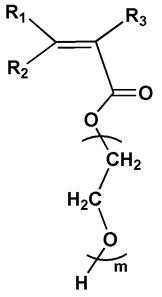
[0096] In this embodiment, the first monomer is polyethylene glycol methacrylate ( The number of repeating units m=19), the second monomer is polyethylene glycol methyl ether methacrylate ( The number of repeating units is y=19), and the third monomer is sodium methylpropanesulfonate.

[0097] Preparation of single-ion polymers

[0098] (1) Preparation of PEGMA

[0099] Under the protection of argon, in a closed reaction vessel, dissolve 10g of the first monomer, 10g of the second monomer and 0.0085g of AIBN in the NMP solvent and mix evenly, then perform at least three degassing operations to ensure that the system is anhydrous and oxygen-free environment, at 70 o C temperature reaction 8h, the end of the reaction. The product was precipitated in hexane, washed, and dried in vacuum for 24 hours to obtain PEGMA with a yield of 92%.

[0100] (2) Preparation of PEGMA-Br

[0101] at 0 o Under the temperature of ℃, the PEGMA of above-mentioned synthesis 15g and the trieth...

Embodiment 2

[0107] In this embodiment, the first monomer is polyethylene glycol methacrylate ( The number of repeating units m=32), the second monomer is polyethylene glycol methyl ether methacrylate ( The number of repeating units is y=28), and the third monomer is 2-acrylamide-2-methylpropanesulfonic acid.

[0108] Preparation of single-ion polymers

[0109] (1) Preparation of PEGMA

[0110] Under the protection of argon, in a closed reaction vessel, dissolve 14g of the first monomer, 6g of the second monomer and 0.0046g of AIBN in the NMP solvent and mix evenly, then perform at least three degassing operations to ensure that the system is anhydrous and oxygen-free environment, at 70 o C temperature reaction 8h, the end of the reaction. The product was precipitated in hexane, washed, and dried in vacuum for 24 hours to obtain PEGMA, weight average molecular weight.

[0111] (2) Preparation of PEGMA-Br

[0112] at 0 o Under the temperature of C, the PEGMA of 15g synthesized abov...

Embodiment 3

[0118] In this embodiment, the first monomer is polyethylene glycol methacrylate ( The number of repeating units m=9), the second monomer is polyethylene glycol methyl ether methacrylate ( The number of repeating units is y=9), and the third monomer is sodium styrene sulfonate.

[0119] Preparation of single-ion polymers

[0120] (1) Preparation of PEGMA

[0121] Under argon protection, in a closed reaction vessel, after dissolving 6g of the first monomer, 14g of the second monomer and 0.0317g of AIBN in a dioxane solvent and mixing them uniformly, perform at least three degassing operations to ensure that the system is free of In an oxygen-free water environment, react at a temperature of 70° C. for 8 hours to end the reaction. The product was precipitated in hexane, washed, and dried in vacuum for 24 hours to obtain PEGMA with a yield of 89%.

[0122] (2) Preparation of PEGMA-Br

[0123] At a temperature of 0°C, 15 g of PEGMA synthesized above was reacted with 0.0037...

the structure of the environmentally friendly knitted fabric provided by the present invention; figure 2 Flow chart of the yarn wrapping machine for environmentally friendly knitted fabrics and storage devices; image 3 Is the parameter map of the yarn covering machine
Login to View More

PUM

PropertyMeasurementUnit
molecular weight distributionaaaaaaaaaa
Login to View More

Abstract

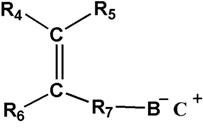
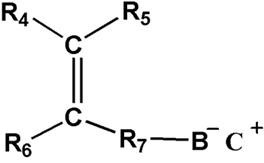
The invention provides a single ion polymer electrolyte, a preparation method thereof and a lithium ion battery. The structural formula of the single-ion polymer electrolyte is, wherein, R1-R6, R8-R10 are selected from one of H and C1-C10 alkyl groups; R7C1-C10 alkyl groups, C1-C10 alkoxy groups, One of C1-C10 amidoalkyl and phenyl; R11 is selected from C1-C5 alkyl or phenyl; B is selected from sulfonic acid group, sulfonimide group, imide group and One of the carboxylic acid groups; A is ‑(C=O)‑(CH 3 ) 2 C‑; n, x=10‑2500, m, y=2‑40, p=1‑500, q=1‑200, n, m, p, x, and y are integers. Single-ion polymer electrolytes have high mechanical strength and ionic conductivity. The service life and safety performance of the battery containing the polymer electrolyte are improved.

Description

technical field [0001] The invention relates to the field of lithium ion batteries, in particular to a polyelectrolyte, a preparation method thereof and a lithium ion battery. Background technique [0002] With the continuous improvement of the energy density of lithium-ion batteries, traditional graphite materials (theoretical specific capacity is only 372mAh / g) are far from meeting people's needs. People have successively developed a variety of high specific capacity negative electrode materials. Among them, The specific capacity of the metal lithium negative electrode is 3860mAh / g, and the potential is 3.04V (vs standard hydrogen electrode), which is very suitable for use as a battery negative electrode. Relevant scholars have calculated that if the graphite negative electrode in a lithium-ion battery is replaced by a metallic lithium negative electrode, The specific energy can reach 440Wh / kg, which is almost twice that of the existing lithium-ion battery. However, the me...

Claims

the structure of the environmentally friendly knitted fabric provided by the present invention; figure 2 Flow chart of the yarn wrapping machine for environmentally friendly knitted fabrics and storage devices; image 3 Is the parameter map of the yarn covering machine
Login to View More

Application Information

Patent Timeline
no application Login to View More
Patent Type & Authority Patents(China)
IPC IPC(8): C08F265/04C08F228/02C08F220/06C08F220/28C08F8/20C08F8/44H01M10/0565H01M10/0525
CPCC08F8/20C08F8/44C08F220/28C08F265/04H01M10/0525H01M10/0565H01M2300/0082C08F228/02C08F220/06Y02E60/10
Inventor 李婷婷刘荣华高磊单军
Owner BYD CO LTD
Features
  • R&D
  • Intellectual Property
  • Life Sciences
  • Materials
  • Tech Scout
Why Patsnap Eureka
  • Unparalleled Data Quality
  • Higher Quality Content
  • 60% Fewer Hallucinations
Social media
Patsnap Eureka Blog
Learn More