Check patentability & draft patents in minutes with Patsnap Eureka AI!

Cycloaliphatic epoxy compound and preparation method and application thereof

A cycloaliphatic epoxy and compound technology, applied in the field of compound preparation, can solve the problems of poor mechanical properties and processing properties, lack of chemical resistance, microcircuit corrosion, etc.

Inactive Publication Date: 2012-08-22
GUANGZHOU CHEM CO LTD CHINESE ACADEMY OF SCI
View PDF1 Cites 2 Cited by
  • Summary
  • Abstract
  • Description
  • Claims
  • Application Information

AI Technical Summary

Problems solved by technology

[0005] However, when the above four kinds of epoxy resins for encapsulation are applied to electronic packaging materials, there are many deficiencies.
For example, epoxy resin contains aromatic groups, which cannot well resist carbonization and ultraviolet light irradiation under the action of electric arc; the reason for the condensation of epichlorohydrin and phenol in the preparation process itself leads to the existence of a very small amount of chlorine in the material, which will cause adverse reactions. Corrosion of microcircuits; or due to the lack of outstanding chemical resistance, impact resistance, mechanical properties and processing properties in the resin, it cannot be well applied to epoxy varieties that meet the development of integrated circuit packaging

Method used

the structure of the environmentally friendly knitted fabric provided by the present invention; figure 2 Flow chart of the yarn wrapping machine for environmentally friendly knitted fabrics and storage devices; image 3 Is the parameter map of the yarn covering machine
View more

Image

Smart Image Click on the blue labels to locate them in the text.
Viewing Examples
Smart Image
  • Cycloaliphatic epoxy compound and preparation method and application thereof
  • Cycloaliphatic epoxy compound and preparation method and application thereof
  • Cycloaliphatic epoxy compound and preparation method and application thereof

Examples

Experimental program
Comparison scheme
Effect test

Embodiment 1

[0079] When reaction starting raw material is limonene and aliphatic glycol, the preparation method of cycloaliphatic epoxy compound is as follows:

[0080] (1) 10mmol limonene, 11mmol 1,4-butanediol and 2.0mmol iron trichloride were added to 45mL chloroform solvent cooled in an ice bath, heated to 25°C after magnetic stirring for 60 minutes, passed through a developing agent (by Petroleum ether: ethyl acetate is composed of 3:1 by volume) TLC monitors the reaction process until the raw material disappears on the TLC thin-layer plate or no longer decreases, adding water to terminate the reaction, extracting the aqueous layer with dichloromethane, combining the organic layers, and reducing The solvent was distilled off under pressure; the product was purified by column chromatography (eluent: petroleum ether: ethyl acetate in a volume ratio of 3:1).

[0081] The resulting product is detected by nuclear magnetic resonance, and the obtained data are as follows: 1 HNMR (400MHz, C...

Embodiment 2

[0094] When reaction starting raw material is limonene and aliphatic glycol, the preparation method of cycloaliphatic epoxy compound is as follows:

[0095] (1) 10mmol limonene, 13mmol 1,3-propanediol and 2.5mmol ferric trichloride are added in the 50mL acetonitrile solvent that the ice bath cools down, and the gained mixed solution is magnetically stirred for 30 minutes and then warmed up to 35°C, passed through the developing agent (by Petroleum ether: ethyl acetate by volume ratio 3: 1 composition) TLC monitors the reaction process. When the raw material disappears on the TLC thin-layer plate or no longer decreases, water is added to terminate the reaction. The aqueous layer is extracted with dichloromethane, and the organic layer is combined. The solvent was distilled off; the product was purified by column chromatography (eluent: petroleum ether: ethyl acetate at a volume ratio of 5:1).

[0096] The resulting product is detected by nuclear magnetic resonance, and the obta...

Embodiment 3

[0109] When reaction starting raw material is limonene and cycloaliphatic olefin monohydric alcohol, the preparation method of cycloaliphatic epoxy compound is as follows:

[0110] (1) 10mmol limonene, 10mmol cyclohexene alkyl alcohol and 2.0mmol anhydrous ferric trichloride were added to 45mL methylene chloride solvent cooled in an ice bath, and the temperature was raised to 45°C after magnetic stirring for 40 minutes, and the developer ( Composed of petroleum ether: ethyl acetate in a volume ratio of 4:1) TLC monitors the reaction process until the raw material disappears on the TLC thin layer plate or no longer decreases, adding water to terminate the reaction, extracting the water layer with dichloromethane, combining the organic layers, and The residual solvent in the organic layer was distilled off under reduced pressure, and the obtained crude product was purified with a column chromatography eluent (petroleum ether: ethyl acetate in a volume ratio of 3:1);

[0111] The...

the structure of the environmentally friendly knitted fabric provided by the present invention; figure 2 Flow chart of the yarn wrapping machine for environmentally friendly knitted fabrics and storage devices; image 3 Is the parameter map of the yarn covering machine
Login to View More

PUM

No PUM Login to View More

Abstract

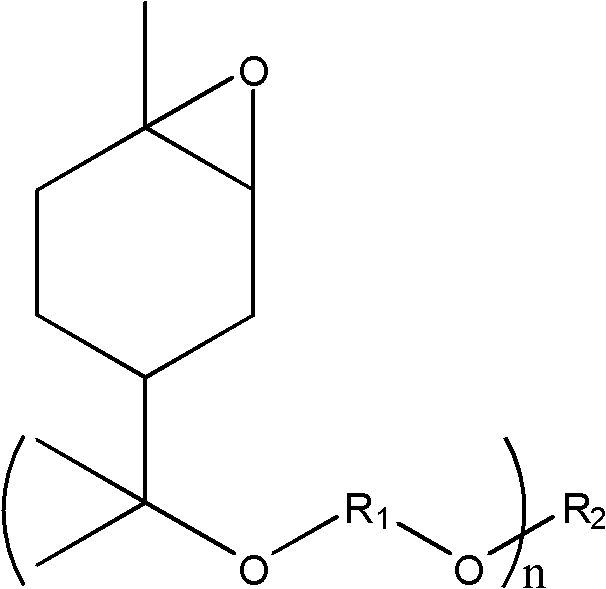
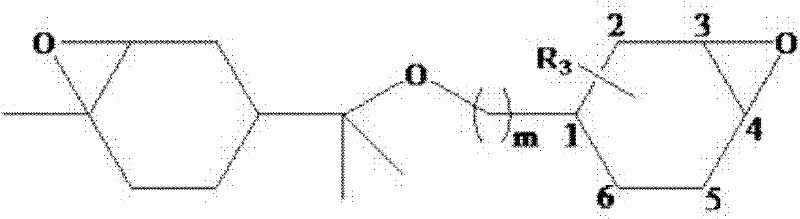
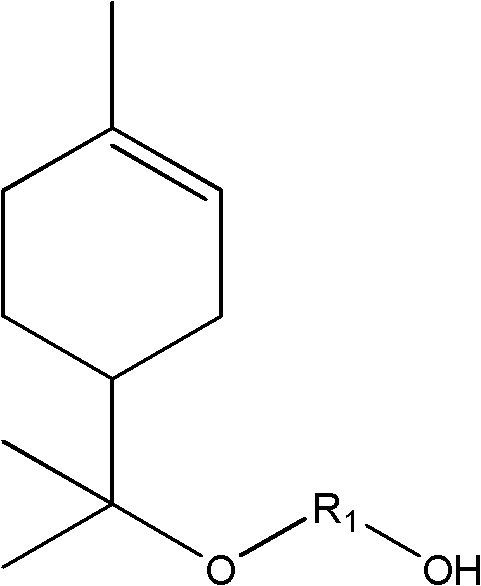
The invention discloses a cycloaliphatic epoxy compound and a preparation method and an application thereof. The cycloaliphatic epoxy compound is prepared from a natural product-limonene, the limonene is introduced into the cycloaliphatic epoxy compound by a cyclic structure on the limonene, and when a reaction initiator is aliphatic dibasic alcohol, the limonene is alcoholized with aliphatic dihydric alcohol hydroxyl and then esterified with cyclic anhydride, and finally the cycloaliphatic epoxy compound is prepared through epoxidation reaction; and when the reaction initiator is cycloaliphatic olefin monohydric alcohol, the limonene is esterified with the cycloaliphatic olefin monohydric alcohol, and finally the cycloaliphatic epoxy compound is prepared through the epoxidation reaction. The cycloaliphatic epoxy compound is prepared by epoxidizing cycloaliphatic olefin with organic peroxy acid, and does not contain organic chloride, inorganic chloride, other inorganic ions or aromatic groups, a microcircuit can be protected when the cycloaliphatic epoxy compound is applied to electronic packaging material, carbonization and ultraviolet irradiation can be well resisted under arcing, and the cycloaliphatic epoxy compound is prepared from the natural product-limonene, the pollution is low, and the material is simple and easy to obtain.

Description

technical field [0001] The invention belongs to the field of compound preparation, in particular to an alicyclic epoxy compound and its preparation method and application. Background technique [0002] Compared with metal and ceramic electronic packaging materials, polymer packaging materials have excellent electrical insulation, light weight, low cost, small expansion coefficient, good dielectric properties, easy processing, suitable for large-scale production, thermal conductivity and reliability, etc. advantage. Polymer encapsulation materials are divided into thermoplastic polymer encapsulation materials and thermosetting polymer encapsulation materials. Polymer packaging materials are mainly thermosetting polymers, including phenolic resins, polyesters, epoxy resins and silicone polymers, among which epoxy resins are the most widely used. [0003] Epoxy resin has excellent electrical insulation, heat resistance, water resistance, adhesiveness, chemical resistance and ...

Claims

the structure of the environmentally friendly knitted fabric provided by the present invention; figure 2 Flow chart of the yarn wrapping machine for environmentally friendly knitted fabrics and storage devices; image 3 Is the parameter map of the yarn covering machine
Login to View More

Application Information

Patent Timeline
no application Login to View More
IPC IPC(8): C07D303/40C07D303/28C07D301/14H01L23/29
Inventor 许凯郭莹陈鸣才蔡华轮刘新付子恩
Owner GUANGZHOU CHEM CO LTD CHINESE ACADEMY OF SCI
Features
  • R&D
  • Intellectual Property
  • Life Sciences
  • Materials
  • Tech Scout
Why Patsnap Eureka
  • Unparalleled Data Quality
  • Higher Quality Content
  • 60% Fewer Hallucinations
Social media
Patsnap Eureka Blog
Learn More