[0030]More preferable conditions for taking the full
advantage of the invention are (a) the average particle
diameter of 7 μm to 15 μm inclusive as measured by a
laser diffraction scattering method, and (b) the
particle size distribution as measured by a laser
diffraction scattering method, in which distribution the ratio of particles having a particle diameter of less than 3 μm is 2% to 7% inclusive. To make sure the long-term reliability of the negative electrode, the
amorphous carbon material should also preferably have a
weight change of less than 3% by
mass after 50 hours in an environment having a temperature of 40° C. and a
humidity of 90%. Weight changes exceeding 3% by mass are not preferable, because there is much
moisture adsorbed to the amorphous carbon material, incurring degradation of the negative electrode and a decrease in the service life of the battery. A more preferable condition for taking the full
advantage of the invention is (c) the
weight change of less than 2% by mass after 50 hours in an environment having a temperature of 40° C. and a
humidity of 90%.
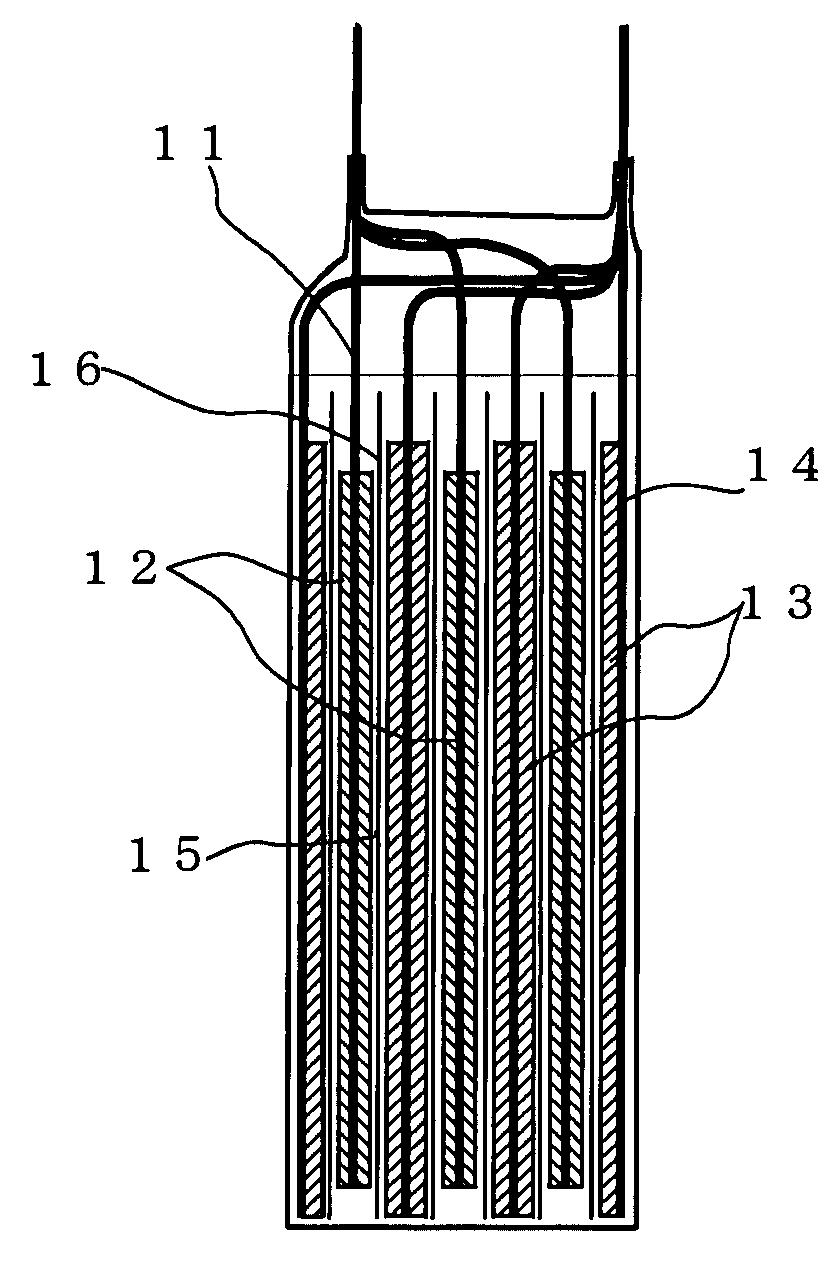
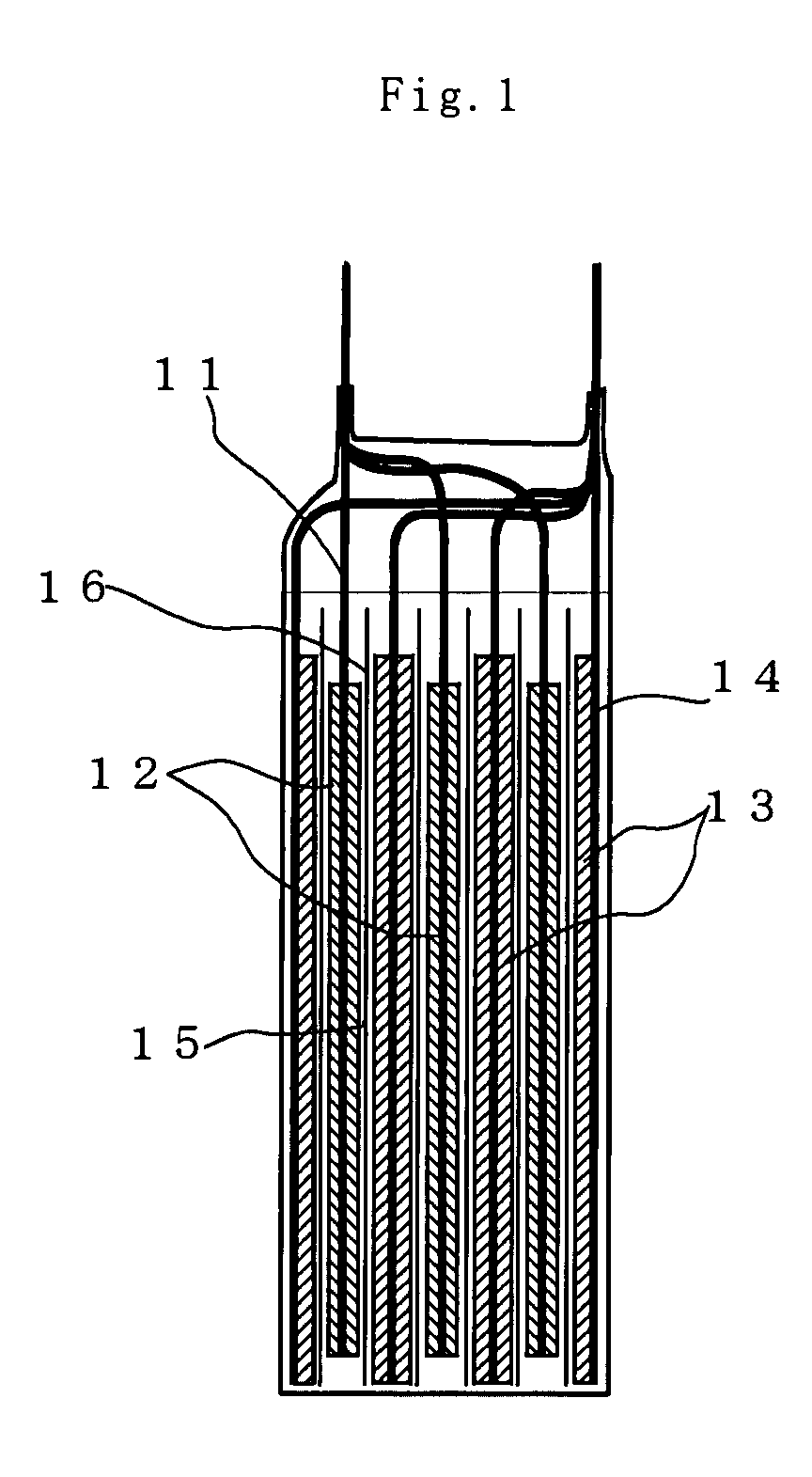
[0032]For an
electrolysis solution 15, an aprotic
solvent having an
electrolyte dissolved in it may be used. In the case of a lithium ion secondary battery, a lithium salt used for the
electrolyte is dissolved in the aprotic
solvent. For the lithium salt, shows
lithium imide salt, LiPF6, LiAsF6, LiAlCl4, LiClO4, LiBF4 and LiSbF6, among which LiPF6, and LiBF4 is most preferable. For the
lithium imide salts, there is the mention of LiN(CkF2k+1SO2) (CmF2m+1SO2) where k, and m is independently 1 or 2. These may be used alone or in combination of two or more.
[0033]The aprotic solvent used here, for instance, includes at least one of organic solvents such as cyclic carbonates, chain carbonates, aliphatic
carboxylic acid esters, γ-lactones, cyclic ethers and chain ethers as well as their
fluoride derivatives. More specifically, use is made of cyclic carbonates such as
propylene carbonate (PC),
ethylene carbonate (EC), butylene
carbonate (BC) and their derivatives; chain carbonates such as
dimethyl carbonate (DMC),
diethyl carbonate (DEC), ethyl
methyl carbonate (EMC), dipropyl
carbonate (DPC) and their derivatives; aliphatic
carboxylic acid esters such as
methyl formate,
methyl acetate,
ethyl propionate and their derivatives; γ-lactones such as γ-butylolactone and their derivatives; chain ethers such as 1,2-ethoxyethane (DEE), ethoxymethoxyethane (EME),
diethyl ether, and their derivatives; cyclic ethers such as
tetrahydrofuran, and 2-methyltetrahydrofuran; dimethysulfoxide; 1,3-dioxolan;
formamide;
acetamide;
dimethylformamide; dioxolan;
acetonitrile; propylnitrile;
nitromethane; ethyl monoglime;
phosphoric acid triester; trimethoxymethane; dioxolan derivatives;
sulfolane; methylsulfolane; 1,3-dimethyl-2-
imidazolidinone; 3-methyl-2-oxazolidinone;
propylene carbonate derivatives;
tetrahydrofuran derivatives; ethyl
ether; 1,3-
propanesultone,
anisole; N-methylpyrrolidone; and fluorinated
carboxylic acid esters, which may be used alone or in admixture of two or more.
[0034]Further,
vinylene carbonate (VC), etc. may be added as an additive to the electrolysis solution.
[0035]The lithium ion secondary battery according to the invention may be configured in various forms such as cylindrical, prismatic,
coin and laminated forms. Of these, the laminated type battery is sealed up with a film wrap made up of a flexible film having a laminated structure of a
synthetic resin and a
metal foil, so that its weight can be reduced. It is thus possible to use a film wrap made of a flexible film so as to improve the
energy density of the battery.
[0036]The lithium ion secondary battery according to the invention is obtained by laminating the negative electrode layer 13 and the positive electrode layer 12 or winding them, via the separator 16, in a dry air or
inert gas
atmosphere, inserting them a film wrap, impregnating them with an electrolysis solution, and sealing up the film wrap.EXAMPLES


 Login to View More
  Login to View More