
Soluble Recombinant Influenza Antigens
a technology of recombinant influenza and antigens, which is applied in the field of soluble recombinant influenza antigen production, can solve the problems of increasing or the transmission to humans of a subtype endemic in animals, and the risk of the emergence of a new subtype or the transmission of a subtype to humans, and achieves high production costs, high expression levels and yields
- Summary
- Abstract
- Description
- Claims
- Application Information
AI Technical Summary
Benefits of technology
Problems solved by technology
Method used
Image

Examples
example 1
rHA Strategy
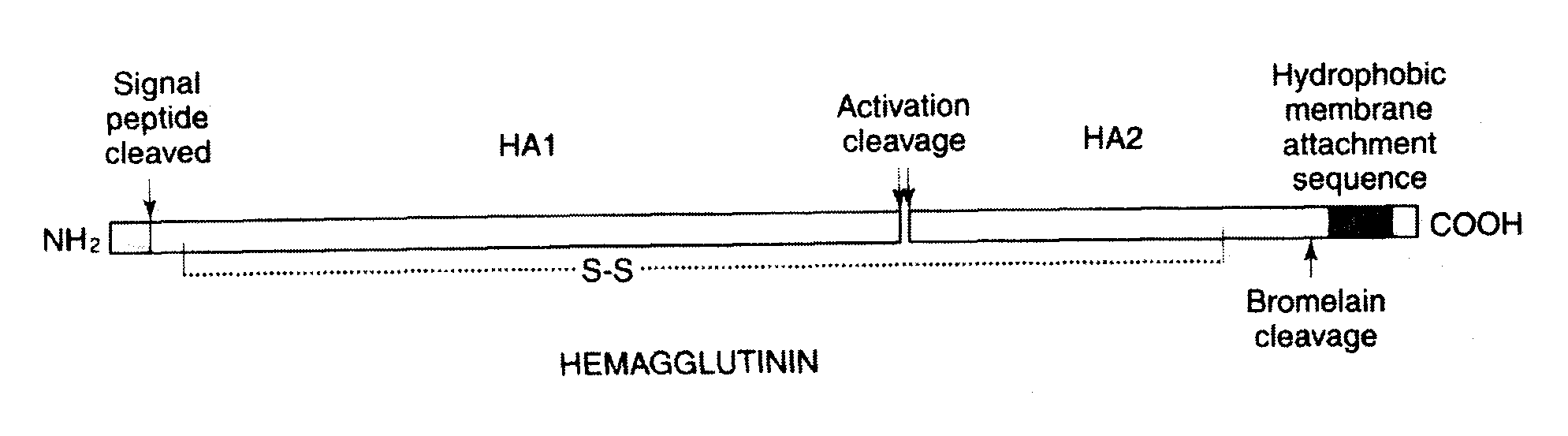
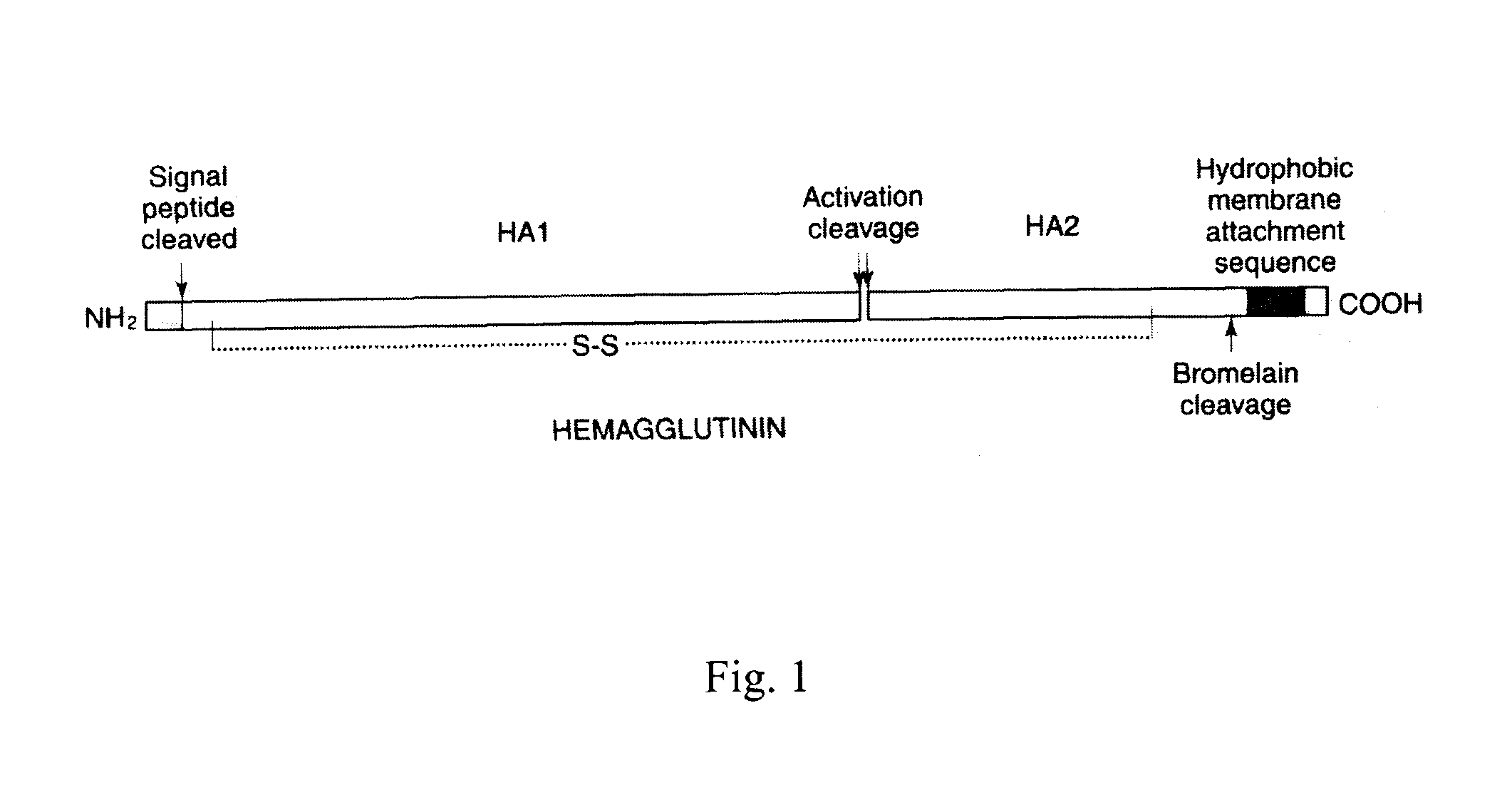
[0080]The HA chosen to exemplify the present invention was obtained from influenza strain A / New Caledonia / 20 / 99 (H1N1). The A / New Caledonia / 20 / 99 HA has been well characterized and immunodetection tools are commercially available. As the three-dimensional structures of all HAs are well conserved, the present expression strategy can directly apply to any other HA.
[0081]The expression of rHA was directed to the ER and the secretory pathway using the signal peptide of the alfalfa PDI (SEQ ID NO:3). This signal peptide was fused directly to the N-terminal primary sequence of mature rHA (FIG. 4; SEQ ID NO:8). The theoretical cleavage of the signal peptide from mature rHA with the PDI signal peptide was verified using the SignalP server 3.0.
[0082]rHA can be retained in the ER using the SEKDEL (SEQ ID NO:4) or the HDEL (SEQ ID NO:5) retention signals, both fused to the C-terminal end of rHA protein sequence.
[0083]When the GCN4-pII peptide was used as the oligomerization domain...
example 2
Gene Synthesis
[0094]The eight different gene constructs described in Example 1 were synthesized. The wild-type nucleotide sequence of HA from influenza strain A / New Caledonia / 20 / 99 was only modified to insert or remove restriction sites to facilitate the cloning steps. These minor modifications in the gene sequence did not change the resulting amino acid sequence of the protein. The HA0 gene was synthesized with an ApaI restriction site at the 5′-end, in phase with the ATG of the PDI signal peptide. The 7 other genes bear a KpnI restriction site at their 5′-end. Every gene ends at the 3′ end with a stop codon (TAA), followed by a SacI and a StuI restriction sites. According to the designed cloning strategy, the following restriction sites were design to be unique in the final plasmid: ApaI, BstZ17 I, Sac I, Kpn I, Bgl II, and Stu I. The different gene fragments were synthesized at the Plant Biotechnology Institute and were delivered cloned into pUC18. Selected nucleotide sequence i...
example 3
Transient Expression of rHA in Tobacco
[0101]Agrobacterium growth. The Agrobacterium clones containing a binary vector bearing rHA DNA constructs (Table 1) were grown for 24 hours at 28° C. in 2 mL of YEB or LB medium containing 25 and 50 μg / mL of each carbenicilin and kanamycin, respectively. 10 μL of these cultures were used as starting inoculums to generate cultures of 25 mL of YEB induction medium (YEB medium, 10 mM 2 (N morpholino) ethanesulfonic acid (MES), pH adjusted to 5.6, 25 mg / L carbenicillin, 50 mg / L kanamycin, 20 μM acetosyringone). The latter were grown in rotary shaker (220 rpm) incubator at 28° C. for 18 hours or until an optical density at 600 nm (OD600) of 0.8 to 1 was reached.
[0102]Growth of non-transgenic tobacco. Nicotiana benthamiana and Nicotiana tabacum plants were grown from seeds in a peat-based substrate (AgroMix) in a greenhouse. Seedlings were initially raised in a nursery and later transplanted to pots. Plants were irrigated twice a day and receive 180...
PUM
| Property | Measurement | Unit |
|---|---|---|
| Tm | aaaaa | aaaaa |
| PDI | aaaaa | aaaaa |
| optical density | aaaaa | aaaaa |
Abstract
Description
Claims
Application Information
 Login to View More