Sulfonium salt, photo-acid generator, and photosensitive resin composition

a technology of photoacid generator and sulfonium salt, which is applied in the direction of photosensitive materials, instruments, group 3/13 element organic compounds, etc., can solve the problems of low sensitivity to the i-line (365 nm), low storage stability of resist composition, and failure to cure, etc., to achieve excellent photosensitivity, excellent storage stability, and high compatibility

a technology of photoacid generator and sulfonium salt, which is applied in the direction of photosensitive materials, instruments, group 3/13 element organic compounds, etc., can solve the problems of low sensitivity to the i-line (365 nm), low storage stability of resist composition, and failure to cure, etc., to achieve excellent photosensitivity, excellent storage stability, and high compatibility

US20110300482A1Active Publication Date: 2011-12-08SAN APRO

Image

Smart Image Click on the blue labels to locate them in the text.
Viewing Examples
Smart Image
  • Sulfonium salt, photo-acid generator, and photosensitive resin composition
  • Sulfonium salt, photo-acid generator, and photosensitive resin composition
  • Sulfonium salt, photo-acid generator, and photosensitive resin composition

Examples

Experimental program
Comparison scheme
Effect test

production example 1

Synthesis of 4-(phenylthio)biphenyl

[0283]Uniformly mixed were 3.0 parts of 4-bromobiphenyl, 1.7 parts of thiophenol, 2.5 parts of sodium tert-butoxide, 0.15 parts of tetrakis(triphenylphosphine)palladium, and 64.3 parts of 1-butanol, and allowed to react at 120° C. for 2 hours. The reaction solution was cooled to room temperature (about 25° C.) and then filtered. The filtrate was transferred to a rotary evaporator, and the solvent was removed by distillation, so that a red-brown, crystalline product was obtained. The product was dissolved in 70 parts of dichloromethane, and 50 parts of an aqueous saturated sodium hydrogen carbonate solution was added thereto. After washing three times by liquid-liquid separation, the dichloromethane layer was washed with 70 parts of distilled water until the pH became neutral. The dichloromethane layer was transferred to a rotary evaporator, and the solvent was removed by distillation, so that a brown, crystalline product was obtained. Twenty parts ...

production example 2

Synthesis of a Mixture Containing 4-[(phenyl)sulfinyl]biphenyl and 4-(phenylthio)biphenyl

[0284]Uniformly mixed were 2.0 parts of 4-(phenylthio) biphenyl synthesized in Production Example 1, 8.0 parts of acetonitrile, 0.037 parts of sulfuric acid, and 0.43 parts of an aqueous 30% hydrogen peroxide solution, and allowed to react at 65° C. for 3 hours. After the reaction solution was cooled to room temperature (about 25° C.), 30 parts of dichloromethane was added, and washing by liquid-liquid separation was performed with 40 parts of distilled water until the pH became neutral. The dichloromethane layer was transferred to a rotary evaporator, and the solvent was removed by distillation, so that a brown liquid mixture containing 55% of 4-[(phenyl)sulfinyl]biphenyl and 45% of 4-(phenylthio)biphenyl. The product was isolated by column chromatography (eluent: ethyl acetate / hexane=1 / 1 in volume ratio) and then identified by 1H-NMR. The 1H-NMR data for 4-[(phenyl)sulfinyl]biphenyl: {d6-dimet...

production example 3

Synthesis of 4-[(2-methylphenyl)thio]biphenyl

[0285]Brown crystalline 4-[(2-methylphenyl)thio]biphenyl was obtained in a yield of 89% as in Production Example 1, except that “1.7 parts of thiophenol” was replaced with “1.8 parts of 2-methylthiophenol”. The product was identified by 1H-NMR {d6-dimethylsulfoxide, δ (ppm) 7.6-7.7 (4H, m), 7.3-7.5 (9H, m), 2.3 (3H, s)}.

the structure of the environmentally friendly knitted fabric provided by the present invention; figure 2 Flow chart of the yarn wrapping machine for environmentally friendly knitted fabrics and storage devices; image 3 Is the parameter map of the yarn covering machine
Login to View More

PUM

PropertyMeasurementUnit
thicknessaaaaaaaaaa
wavelengthaaaaaaaaaa
emission wavelengthaaaaaaaaaa
Login to View More

Abstract

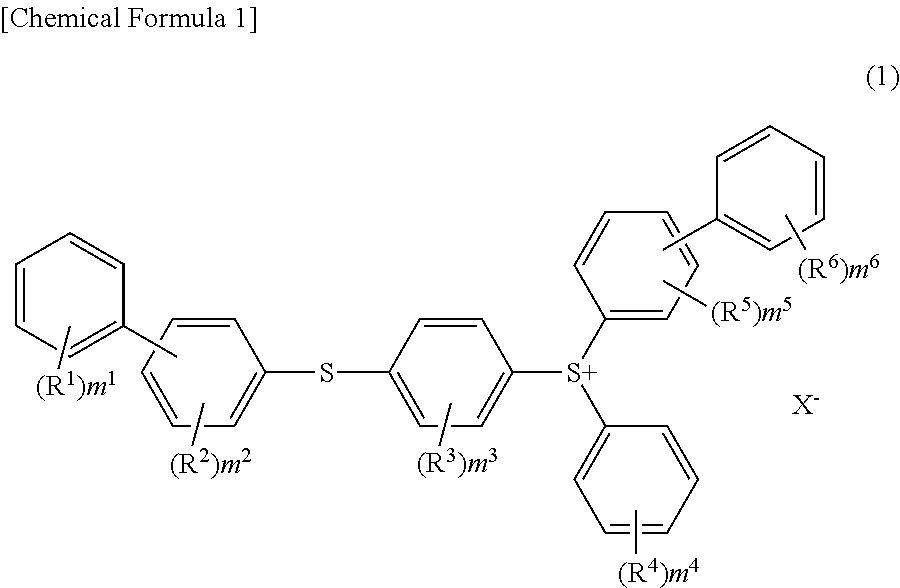
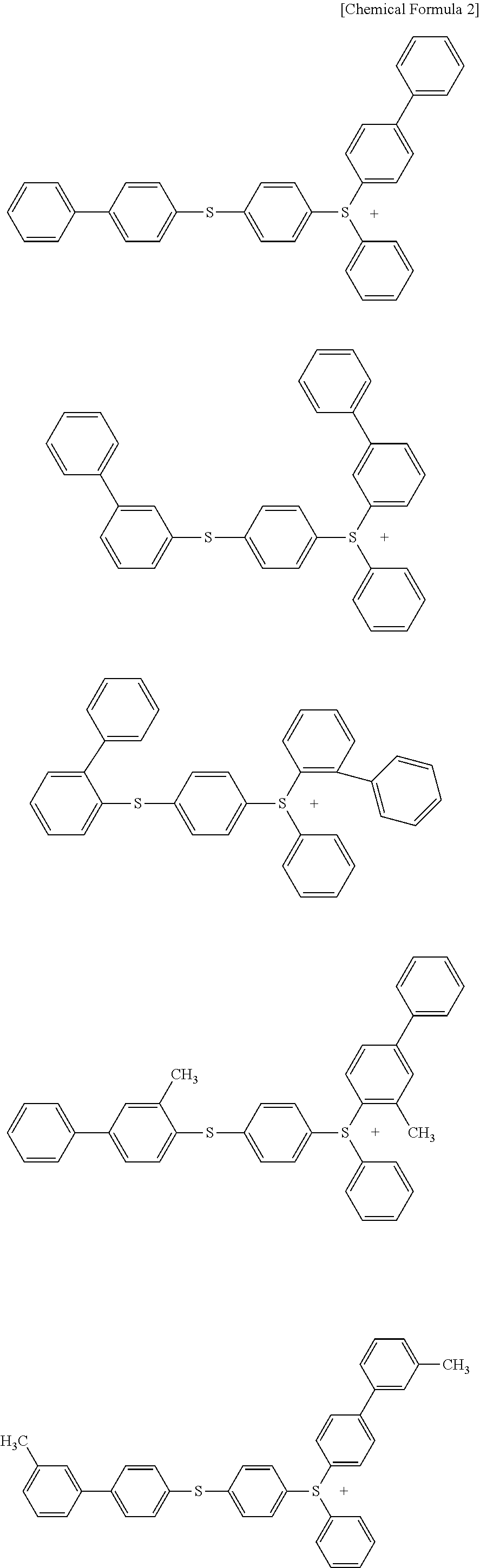
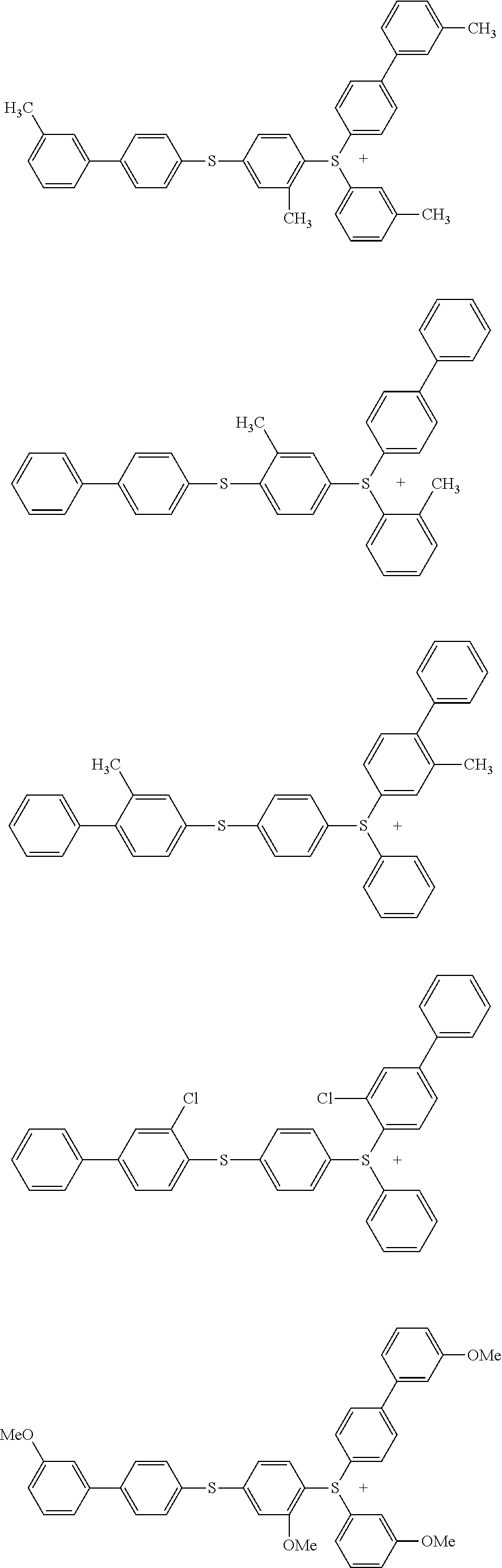
There is provided a sulfonium salt having high photosensitivity to the i-line. The invention relates to a sulfonium salt represented by formula (1) described below: [in formula (1), R1 to R6 each independently represent an alkyl group, a hydroxy group, an alkoxy group, an alkylcarbonyl group, an arylcarbonyl group, an alkoxycarbonyl group, an aryloxycarbonyl group, an arylthiocarbonyl group, an acyloxy group, an arylthio group, an alkylthio group, an aryl group, a heterocyclic hydrocarbon group, an aryloxy group, an alkylsulfinyl group, an arylsulfinyl group, an alkylsulfonyl group, an arylsulfonyl group, a hydroxy(poly) alkyleneoxy group, an optionally substituted amino group, a cyano group, a nitro group, or a halogen atom, m1 to m6 each represent the number of occurrences of each of R1 to R6, m1, m4, and m6 each represent an integer of 0 to 5, m2, m3, and m5 each represent an integer of 0 to 4, and X− represents a monovalent polyatomic anion].

Description

TECHNICAL FIELD[0001]The invention relates firstly to a sulfonium salt and secondly to a photo-acid generator, more specifically, a photo-acid generator containing a specific sulfonium salt suitable for curing a cationically polymerizable compound by the action of an active energy ray such as light, an electron beam, or an X-ray. The invention relates thirdly to a curable composition containing the photo-acid generator and a cured product obtained by curing the composition. The invention relates fourthly to a chemically amplified positive photoresist composition containing the photo-acid generator and a method for forming a resist pattern using the composition. The invention relates fifthly to a chemically amplified negative photoresist composition containing the photo-acid generator.BACKGROUND ART[0002]Photo-fabrication, which is currently in vogue for a precision microfabrication technique, is the generic name for techniques in which various precision parts such as semiconductor p...

Claims

the structure of the environmentally friendly knitted fabric provided by the present invention; figure 2 Flow chart of the yarn wrapping machine for environmentally friendly knitted fabrics and storage devices; image 3 Is the parameter map of the yarn covering machine
Login to View More

Application Information

Patent Timeline
08 Dec 2011
Publication
US20110300482A1
IPC
G03F7/004; C07C317/10; C07F9/92; C07F5/02; G03F7/20; C07F9/06
CPC
C07C381/12; C08F2/50; C08G59/687; G03F7/0397; G03F7/0045; G03F7/0382; C08K5/375; C08L25/00
Inventors
SUZUKI, ISSEI; KIMURA, HIDEKI