
Method for selective hydrogenation through cracking of C5-C9 distillate
A C5-C9, selective technology, applied in the direction of selective hydrorefining, chemical instruments and methods, treatment of hydrocarbon oil, etc., can solve the problem of inability to achieve controllable adjustment of macropore-mesoporous pore diameter, difficult to complete distillate pyrolysis gasoline Selective hydrogenation and other problems, to achieve the effects of strong coking inhibition, improved diene hydrogenation selectivity, and coking inhibition.
- Summary
- Abstract
- Description
- Claims
- Application Information
AI Technical Summary
Problems solved by technology
Method used
Image

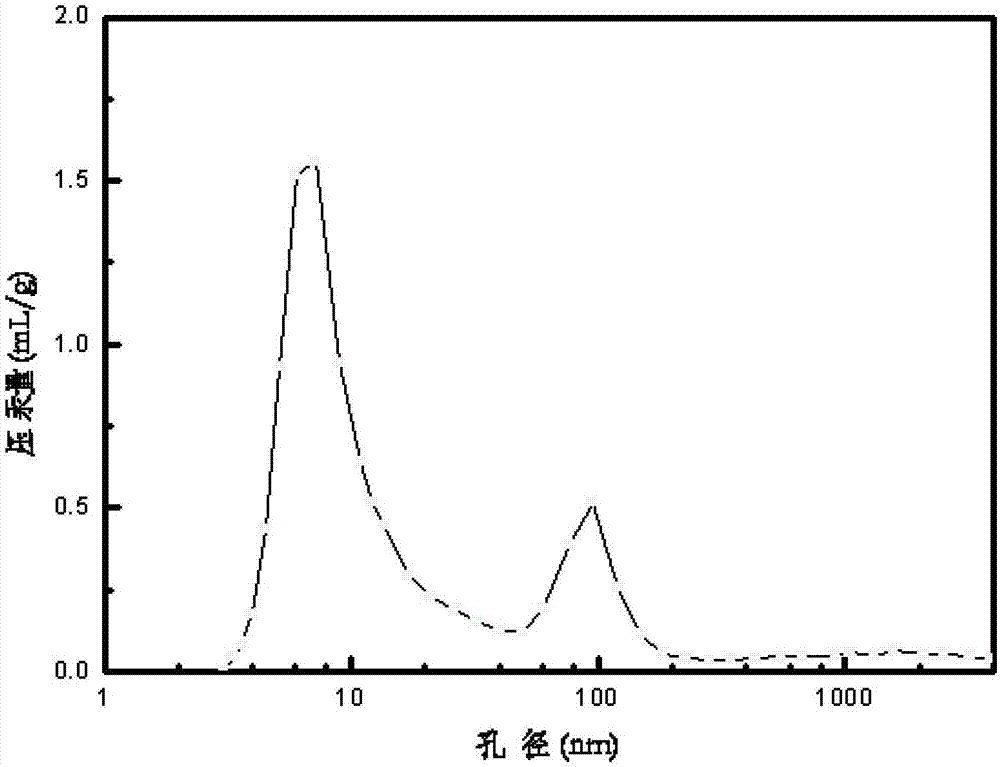
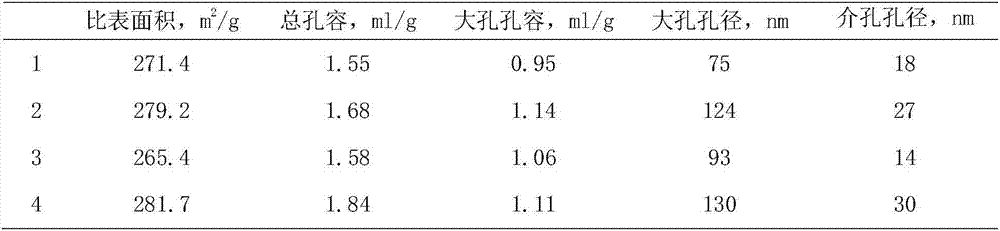
Examples
Embodiment 1
[0042] Firstly, 8.0 g of water-soluble chitosan pore expander was added to deionized water at 50°C, and then acetic acid was added dropwise until the chitosan was completely dissolved to obtain an acid solution containing the pore expander. Weigh 1.46g of phosphoric acid and 7.35g of magnesium nitrate respectively, completely dissolve phosphoric acid and magnesium nitrate in 70g of distilled water to prepare an aqueous solution containing phosphorus and magnesium. Weigh 350g pseudo-boehmite powder and 20.0g sesame powder into the kneader and mix them evenly, then add the mixed solution of phosphoric acid and magnesium nitrate, and finally add the acid solution containing chitosan to the pseudo-boehmite Evenly kneaded in the stone, kneaded and extruded into a clover shape. It was dried at 120°C for 8 hours and calcined at 700°C for 4 hours to obtain an alumina carrier 1 containing phosphorus and magnesium. The carrier 1 contains 0.5 wt% phosphorus pentoxide and 0.8 wt% magnesiu...
Embodiment 2
[0045] 8.0 g of a water-soluble chitosan pore expander was added to deionized water at 50° C., and then acetic acid was added dropwise until the chitosan was completely dissolved to obtain an acid solution containing the pore expander. Weigh 1.09g of phosphoric acid and 9.12g of magnesium nitrate respectively, completely dissolve phosphoric acid and magnesium nitrate in 70g of distilled water to prepare an aqueous solution containing phosphorus and magnesium. Weigh 350g pseudo-boehmite powder and 20.0g sesame powder into the kneader and mix them evenly, then add the mixed solution of phosphoric acid and magnesium nitrate, and finally add the acid solution containing chitosan to the pseudo-boehmite Evenly kneaded in the stone, kneaded-extruded into a clover shape. It was dried at 120°C for 8 hours and calcined at 700°C for 4 hours to obtain an alumina carrier 1 containing phosphorus and magnesium. Then use phosphorus and magnesium to modify the surface of the carrier, configure...
Embodiment 3
[0048] The preparation method of the carrier was carried out according to Example 1. The difference is that the auxiliary component of the carrier also contains cerium. The water-soluble chitosan pore expander is replaced with a non-water-soluble chitosan pore expander. The chitosan formic acid solution is stirred with a magnetic stirrer for 30 minutes to obtain Alumina support of macroporous structure 3. The content of the auxiliary components phosphorus, magnesium and cerium in the carrier are 1.8wt%, 2.0wt%, and 0.6wt% respectively. The specific surface area and pore size distribution are shown in Table 1.
[0049] A solution containing nickel and tungsten was prepared to impregnate the alumina carrier 3, dried at 120°C for 6 hours, and calcined at 500°C for 6 hours to obtain a catalyst 3. The composition of the catalyst 3 is: the content of tungsten oxide is 5.5 wt%, the content of nickel oxide is 14 wt%, and the content of alumina carrier is 80.5 wt%.
PUM
| Property | Measurement | Unit |
|---|---|---|
| pore size distribution | aaaaa | aaaaa |
| specific surface area | aaaaa | aaaaa |
| mesopore | aaaaa | aaaaa |
Abstract
Description
Claims
Application Information
 Login to View More