Check patentability & draft patents in minutes with Patsnap Eureka AI!

Large Stokes shift dark red fluorescent probe RQNA for detecting copper ions, and preparation method and application thereof

A copper ion detection and Stokes technology, applied in the field of molecular fluorescent probes, can solve problems such as rare probes, and achieve the effects of good cell membrane permeability, low cytotoxicity and mild reaction conditions

Active Publication Date: 2020-01-03
TIANJIN UNIVERSITY OF TECHNOLOGY
View PDF3 Cites 0 Cited by
  • Summary
  • Abstract
  • Description
  • Claims
  • Application Information

AI Technical Summary

Problems solved by technology

At present, there are relatively few reports on open-type fluorescent probes with large Stokes shift deep red emission wavelengths, and most of them are cyanine and BODIPY probes, and probes based on rhodamine structure are relatively rare.

Method used

the structure of the environmentally friendly knitted fabric provided by the present invention; figure 2 Flow chart of the yarn wrapping machine for environmentally friendly knitted fabrics and storage devices; image 3 Is the parameter map of the yarn covering machine
View more

Image

Smart Image Click on the blue labels to locate them in the text.
Viewing Examples
Smart Image
  • Large Stokes shift dark red fluorescent probe RQNA for detecting copper ions, and preparation method and application thereof
  • Large Stokes shift dark red fluorescent probe RQNA for detecting copper ions, and preparation method and application thereof
  • Large Stokes shift dark red fluorescent probe RQNA for detecting copper ions, and preparation method and application thereof

Examples

Experimental program
Comparison scheme
Effect test

Embodiment 1

[0023] Embodiment 1, the preparation route of compound B are as follows:

[0024]

[0025] Concrete preparation steps are as follows:

[0026] 1) Change CH 3 I (30mmol, 4.26g) was added to a mixture of 7-chloro-6-nitroquinazolin-4(3H)-one (20mmol, 4.5g) and anhydrous potassium carbonate (60mmol, 8.28g) in methanol (50mL) solution, and then reacted at 65°C for 22 hours, and cooled to room temperature after the reaction to obtain a reaction solution;

[0027] 2) The above reaction solution was poured into 100 mL of water and extracted with dichloromethane (3×100 mL). The organic phases were combined and collected, dried over anhydrous sodium sulfate, and then concentrated by vacuum distillation to obtain a crude product. The crude product was separated and purified by column chromatography on silica gel, and the eluent used was a dichloromethane-methanol mixture with a volume ratio of 25:1-2 to obtain light yellow solid Compound B with a yield of 89%; melting point: 208 -...

Embodiment 2

[0029] Embodiment 2, the preparation route of compound C are as follows:

[0030]

[0031] Concrete preparation steps are as follows:

[0032] 1) Dissolve rhodanol isomers (2.2mmol, 1688.6 mg) and compound B (2mmol, 478mg) in DMF (6mL), then react at 80°C for 12 hours, cool to room temperature after the reaction to obtain a reaction solution ;

[0033] 2) The above reaction solution was poured into 100 mL of water and extracted with dichloromethane (3×50 mL). The organic phases were combined and collected, dried over anhydrous sodium sulfate, and then concentrated by vacuum distillation to obtain a crude product. The crude product was separated and purified by column chromatography on silica gel, and the eluent used was a mixture of petroleum ether-ethyl acetate-methanol with a volume ratio of 20:6:1 to obtain compound C as a yellow solid with a yield of 81%; : 168-172°C.

[0034] 1 H NMR (CDCl 3,400MHz,ppm)δ=8.76(1H),8.02(1H),7.95(1H),7.66(1H),7.58(1H),7.32(1H),7.21(...

Embodiment 3

[0035] Embodiment 3, the preparation route of compound D are as follows:

[0036]

[0037] Concrete preparation steps are as follows:

[0038] 1) Add 1mL of concentrated hydrochloric acid to a mixed methanol solution (20mL) of compound C (2mmol, 1.18g) and tin protochloride (10mmol, 2.25g), then react at 65°C for 12 hours, and cool to room temperature after the reaction get the reaction solution;

[0039] 2) The above reaction solution was poured into 100 mL of water and extracted with dichloromethane (3×50 mL). The organic phases were combined and collected, dried over anhydrous sodium sulfate, and then concentrated by vacuum distillation to obtain a crude product. The crude product was separated and purified by column chromatography on silica gel, and the eluent used was a dichloromethane-methanol mixture with a volume ratio of 50:1-2 to obtain compound D as a yellow solid with a yield of 77%; melting point: 178- 182°C.

[0040] 1 H NMR (CDCl 3 ,400MHz,ppm)δ=8.25(1H...

the structure of the environmentally friendly knitted fabric provided by the present invention; figure 2 Flow chart of the yarn wrapping machine for environmentally friendly knitted fabrics and storage devices; image 3 Is the parameter map of the yarn covering machine
Login to View More

PUM

No PUM Login to View More

Abstract

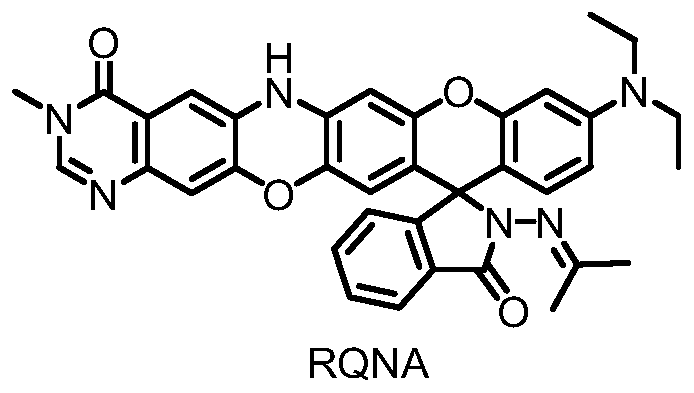
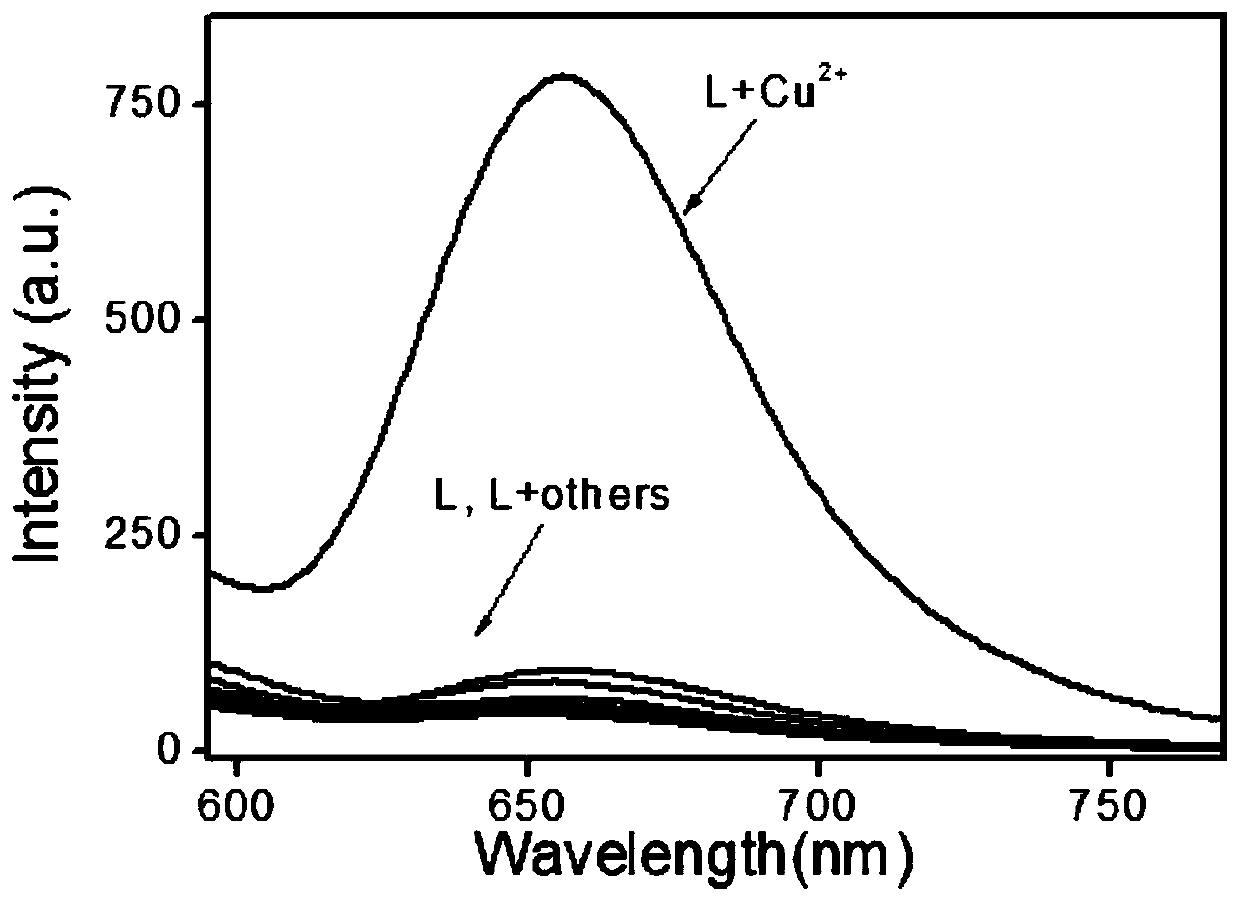
The invention provides a large Stokes shift dark red fluorescent probe RQNA for detecting copper ions, and a preparation method and an application thereof. The preparation method comprises the following steps: adding hydrazine hydrate into a methanol solution of a dye RQN, performing a reaction, removing the solvent, dissolving the obtained reaction product in acetone, and performing a reaction toobtain the solid probe RQNA. The probe is simple to synthesize and has mild reaction conditions. The prepared probe has a high selectivity and a high sensitivity, can react with copper ions in a widepH range, has a short response time, and causes remarkable change of a dark red fluorescence emission spectrum to realize specific detection of the copper ions. Cell imaging experiments show that theprobe has a good cell membrane permeability, a low cytotoxicity and a mitochondrial targeting positioning function, and successfully achieves fluorescence imaging detection of copper ions in human cervical cancer (HeLa) cells.

Description

technical field [0001] The invention relates to the technical field of molecular fluorescent probes, in particular to a large Stokes shift deep red fluorescent probe for detecting copper ions based on a xanthene dye and a preparation method and application thereof. Background technique [0002] In recent years, thanks to the development of fluorescence imaging technology, fluorescent probe technology can realize non-invasive, high temporal and spatial resolution visual detection at the level of cells and organelles due to its high selectivity, sensitivity, and fast response. The field of detection and monitoring of bioactive molecules shows great application potential. Compared with fluorescent probes with emission spectra in the ultraviolet-visible region, fluorescent probes with emission spectra in the deep red region show better tissue penetration and less photodamage, and can effectively avoid background fluorescence of biological tissues The resulting interference is f...

Claims

the structure of the environmentally friendly knitted fabric provided by the present invention; figure 2 Flow chart of the yarn wrapping machine for environmentally friendly knitted fabrics and storage devices; image 3 Is the parameter map of the yarn covering machine
Login to View More

Application Information

Patent Timeline
no application Login to View More
Patent Type & Authority Applications(China)
IPC IPC(8): C07D498/22C09K11/06G01N21/64
CPCC07D498/22C09K11/06G01N21/6428C09K2211/1029C09K2211/1044C09K2211/1033C09K2211/1088G01N2021/6439
Inventor 曾宪顺公锦
Owner TIANJIN UNIVERSITY OF TECHNOLOGY
Features
  • R&D
  • Intellectual Property
  • Life Sciences
  • Materials
  • Tech Scout
Why Patsnap Eureka
  • Unparalleled Data Quality
  • Higher Quality Content
  • 60% Fewer Hallucinations
Social media
Patsnap Eureka Blog
Learn More