Unlock instant, AI-driven research and patent intelligence for your innovation.

Treatment of topical and systemic bacterial infections

a bacterial infection and topical technology, applied in the field of topical bacterial infections and systemic bacterial infections, can solve the problems of resistance strain emergence, lack of demonstration of efficacy, no working formulation or proof of principle, etc., to reduce the immune response, increase the likelihood of neutralising antibodies, and low stimulation of antibody responses.

Inactive Publication Date: 2017-01-26
FIXED PHAGE
View PDF3 Cites 0 Cited by
  • Summary
  • Abstract
  • Description
  • Claims
  • Application Information

AI Technical Summary

Benefits of technology

The invention is a method of using bacteriophage (a type of virus that targets specific bacteria) to treat skin and systemic infections. The main technical effects of this invention include increased activity and resistance to heat, as well as reduced antibody responses and a prolonged effectiveness of therapy. The use of immobilized bacteriophage (bacteriophage that is attached to particles) has the advantage of no or low antibody response and can be retained in the body for long periods of time, resulting in a long-term effectiveness of the therapy. Additionally, phage immobilized onto particles is not neutralized by complement, which is a beneficial attribute for the uses and therapies of the invention.

Problems solved by technology

In recent years, as resistance to conventional antibiotics has continued to grow and the application of chemical biocides becomes increasingly unacceptable on environmental grounds, attention has turned to alternative methods for control of bacterial infection.
Antibiotics have wider specificity and are therefore useful for non-targeted interventions and emergency use, but suffer from resistant strain emergence with use.
Topical infections such as acne and impetigo may be treatable with bacteriophage as an alternative to existing products that are regarded as inefficient: some hospital handwashes have been proposed that contain bacteriophage K but have not been widely pursued; many acne treatments are known but most include active agents such as salicylic acid and benzoyl peroxide known to damage the skin.
One general problem with bacteriophage therapy, identified e.g. in the “Bacteriophage Therapy” minireview by Sulakvelidze et al, Antimicrobial Agents and Chemotherapy, March 2001, pp 649-659 is the absence of demonstration of efficacy of such preparations.
Indeed, in the prior art mentioned above no working formulations or proof of principle are provided.
Other problems identified by Sulakvelidze et al include the risk that rapid clearance of phage from the human body will reduce or negate possible effects, production of anti-phage antibodies in the patient, poor stability of phage in the body, the narrow host range of phages and insufficient purity of phage preparations.
It does not disclose the use of beads of any other size.

Method used

the structure of the environmentally friendly knitted fabric provided by the present invention; figure 2 Flow chart of the yarn wrapping machine for environmentally friendly knitted fabrics and storage devices; image 3 Is the parameter map of the yarn covering machine
View more

Image

Smart Image Click on the blue labels to locate them in the text.
Viewing Examples
Smart Image
  • Treatment of topical and systemic bacterial infections
  • Treatment of topical and systemic bacterial infections
  • Treatment of topical and systemic bacterial infections

Examples

Experimental program
Comparison scheme
Effect test

example 1

Bacteriophage Formulations for Acne Treatment

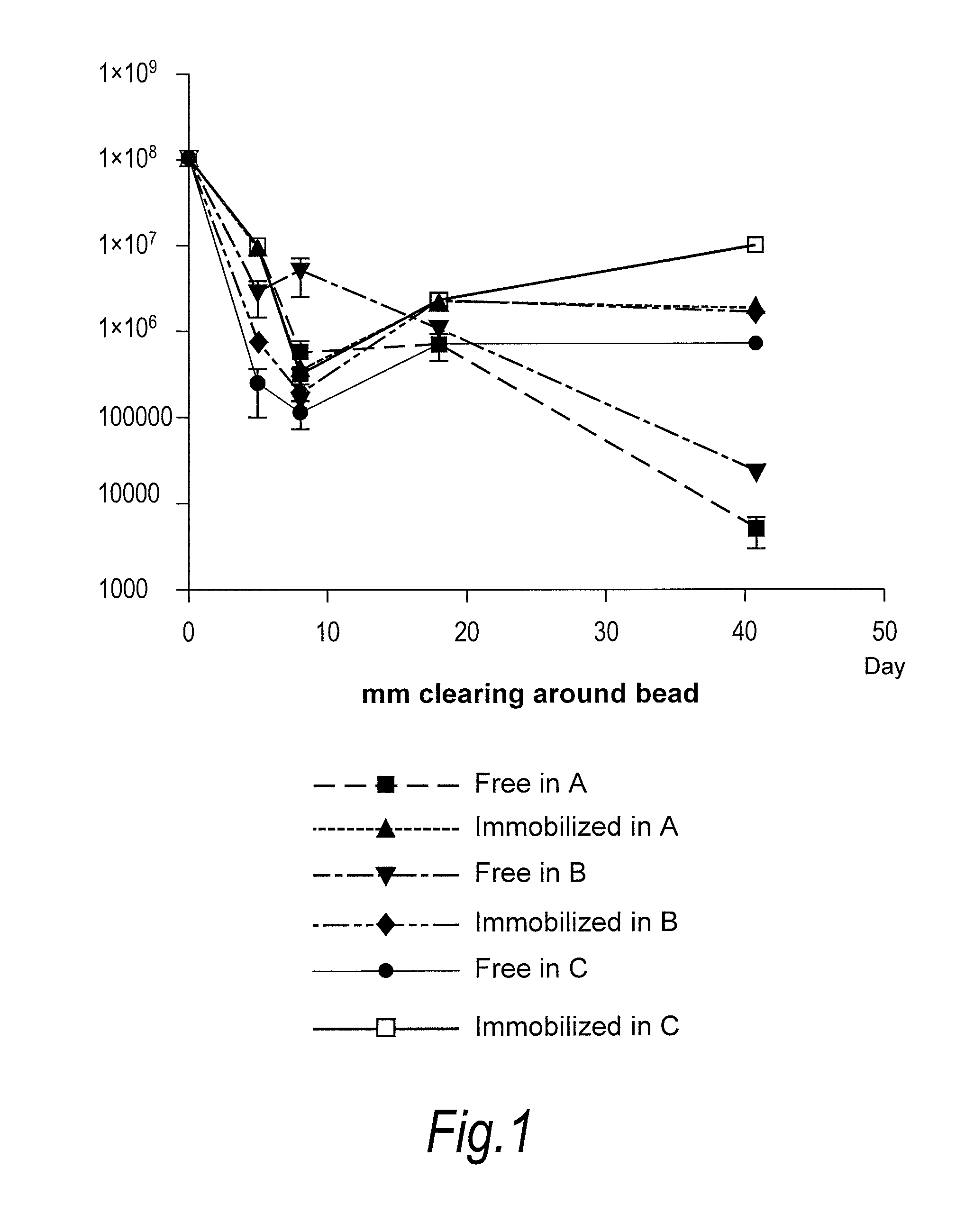
[0085]Propionibacterium acnes bacteriophages (FP pa1) were immobilised onto nylon beads (average diameter 10 microns) and mixed into Formulations A, B and C as set out below. Each Formulation was then tested for survival of bacteriophage at room temperature.

[0086]Formulation A—Aqueous Cream

Anhydrous Lanolin 1.0% w / wWhite Soft Paraffin BP14.5% w / wLight Liquid Paraffin PhEur12.6% w / wWater[to 100%]

[0087]Formulation B—Face Wash (Commercially Available Under the Trade Mark “Clearasil”)

[0088]Product contents: Aqua, Sodium Gluconate, Propylene Glycol, Octyldodecanol, Steareth-2, Cyclopentasiloxane, Steareth-21, Salicylic Acid, Cetyl Alcohol, Behenyl Alcohol, Cyclohexasiloxane, Polyacrylamide, C13-14 Isoparaffin, Xanthan Gum, Phenoxyethanol, Magnesium Aluminum Silicate, Laureth-7, Menthol, Methylparaben, Butylparaben, Ethylparaben, Isobutylparaben, Propylparaben, CI 77891.

[0089]Formulation C—Gel (Commercially Available Under the Trade Mark “Dr Sp...

example 2

Formulation for Topical Use (S. aureus)

[0096]Base Cream Preparation:

[0097]120 g of Emulsifying Ointment BP was heated to 60 degrees C. and mixed with 270 ml water also heated to the same temperature. The mixture was carefully stirred as it cooled, producing a smooth, white cream formulation. The cream was cooled to room temperature and divided into 5 equal portions.

[0098]Bacteriophage-Particle Production:

[0099]Nylon 12 particles of average diameter 3 microns were treated by corona discharge (75 kV field) and rapidly added to a bacteriophage suspension at 1×10⁹ pfu / ml. Particles were washed 3 times to remove non-bound bacteriophages. Using this method, 5 separate 2 ml preparations were made utilizing one of each of 5 different strains of bacteriophage specific for S. aureus from stored phage stock.

[0100]Formulation:

[0101]To each of the 5 separate portions of cream base was added a separate bacteriophage-particle preparation by admixture and agitation until the suspension had been ful...

example 3

Formulation for Topical Use (P. acnes)

[0102]A formulation was prepared as follows.[0103]Oil phase: Stearic acid 4%, stearyl alcohol 5%, lanolin 7%, isopropyl myristate 8%.[0104]Aqueous phase: Methyl cellulose 1%, in purified water

[0105]The two phases were prepared separately by weight and heated to 70° C. The water phase was then mixed with the oil phase by trituration till the cream congealed and cooled.

[0106]Nylon 6,6 particles of average diameter 10 microns were treated by passing through a corona discharge at 70 kv and rapidly added to a mixed bacteriophage preparation containing 5 different bacteriophages against P acnes at a final concentration of 1×10⁹ pfu / ml. The particles were washed 3 times to remove non-bound bacteriophages and added to the cream base to give a final bacteriophage concentration of 1×10⁵ pfu / ml.

the structure of the environmentally friendly knitted fabric provided by the present invention; figure 2 Flow chart of the yarn wrapping machine for environmentally friendly knitted fabrics and storage devices; image 3 Is the parameter map of the yarn covering machine
Login to View More

PUM

PropertyMeasurementUnit
diameteraaaaaaaaaa
diameteraaaaaaaaaa
average diameteraaaaaaaaaa
Login to View More

Abstract

Bacteriophage covalently attached to a carrier particle with an average diameter of from 0.1 microns to 15 microns, are used in topical treatment of bacterial infection. Bacteriophage covalently attached to a carrier particle of average diameter 7 microns or less are used in systemic treatment of bacterial infection. A plurality of bacteriophages lytic against different bacterial strains gives wide antibacterial activity. A combination therapy comprises administration of antibiotic and bacteriophage covalently attached to a carrier particle.

Description

FIELD OF THE INVENTION[0001]The present invention relates to compositions and methods for treatment of bacterial infections in mammals, especially in humans. In particular, the present invention relates to treatment of topical bacterial infections and systemic bacterial infections.BACKGROUND TO THE INVENTION[0002]In recent years, as resistance to conventional antibiotics has continued to grow and the application of chemical biocides becomes increasingly unacceptable on environmental grounds, attention has turned to alternative methods for control of bacterial infection.[0003]One promising approach involves the application of bacteriophages, being naturally occurring ubiquitous viruses that are harmless to humans, animals, plants and fish but lethal for bacteria. Bacteriophages are specific and will infect only particular bacterial types, with several sanitation products now on the market against pathogens such as Salmonella and Listeria. [0004]Bacteriophages have specific actions ag...

Claims

the structure of the environmentally friendly knitted fabric provided by the present invention; figure 2 Flow chart of the yarn wrapping machine for environmentally friendly knitted fabrics and storage devices; image 3 Is the parameter map of the yarn covering machine
Login to View More

Application Information

Patent Timeline
no application Login to View More
Patent Type & Authority Applications(United States)
IPC IPC(8): A61K35/76A61K9/06A61K47/34A61K9/00A61K31/43A61K47/48C12N7/00
CPCA61K35/76A61K47/48876A61K9/06C12N2795/00033A61K9/0014A61K31/43A61K47/34C12N7/00A61K9/0019C12N2795/10132C12N2795/00032A61K2300/00A61K47/6927A61P17/00A61P17/02A61P17/10A61P31/02A61P31/04Y02A50/30
Inventor MATTEY, MICHAELBELL, EMMA LISA
Owner FIXED PHAGE