Unlock instant, AI-driven research and patent intelligence for your innovation.

Weak ion exchange particulate medium prepared from phenol-containing organic matter for anions contained in aqueous solutions

a technology of ion exchange particulate medium and organic matter, which is applied in the direction of ion exchanger, water/sewage treatment by ion exchange, quary sewage treatment, etc., can solve the problems of affecting the ability of ion exchange to reach the level of breakthrough capacity

Active Publication Date: 2020-10-15
AMERICAN PEAT TECH +1
View PDF1 Cites 0 Cited by
  • Summary
  • Abstract
  • Description
  • Claims
  • Application Information

AI Technical Summary

Benefits of technology

The invention is a method of producing a peat granule product that has good strength and can withstand high pH conditions. The peat granule also has a high capacity for absorbing anions due to the functional amine groups attached to the material. The resulting product has a nitrogen content of at least 3.0% and a weak anion exchange capacity of 58-80 mEq / 100 g. This makes it useful for various applications such as wastewater treatment.

Problems solved by technology

Pollutants can contaminate these surface water sources that harm numerous plant and animal species.
But, they also frequently seep directly into the ground and pollute the aquifers and other ground water systems below.
But human activities also impact ground water, introducing pollutants in the process to elevate the natural contamination level of the ground water.
Heavy metal cation contaminants like arsenic, lead, mercury, cadmium, iron, aluminum, antimony, chromium, cobalt, copper, manganese, nickel, uranium, vanadium, and zinc become toxic when they are not metabolized by the body, and accumulate in the soft tissues, posing significant health problems.
At levels above this 250 mg / L threshold, sulfates can cause diarrhea and resulting dehydration.
High sulfate levels in drinking water can also cause fluid and weight loss in animals.
But, because calcium sulfate has a solubility of approximately 2000 mg / L as sulfate, this method does not provide effective sulfate reduction below this 2000 mg / L concentration level.
However, this technology requires costly equipment, and produces byproduct streams that must in turn be treated and handled.
However, such sorption media that are particularly useful for removing toxic cations from wastewaters do not constitute ion exchange media.
It is a chemical treatment process that treats lime-treated water to precipitate sulfate as a nearly insoluble calcium-alumina-sulfate compound known as “ettringite.” But this system also requires costly equipment and produces a substantial amount of byproduct streams that must in turn be treated and handled for proper disposal.
Although Mortimer Harvey and L. H. Baekland demonstrated the presence of nitrogen in the resulting compound, they failed to show the amine nature of the nitrogen.
However, these authors did not disclose the production of weak anion exchange resin using reaction of novalacs with hexamethylenetetramine.
This process for producing synthetic resins is expensive.
The resin beads are also highly susceptible to “fouling.” While soluble organic acids and bases removed by the synthetic ion-exchange resin are shed during regeneration, non-ionic organic materials, oils, greases, and suspended solids also removed from the water tend to remain on the surface of the resin bead.
Foulants can form rapidly on the resin, and can significantly hinder performance of the ion-exchange system.
Cationic polymers and other high molecular weight cationic organics are particularly troublesome at any concentration.
For certain types of resins, even one ppm suspended solids can cause significant fouling of the resin beads over time.
Thus, a prefiltration unit in the form of activated carbon or other separation material may need to be positioned upstream of the ion-exchange unit to remove these organic contaminants before the wastewater is passed through the ion exchange resin, further complicating the water treatment process and its costs.
The costs associated with this pretreatment can be substantial.
But, chemically-regenerated ion-exchange processes known in the art tend to use excessive amounts of regeneration chemicals, which require periodic and even on-going treatment, as well as safe disposal of the chemical waste.
These processes can be complex and expensive to operate.
However, neither of these products are capable of being used as an anion exchange medium.
However, all of these prior art references disclose sorption media useful for sorbing heavy metals or other cations—not anion exchange media useful for removing anions from wastewater or other aqueous solutions.
But, this will actually destroy the carbon fibers.
But in all of these cases, the prior art products are acting as cation exchange media for removing heavy metals or other cations—not anion exchange media useful for removing anions from wastewater or other aqueous solutions.
The peat-based cation exchange media known in the prior art will not work to remove anions from wastewaters or other aqueous solutions.
Second, in its natural form, peat has low mechanical strength, tends to shrink and swell, and does not allow for hydraulic loading.
Naturally-occurring organic ion exchange media are unstable outside a moderately neutral pH range.
Third, such natural organic ion exchange media like peat tend to be prone to excessive swelling and peptizing, and tend to leach naturally occurring heavy metals from the substrate material into the treated wastewater solution.
Fourth, prior art steps commonly applied to peat and other organic materials like pyrolysis can cause these materials to lose their ion-exchange capacity.
Carbonization may cause considerable shrinkage and weight loss of the materials, as well as loss of naturally-occurring phenolic compounds.
But peat provides another chemical challenge to the production of anion exchange medium.

Method used

the structure of the environmentally friendly knitted fabric provided by the present invention; figure 2 Flow chart of the yarn wrapping machine for environmentally friendly knitted fabrics and storage devices; image 3 Is the parameter map of the yarn covering machine
View more

Image

Smart Image Click on the blue labels to locate them in the text.
Viewing Examples
Smart Image
  • Weak ion exchange particulate medium prepared from phenol-containing organic matter for anions contained in aqueous solutions
  • Weak ion exchange particulate medium prepared from phenol-containing organic matter for anions contained in aqueous solutions
  • Weak ion exchange particulate medium prepared from phenol-containing organic matter for anions contained in aqueous solutions

Examples

Experimental program
Comparison scheme
Effect test

example 1

ion of Peat Granules

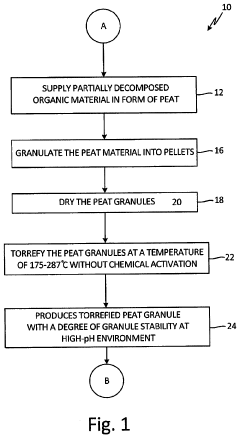
[0098]The process used to produce the torrefied intermediate product 24 is illustrated as follows:

[0099]Peat of a reed-sedge type commercially available from American Peat Technology, LLC of Aitkin, Minn., was first dried to a moisture content of about 40% wt. The dried raw peat was extruded into pellets, dried again to reduce the moisture content to about 12% wt, and finally crumbled and sieved. This process resulted in a multifunctional granular media called “bioAPT.”

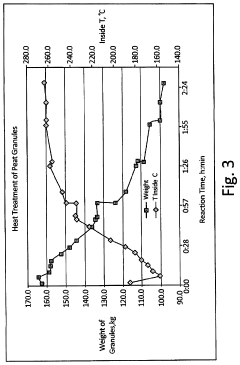
[0100]The finished bioAPT peat granule with a size range of 10×30 mesh was then thermally treated to produce the torrefied peat granule media. The bioAPT granules were introduced into a jacketed ribbon mixer. The mixer had thermal fluid circulating through the jacket at a temperature of about 300° C., thereby effectively heating the atmosphere inside the mixer. Additionally, the mixer ribbons were fitted with “lifters” that picked up the media and dropped it through the heated atmosphere. Also, the...

example 2

s of the Torrefied Peat Granules

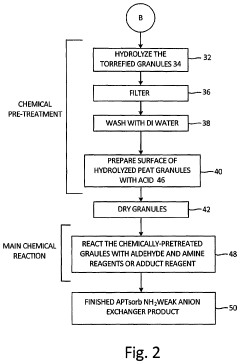
[0105](a) Hydrolysis of Torrefied Granules with a Na2CO3 Solution

[0106]Two hundred milliliters of 1M solution of Na2CO3 was added to 10 g of thermally-treated peat granules and refluxed for 20 hrs. The granules were filtered, washed with deionized water and dried at 105° C. for 24 hrs. This process was repeated for each of the APTsorb intermediate samples of Table 1. The loss of material is presented in Table 2. The higher loss, the less stable granules are.

(b) Hydrolysis of Torrefied Granules with a HCl Solution

[0107]A 2.5 L amount of a 1 N solution of HCl was added to 0.1 kg of the torrefied granules at room temperature. The mixture was heated up to 95° C. and kept at 95° C. for 3 hrs with periodic shaking in such a fashion so as not to destroy the granules. The pH was maintained at a value of 2 or lower. The mixture was filtered and washed six times with DI water, or until the test for the presence of chloride ions in the filtrate was negative. The...

example 3

of Torrefied, Hydrolyzed Peat Granules

[0114](a) Reaction of Torrefied, Hydrolyzed Peat Granules with Aldehyde+Amine

[0115]Forty milliliters of water was added into 43.3 ml (38.8 g) of a 40% solution of methylamine (CH3NH2). A solution of 30 ml water and 28.2 ml (22 g) of acetic aldehyde (CH3CHO) was then added drop wise to the resulting water solution of CH3NH2 at room temperature, and then DI water was added up to 200 ml. Twenty grams of torrefied and hydrolyzed intermediate APTsorb peat granules obtained from the procedure described in Example 2(c) were wetted with water for 12 hours at room temperature. The water was filtered, and a 40 ml solution of CH3NH2 (100 mmol) / CH3CHO (100 mmol) was added. The reaction mixture was kept at 120° C. in an autoclave reactor for 17 hours. The granules were filtered, washed with water until there was no color leaching, and dried at 105° C. for 24 hours. The resulting granules were analyzed for total nitrogen. The results are shown in Table 3. The...

the structure of the environmentally friendly knitted fabric provided by the present invention; figure 2 Flow chart of the yarn wrapping machine for environmentally friendly knitted fabrics and storage devices; image 3 Is the parameter map of the yarn covering machine
Login to View More

PUM

PropertyMeasurementUnit
temperatureaaaaaaaaaa
concentrationsaaaaaaaaaa
Login to View More

Abstract

A process for the preparation of a granulated or pelletized weak anion exchange medium from a phenol-containing organic material like peat, followed by low-temperature torrefaction of the granules to produce a high degree of physical stability of the granules at high-pH conditions, followed by chemical pretreatment of the stable granule via a hydrolysis reaction, and optionally surface treatment with acids, followed by the main chemical treatment of the hydrolyzed granule via separate aldehyde and amine reagents, or alternatively via an adduct reagent like hexamethylenetetramine is provided by this invention. The weak anion exchange medium of this invention can be used in a variety of aqueous solution treatment processes, such as wastewater treatment for removing mineral acids like H2SO4, HNO3, HCl, HBr, HF, H3PO4, HI, or formic acid from the wastewater. The resulting anion exchanger medium is particularly useful for treating wastewaters in a low-pH environment.

Description

CROSS-REFERENCE TO RELATED APPLICATIONS[0001]This application is a divisional of U.S. Ser. No. 15 / 611,175 filed on Jun. 1, 2017 entitled “Weak Anion Exchange Particulate Medium Prepared from Phenol-Containing Organic Matter for Anions Contained in Aqueous Solutions,” which is hereby incorporated by reference in its entirety.FIELD OF THE INVENTION[0002]This invention relates generally to particulate anion exchange media prepared from phenol-containing organic matter like peat, and more specifically to granules made from such material that are torrefied and chemically modified to provide them the requisite physical and chemical stability at high pH conditions and anion exchange capacity for removal of anions found in aqueous solutions like wastewater or mine waters at low pH.BACKGROUND OF THE INVENTION[0003]Our planet's surface area is covered primarily by water. Aquatic water systems like oceans, rivers, bays and estuaries, lakes, and ponds cover over two-thirds of the Earth's surfac...

Claims

the structure of the environmentally friendly knitted fabric provided by the present invention; figure 2 Flow chart of the yarn wrapping machine for environmentally friendly knitted fabrics and storage devices; image 3 Is the parameter map of the yarn covering machine
Login to View More

Application Information

Patent Timeline
no application Login to View More
Patent Type & Authority Applications(United States)
IPC IPC(8): B01J41/09C10B53/02C02F1/42B01J2/20
CPCC02F2001/422B01J2/20C02F2103/10B01J41/09C10B53/02C02F1/42Y02E50/10C02F2101/101B01J41/07B01J41/18B01J49/07B01J49/57
Inventor KOLOMITSYN, IGOR V.GREEN, DOUGLAS A.KILDYSHOVA, LIUDMYLA
Owner AMERICAN PEAT TECH