Check patentability & draft patents in minutes with Patsnap Eureka AI!

Core-shell structure silicon-carbon composite material for lithium ion battery, preparation method of core-shell structure silicon-carbon composite material and negative electrode

A silicon-carbon composite material, lithium-ion battery technology, applied in battery electrodes, carbon preparation/purification, nanotechnology for materials and surface science, etc., can solve poor conductivity, poor electrode cycle performance, and cannot be commercialized production and other problems, to achieve the effect of reducing impedance and polarization, improving electrochemical performance, and easy large-scale production

Active Publication Date: 2021-12-28
BAOWU CHARCOAL MATERIAL TECH CO LTD +1
View PDF11 Cites 0 Cited by
  • Summary
  • Abstract
  • Description
  • Claims
  • Application Information

AI Technical Summary

Problems solved by technology

[0002] With the rapid development and wide application of various portable electronic devices and new energy vehicles in the past ten years, people have put forward higher requirements for the charging and discharging performance and capacity of lithium-ion secondary batteries, but the currently used lithium-ion batteries Positive and negative electrode materials are increasingly unable to meet the above needs; improving the electrochemical performance of lithium-ion secondary batteries is the most convenient and efficient means of improving positive and negative electrode materials (especially negative electrodes); currently commercialized lithium-ion secondary batteries Secondary batteries generally use various carbon materials as negative electrodes, such as natural graphite, modified graphite, mesocarbon microspheres, soft carbon and hard carbon, etc. However, the specific capacity of such materials is too low (such as graphite theoretical capacity 372mAh / g) It is far from meeting the needs of high energy density batteries, so the development of new negative electrodes that replace carbon materials has attracted much attention
[0003] Among them, silicon-based negative electrode materials have the advantages of high lithium storage capacity (4200mAh / g), low lithium intercalation potential, and abundant reserves in the earth's crust, but the conductivity of silicon-based negative electrode materials is poor. A large volume change (>300%) will cause the pulverization of the silicon-based negative electrode material and the falling off of the active material from the current collector, resulting in poor cycle performance of the electrode; in recent years, the poor and serious electrical conductivity of silicon materials Volume effect, researchers have tried many new methods and technologies for modification to improve cycle performance, among which the preparation of core-shell silicon-carbon composite materials is an effective method, using the synergistic effect between the components of the composite material, on the one hand to improve The problem of volume expansion during the charge and discharge process of the material, on the other hand, improves the conductivity of the silicon negative electrode
[0004] In recent years, with the development of lithium battery technology, some synthesis methods of carbon-coated silicon negative electrode materials have emerged. For example, application number 201510129121.0 discloses a silicon-carbon composite material and its preparation method and its application in lithium-ion batteries. Application number 201410025915.8 Discloses a hollow structure material and its preparation method and use, application number 201610139926.8 discloses a preparation method of silicon-based negative electrode material, negative electrode material and battery, application number 201811543711.8 discloses a battery negative electrode material and its manufacturing method, secondary battery With negative electrodes and secondary batteries, etc., these methods first use SiO 2 Coating the silicon material, then coating the organic carbon source, and finally synthesizing the carbon-coated negative electrode material by controlling the temperature and atmosphere and etching with hydrofluoric acid. After the carbon-coated lithium battery negative electrode material is synthesized by the above method, the following problems will occur: (1 ) Conventional carbon coating only obtains a core-shell structure, and cannot leave room for volume expansion of the material, so the electrochemical performance is not good; (2) using SiO 2 Coating, and then coating carbon to synthesize carbon-coated silicon-carbon negative electrode materials, it is necessary to further use hydrofluoric acid etching, which not only increases the process, but also is harmful to the environment; (3) oxidation method is used to oxidize the silicon surface, and then Coating carbon materials will not only seriously waste silicon materials, but also it is not easy to control the thickness of the oxide layer, the process is complicated, and it is often suitable for laboratory synthesis and cannot be commercialized.
[0005] In view of the above situation, it is urgent to develop a new type of silicon-carbon composite material and its preparation method. On the one hand, it can alleviate the problem of poor electrochemical performance of lithium ions caused by expansion during the charging and discharging process of silicon-carbon composite materials, and improve the performance of silicon-carbon composite materials. conductivity, thereby improving the electrochemical performance of lithium-ion batteries, on the other hand, the preparation method is simple, the cost is relatively low, and it is easy to realize large-scale production

Method used

the structure of the environmentally friendly knitted fabric provided by the present invention; figure 2 Flow chart of the yarn wrapping machine for environmentally friendly knitted fabrics and storage devices; image 3 Is the parameter map of the yarn covering machine
View more

Image

Smart Image Click on the blue labels to locate them in the text.
Viewing Examples
Smart Image
  • Core-shell structure silicon-carbon composite material for lithium ion battery, preparation method of core-shell structure silicon-carbon composite material and negative electrode
  • Core-shell structure silicon-carbon composite material for lithium ion battery, preparation method of core-shell structure silicon-carbon composite material and negative electrode
  • Core-shell structure silicon-carbon composite material for lithium ion battery, preparation method of core-shell structure silicon-carbon composite material and negative electrode

Examples

Experimental program
Comparison scheme
Effect test

preparation example Construction

[0036] The preparation method of the core-shell structure silicon-carbon composite material for lithium-ion batteries provided by the invention uses phenol, aldehyde and polymer monomers to coat SiO x , and then by acid treatment and heat treatment, a core-shell structure silicon-carbon composite material for lithium-ion batteries is obtained; the preparation method comprises the following steps:

[0037] S1, the SiO x Evenly dispersed in the aqueous solution, add phenol and aldehyde, and after stirring, the phenolic resin-coated silicon-based composite material is obtained; in the process of forming phenolic resin from phenol and aldehyde, an alkaline catalyst is added to facilitate the coating of the thermosetting phenolic resin on the silicon-based composite material Surface; alkaline catalysts such as ammonia water, sodium hydroxide, etc.;

[0038] Of which SiO x Among them, the range of x is 0~2, SiO x One or more selected from elemental silicon, silicon monoxide, and si...

Embodiment 1

[0049] Add 1g of Si nanoparticles (50-150nm) to 500mL of water, stir for 3h to disperse evenly in the aqueous solution, add 300mg of resorcinol and 0.3mL of formaldehyde solution to the solution, add dropwise 0.2mL of ammonia solution, and stir to react After 60 min, the phenolic resin-coated silicon-based composite material was obtained; add 300 μL of pyrrole and 0.2 g of ammonium persulfate oxidant to the phenolic resin-coated silicon-based composite material, and stir for 3 hours at 30 °C at a stirring rate of 500 rpm Finally, the polypyrrole / phenolic resin-coated silicon-based composite material was obtained; then 1 mL of hydrochloric acid solution was added, stirred for 30 minutes to remove part of the phenolic resin, and the core-shell structure silicon-carbon composite material intermediate was obtained after filtering and drying; the core-shell structure silicon The carbon composite material intermediate is put into a tube furnace for heat treatment. Under an argon atmo...

Embodiment 2

[0051] Add 1g of SiO particles (2μm) to 500mL of water, stir for 3h to disperse evenly in the aqueous solution, add 200mg of 3-aminophenol and 0.2mL of formaldehyde solution to the solution, add dropwise 0.1mL of ammonia solution, and stir for 120min to obtain Phenolic resin-coated silicon-based composite material; add 500 μL of aniline and 0.25 g of ferric chloride oxidant to the phenolic resin-coated silicon-based composite material, and stir at 40 ° C at a rate of 300 rpm for 3 hours to obtain Polyaniline / phenolic resin coated silicon-based composite material; then add 0.5mL of phosphoric acid solution, stir for 30min to remove part of the phenolic resin, after filtering and drying to obtain the core-shell structure silicon-carbon composite material intermediate; core-shell structure silicon The carbon composite material intermediate is put into a tube furnace for heat treatment. Under a nitrogen atmosphere, the temperature rises to 750°C at a rate of 1°C / min. After 3 hours ...

the structure of the environmentally friendly knitted fabric provided by the present invention; figure 2 Flow chart of the yarn wrapping machine for environmentally friendly knitted fabrics and storage devices; image 3 Is the parameter map of the yarn covering machine
Login to View More

PUM

PropertyMeasurementUnit
particle sizeaaaaaaaaaa
pore sizeaaaaaaaaaa
current efficiencyaaaaaaaaaa
Login to View More

Abstract

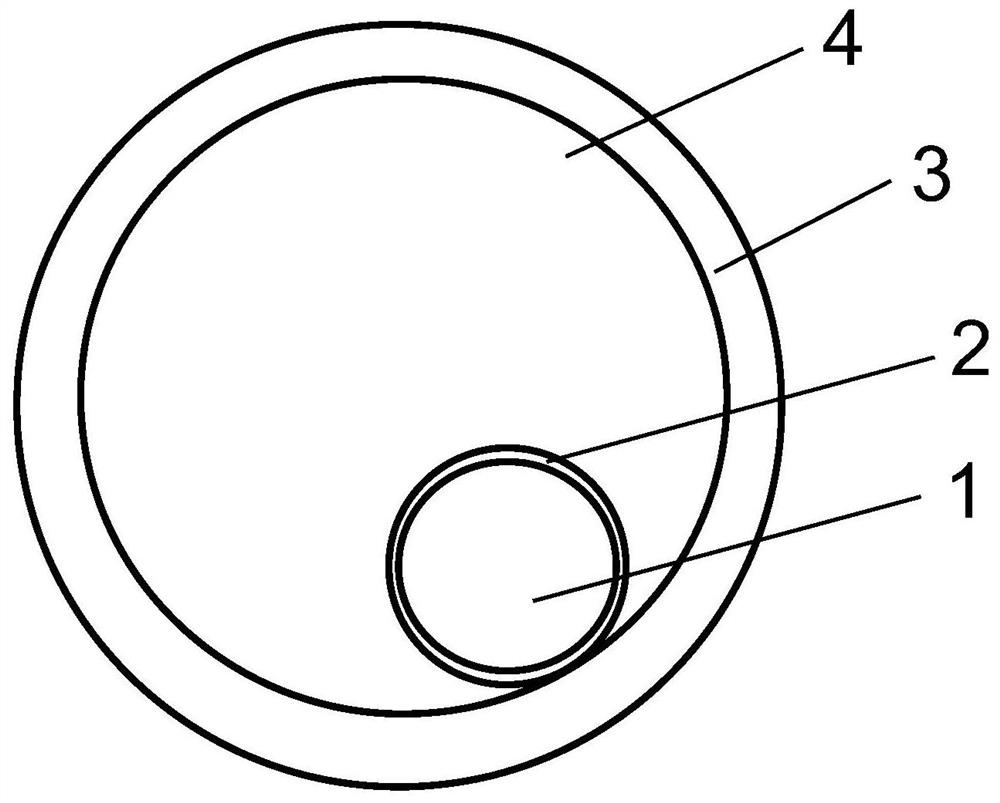
The invention discloses a core-shell structure silicon-carbon composite material for a lithium ion battery, a preparation method of the core-shell structure silicon-carbon composite material and a negative electrode, and the preparation method comprises the following steps: coating SiOx with phenol, aldehyde and a polymer monomer, and carrying out acid treatment and heat treatment to prepare the core-shell structure silicon-carbon composite material for the lithium ion battery. The core-shell structure silicon-carbon composite material for the lithium ion battery is of a core-shell structure and comprises a silicon-based inner core, a first carbon coating layer coating the surface of the silicon-based inner core and a second carbon coating layer coating the first carbon coating layer, mesopores are formed in the surface of the second carbon coating layer, and a cavity is formed between the second carbon coating layer and the second carbon coating layer. The preparation method is simple and convenient in process, relatively low in cost and easy to realize large-scale production, the prepared core-shell structure silicon-carbon composite material for the lithium ion battery has enough space to relieve volume expansion in the charging and discharging process, and the core-shell structure silicon-carbon composite material for the lithium ion battery is applied to a negative electrode of the lithium ion battery, so that high first efficiency and high charge-discharge capacity can be shown.

Description

technical field [0001] The invention relates to the field of battery material manufacturing, in particular to a silicon-carbon composite material with a core-shell structure for a lithium-ion battery, a preparation method thereof, and a negative electrode. Background technique [0002] With the rapid development and wide application of various portable electronic devices and new energy vehicles in the past ten years, people have put forward higher requirements on the charging and discharging performance and capacity of lithium-ion secondary batteries, but the currently used lithium-ion batteries Positive and negative electrode materials are increasingly unable to meet the above needs; improving the electrochemical performance of lithium-ion secondary batteries is the most convenient and efficient means of improving positive and negative electrode materials (especially negative electrodes); currently commercialized lithium-ion secondary batteries Secondary batteries generally...

Claims

the structure of the environmentally friendly knitted fabric provided by the present invention; figure 2 Flow chart of the yarn wrapping machine for environmentally friendly knitted fabrics and storage devices; image 3 Is the parameter map of the yarn covering machine
Login to View More

Application Information

Patent Timeline
no application Login to View More
Patent Type & Authority Applications(China)
IPC IPC(8): H01M4/38H01M4/48H01M4/62H01M10/0525C01B33/113C01B33/18C01B33/02C01B32/05B82Y40/00B82Y30/00
CPCH01M4/386H01M4/483H01M4/625H01M10/0525C01B33/113C01B33/18C01B33/02C01B32/05B82Y30/00B82Y40/00C01P2002/72C01P2004/80C01P2004/64Y02E60/10
Inventor 谭迎宾李铮铮吴若飞陶军杨兵
Owner BAOWU CHARCOAL MATERIAL TECH CO LTD
Features
  • R&D
  • Intellectual Property
  • Life Sciences
  • Materials
  • Tech Scout
Why Patsnap Eureka
  • Unparalleled Data Quality
  • Higher Quality Content
  • 60% Fewer Hallucinations
Social media
Patsnap Eureka Blog
Learn More