
Combination of dehydroepiandrosterone or dehydroepiandrosterone-sulfate with a leukotriene receptor antagonist for treatment of asthma or chronic obstructive pulmonary disease
- Summary
- Abstract
- Description
- Claims
- Application Information
AI Technical Summary
Benefits of technology
Problems solved by technology
Method used
Image

Examples
examples 1 and 2
In Vivo Effects of Folinic Acid and DHEA on Adenosine Levels
[0414] Young adult male Fischer 344 rats (120 grams) were administered dehydroepiandrosterone (DHEA) (300 mg / kg) or methyltestosterone (40 mg / kg) in carboxymethylcellulose by gavage once daily for fourteen days. Folinic acid (50 mg / kg) was administered intraperitoneally once daily for fourteen days. On the fifteenth day, the animals were sacrificed by microwave pulse (1.33 kilowatts, 2450 megahertz, 6.5 seconds (s)) to the cranium, which instantly denatures all brain protein and prevents further metabolism of adenosine. Hearts were removed from animals and flash frozen in liquid nitrogen with 10 s of death. Liver and lungs were removed en bloc and flash frozen with 30 s of death. Brain tissue was subsequently dissected. Tissue adenosine was extracted, derivatized to 1, N6-ethenoadenosine and analyzed by high performance liquid chromatography (HPLC) using spectrofluorometric detection according to the method of Clark and Da...
example 3
Airjet Milling of Anhydrous DHEA-S and Determination of Respirable Dose
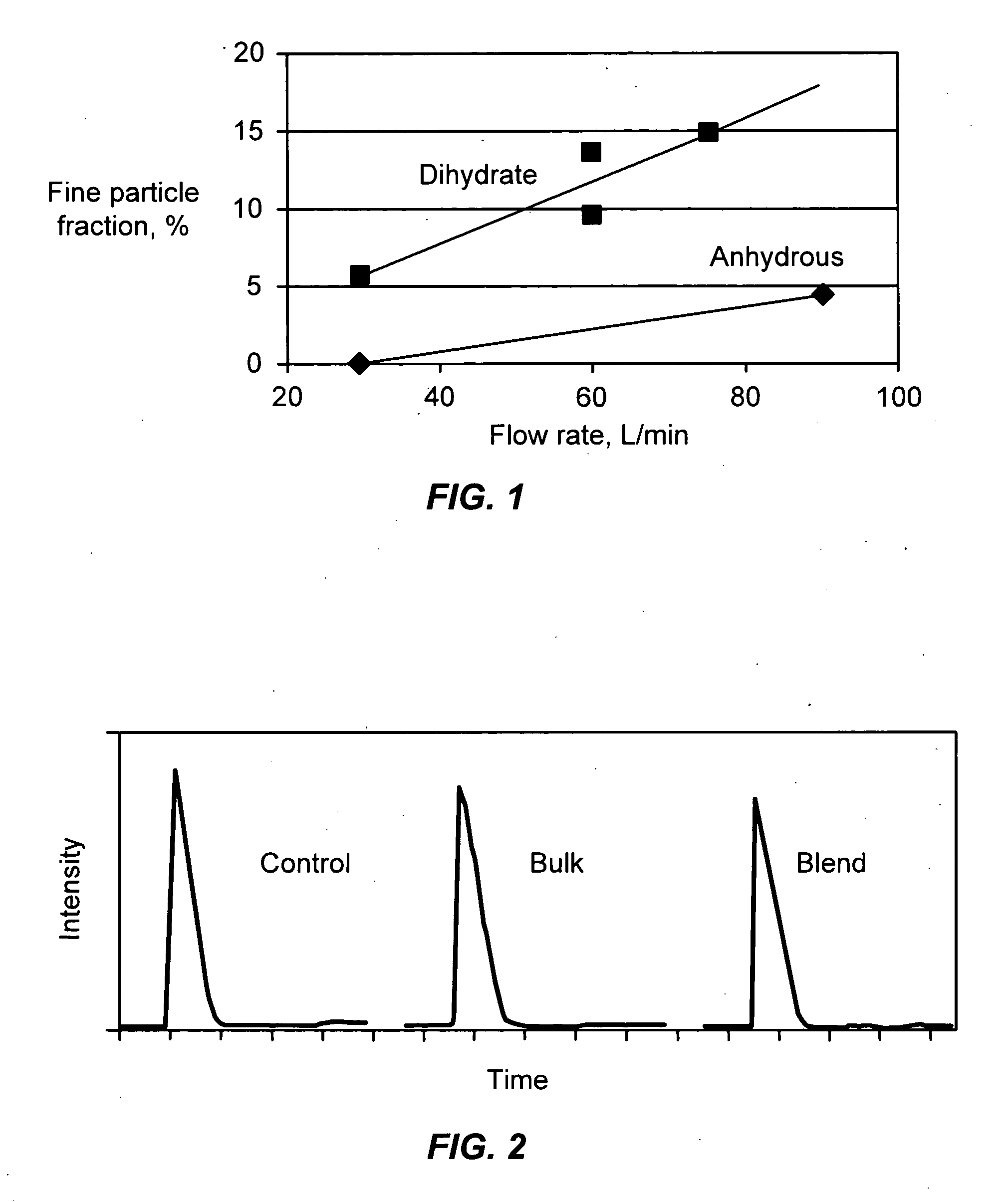
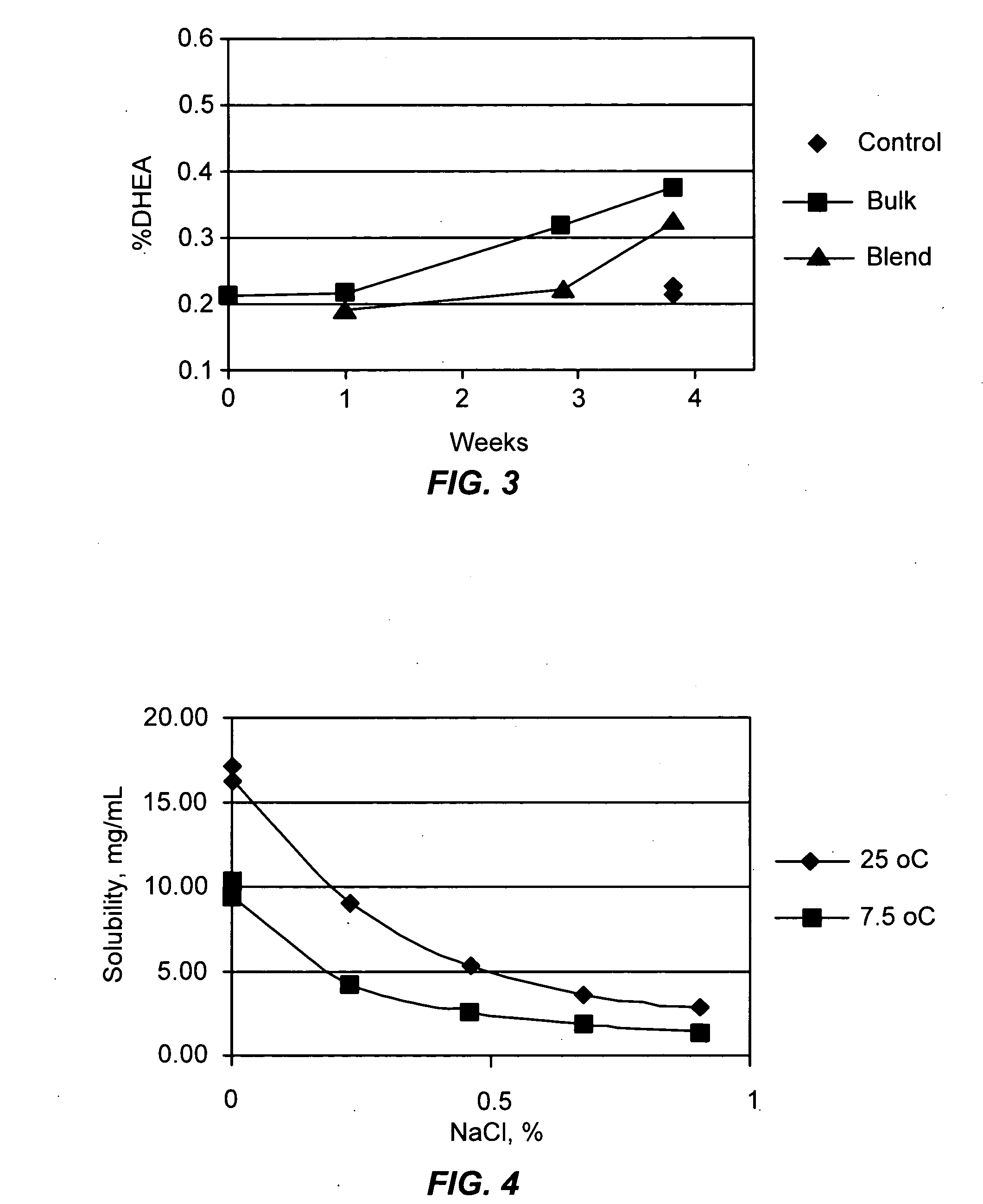
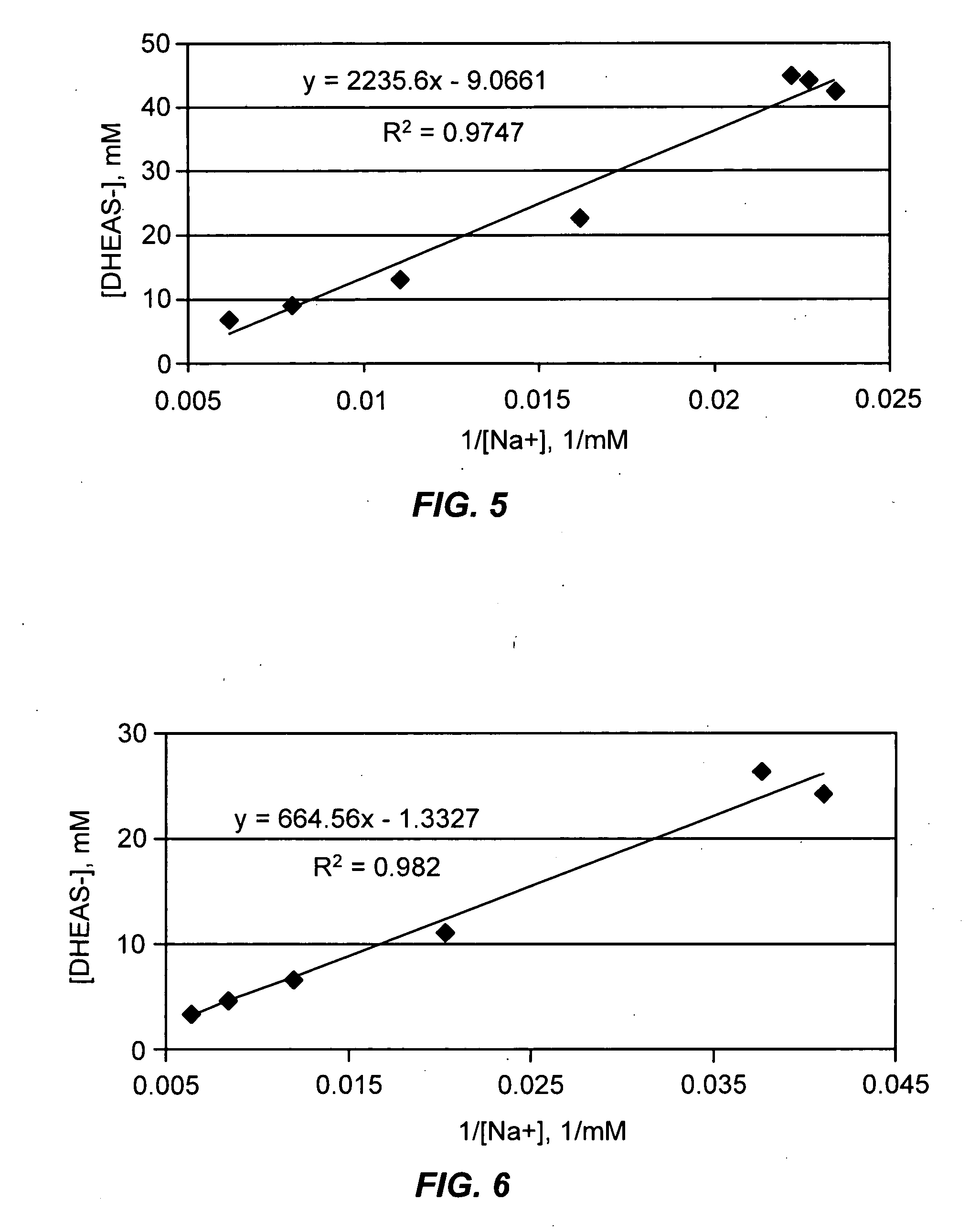
[0416] DHEA-S is evaluated as an asthma therapy. The solid-state stability of sodium dehydroepiandrostenone sulfate (NaDHEA-S) has been studied for both bulk and milled material (Nakagawa, H., Yoshiteru, T., and Fujimoto, Y. (1981) Chem. Pharm. Bull. 29(5) 1466-1469; Nakagawa, H., Yoshiteru, T., and Sugimoto, 1. (1982) Chem. Pharm. Bull. 30(1) 242-248). DHEA-S is most stable and crystalline as the dihydrate form. The DHEA-S anhydrous form has low crystallinity and is very hygroscopic. The DHEA-S anhydrous form is stable as long as it picks up no water on storage. Keeping a partially crystalline material free of moisture requires specialized manufacturing and packing technology. For a robust product, minimizing sensitivity to moisture is essential during the development process.
(1) Micronization of DHEA-S
[0417] Anhydrous DHEA-S was micronized using a jet milling (Jet-O-Mizer Series #00, 100-120 PSI nitrogen). ...
example 4
Spray Drying of Anhydrous DHEA-S and Determination of Respirable Dose
(1) Micronization of the Drug
[0422] 1.5 g of anhydrous DHEA-S were dissolved to 100 ml of 50% ethanol:water to produce a 1.5% solution. The solution was spray-dried with a B-191 Mini Spray-Drier (Buchi, Flawil, Switzerland) with an inlet temperature of 55° C., outlet temperature of 40° C., at 100% aspirator, at 10% pump, nitrogen flow at 40 mbar and spray flow at 600 units. The spray-dried product was suspended in hexane and Span85 surfactant added to reduce agglomeration. The dispersions were sonicated with cooling for 3-5 minutes for complete dispersion and the dispersed solutions tested on a Malvern Mastersizer X with a Small Volume Sampler (SVS) attachment. The two batches of spray dried material were found to have mean particle sizes of 5.07±0.70 μm and 6.66±0.91 μm. Visual examination by light microscope of the dispersions of each batch confirmed that spray drying produced small respirable size particles. ...
PUM
| Property | Measurement | Unit |
|---|---|---|
| Size | aaaaa | aaaaa |
| Size | aaaaa | aaaaa |
| Size | aaaaa | aaaaa |
Abstract
Description
Claims
Application Information
 Login to View More