For easy to isolate
metal compounds such as titania or barite such a process is tenable, however for difficult to separate
oxide solutions such as rare earths, zirconia and hafnia, or
niobium oxide and
tantalum oxide these simplified, non-selective sulfidations are not applicable.
Therefore, while high temperature sulfidation has been performed in the past for
metal recovery, it has not ever been explored in the industrially-critical realm of difficult to separate oxides.
However, the role of carbon Sohn's process is very different from selective sulfidation.
While these sulfidation processes employ a variety of
sulfur sources, other gases including carbon species, and varied operating conditions, a major difference between metal
recovery from a catalyst and metal oxide separation in an ore or concentrate is due to the physical nature of the material.
Therefore, sulfidation operating conditions reported and predicted for catalyst reforming and recycling are not relevant for natural concentrate
processing, where the reaction will be governed by different phenomena as result of working with a natural versus an engineered material.
Furthermore, sulfidation in catalyst recycling is often not offering any improved degree of selectivity due to the chemical makeup of the catalyst itself.
This temperature change is critical, because at higher temperatures
sintering occurs in catalysts, reducing their
catalytic effect.
Therefore, it is not reasonable to assume that the oxide's or oxysulfide's behavior in a lower temperature catalyst (an engineered structure) will be the same as the oxide's or oxysulfide's behavior as an intermediate in the selective sulfidation of a natural concentrate.
Furthermore, the buildup of
solid carbon—coking or
ashing—in the catalyst is highly detrimental to catalyst performance.
However, these end-product
rare earth sulfides remain challenging to synthesize, with minimal considerations made for production beyond a
laboratory scale until now.
In general, for most metals, including rare earths, previously-proposed metal sulfidation techniques are not scalable or economical enough to be applied to industrial synthesis.
However, these approaches face dubious
scalability in industrial settings due to uneconomical and difficult to
handle starting materials.
Meanwhile, despite showing a drop in consumption in recent years, CS2 remains a major chemical feedstock [74], yet requires considerable environmental safeguards where utilized both in the US [75] and abroad [76] due to its
toxicity and
pollution footprint.
Meanwhile to produce H2S or CS2 on-site for use requires significant capital expenditure and high operating costs.
While
rare earth sulfide impurities were present in the direct sulfidation of rare earths oxides to oxysulfides to elemental sulfur, characterization of the conversion process from oxysulfide to sulfide was dubious and never further explored [77].
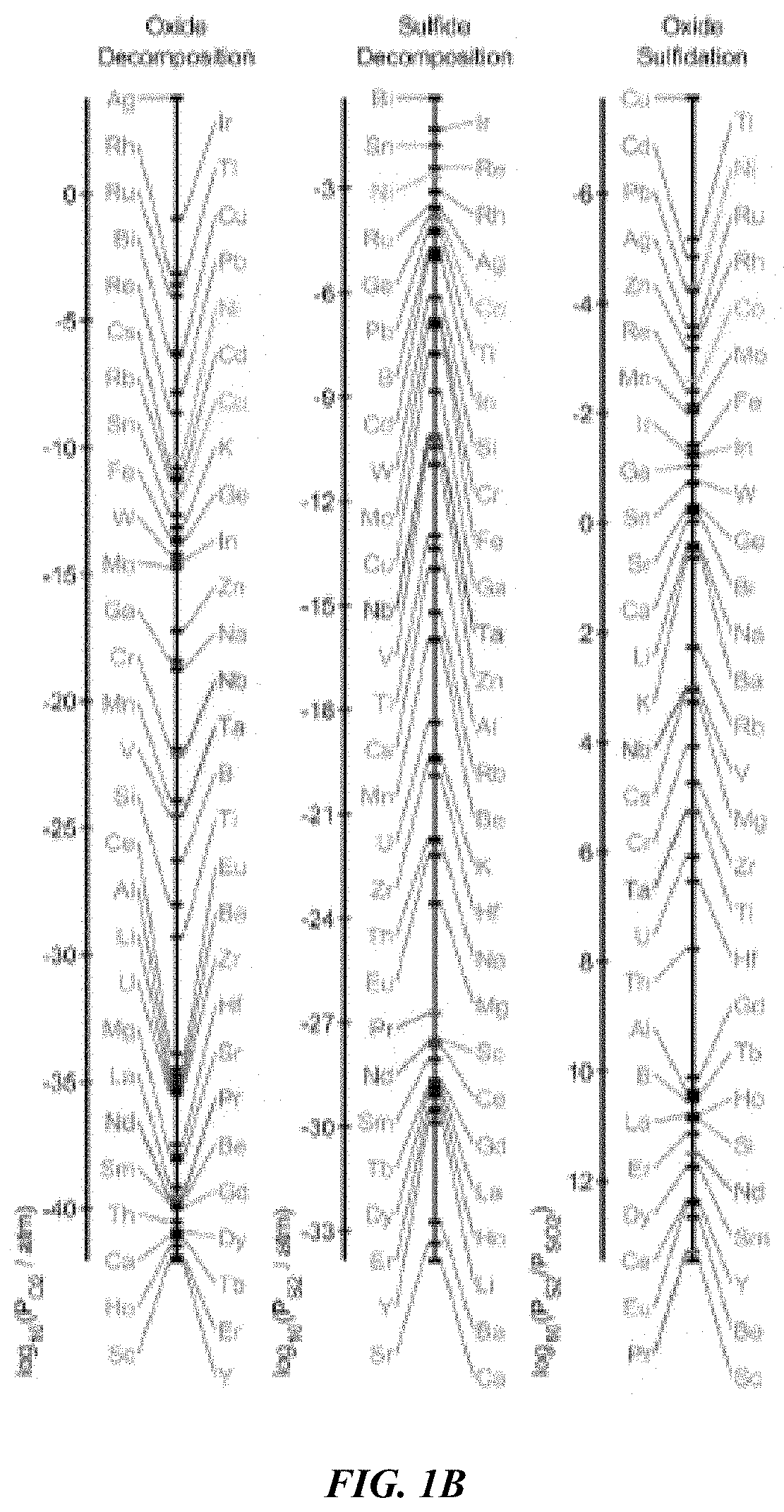
Nevertheless, this table is not enough to fully predict whether or not a sulfidation can be performed.
The oxides are shown to exist closely together in two groups, making separation within a group highly difficult.
One challenging separation of note is strategic metals
niobium and
tantalum.
However, hydrometallurgists are trying to shift away from the use of
hydrofluoric acid due to advancing environmental and
human health regulations limiting the use of
fluoride ions [78].
However, the way in which the
thermodynamic equilibrium changes and to what degree carbon is helpful to sulfidation, is non-obvious and cannot be predicted from a materials agnostic scientific point of view.
This is due to the fact that processes are not run at equilibrium, meaning that the predictions of equilibrium
thermodynamics cannot be used in isolation to design a process.
For a fluid-
solid reaction occurring in a packed-
bed or
fluidized bed reactor, there are three
mass transfer limitations that must be considered: external
mass transfer between the bulk fluid and the outer surface of the
solid, internal
mass transfer within pores of the solid, and diffusional
mass transfer within the grains of the solid.
For a metal-oxide sulfidation reactor, the most important
mass transfer limitations are grain
diffusion and internal mass transfer.
Therefore, a sulfidation reaction is likely to face much higher internal and diffusional mass transfer limitations than in a conventional catalytic reactor, due to an ever increasing, essentially
inert layer surrounding the solid reactant of interest.
Whereas the depletion of the reactant in the fluid
stream is what a typical
fluidized bed reactor is designed to achieve, it is highly detrimental to a metal oxide sulfidation reaction.
While sulfur is required for the reaction to sulfide and will cause depletion accordingly, the sulfidation reaction also produces
sulfur dioxide.
This depletion can have a huge negative effect on the
reaction rate due to the dependence on elemental sulfur.
Furthermore, the buildup of
sulfur dioxide within the reactor can cause the reaction to slow or halt altogether.
However, higher minimum sulfur to sulfur dioxide ratios such as those required for
rare earth or
refractory oxide sulfidation require prohibitively short gas
residence times to keep sulfur dioxide levels sufficiently low for sulfidation to occur, or some other method to remove sulfur dioxide products from the
system such as the carbothermically-driven sulfur
reflux system we propose herein.
For selective sulfidation of difficult to separate
transition metal oxides such as
cobalt oxide and
nickel oxide, the presence of carbon in the reactor would ensure that the sulfidation was not selective; indeed, the addition of carbon is not a guaranteed aid in sulfidation selectivity.
Meanwhile, if the
processing goal is to selectively react a particular component, bulk chlorination or sulfidation may be less desirable.
However, the behavior of carbon in selective sulfidation and carbochlorination are very different in operating regimes where carbon or carbon-
oxygen gasses do not reduce the oxide.
While there is some evidence to suggest that oxysulfide intermediates may aid in catalyzing sulfur dioxide break down back into sulfur in the presence of
carbon monoxide [48-51], the transient and reactive nature of the oxysulfides in selective sulfidation make this notion difficult to prove.
Meanwhile, ore or concentrate materials are not engineered in such a way, putting the notion of their role as a catalyst into question.
The actual effect on sulfidation or selectivity from the carbothermically-driven sulfur
reflux system is impossible to calculate or intuitively determine due to the complicated interplay between reaction
thermodynamics and reaction
kinetics of the mix of carbon,
oxygen, and sulfur gas species involved.
Additionally, the interactions between unknown and difficult to determine sulfidation reaction oxide-sulfide intermediates and reactor gasses further erodes the basis for prediction or description of our carbothermically-driven
reflux system.
Again, the unknown nature and behavior of sulfidation intermediates make this equilibrium impossible to analytically determine.
However, we believe this reaction to be kinetically limited due to the minimum degradation of the carbon components observed during the
lanthanum oxide sulfidation tests.
However, performing the sulfidation at too high of temperature causes aggressive
sintering of the solid oxide feed material, significantly slowing mass transfer and greatly increasing reaction times. Furthermore, sulfur gas is a complicated mixture of different sulfur species, necessitating particular operating pressures and temperatures.
Lower surface areas and
porosity cause mass transfer to be slower for small molecules and almost impossible for large molecules at reasonable
operating time scales.
This assumption cannot be made for separation of difficult to separate metal oxides, due to the fact that catalyst processing is fundamentally different than metallurgical extraction in terms of mass transfer, reaction
kinetics, and materials
chemistry.
However, the temperature must be low enough so that densifying mechanisms of
sintering do not become rapid, causing the
elimination of what little
porosity does exist in the natural concentrate and causing the reaction to become prohibitively slow.
When a complicated mixture of gas species is present, such as in the case of selective sulfidation where the gasses are a mixture of carbon,
oxygen, and
sulfur containing species, in practice the thermodynamic behavior is impossible to fully describe even using current state of the art models.
This challenge exists due to a lack of thermodynamic data for individual components at high temperatures and a lack of the mixing interactions of these components.
Therefore, definitively determining operating conditions from our current understanding of
thermodynamics is impossible.
However, if carbon is present, the carbothermically driven reflux of sulfur from sulfur dioxide is also a source of sulfur dioxide depletion.
Furthermore, in the production of solids, the surface area is likely not engineered as in the case of the catalyst—the surface is that of a natural ore or concentrate.
However, definitive
scientific analysis is impossible because of the unknown atomistic mechanism for sulfidation of a rare earth oxide and the unknown sulfidation and carbothermic behavior of sulfidation intermediates.
This equilibrium is currently impossible to definitively determine from scientific principles due to the non-quantifiable nature of sulfidation intermediates and their unknown roll on sulfidation and S2 to SO2 ratio.
In practice the high number of gasses of difficult to define interactions make the rigorous derivation of an
equation of state impossible, diminishing the predictive nature of these methods of analysis.
However, when mass transfer limitations cause kobservedintrinsic, the minimum US2 / V to suppress the reverse reaction of the sulfidation will also be less than in the intrinsic case.
While the following reaction between carbon and sulfur to form
carbon disulfide is thermodynamically feasible, we believe it to be kinetically limited due to minimal evidence of occurrence in the sulfidation of
lanthanum oxide.
This unknown equilibrium makes the complete role of carbon in the reaction currently impossible to definitively describe from scientifically known principles.
As with sulfidation in the absence of carbon, the CO / CO2 ratio must be carefully controlled within a set region for selective sulfidation, otherwise unwanted sulfidation may occur in other species, resulting in a loss of selectivity.
The exact nature of the functional dependence on the CO / CO2 ratio is impossible to know due to the unknown nature of the interactions of sulfide intermediates and carbon-oxygen-sulfur species.
In general, more difficult to sulfidize metal oxides require more carbon—some easy to sulfidize oxides such as those of
cobalt and
nickel require no carbon to have tenable gas
residence times.
However, the complicated nature of the reaction coupled with the unknown behavior of sulfidation intermediates with carbon and sulfur / oxygen gasses make obvious thermodynamic, kinetic, or otherwise scientific insight into the true behavior of the system impossible.
Their similar chemistries lead to significant challenges in separation.
At a gas flowrate resulting in an average reactor
residence time of 20 seconds, under these conditions
niobium oxide will be sulfidized from
niobium oxide, meanwhile
tantalum will remain an oxide due to presence of a thermodynamically-unfavorable level of sulfur dioxide within the reactor.
Like tantalum and niobium,
zirconium and
hafnium are always found together in nature and also exhibit very similar
chemistry, causing separation to be very difficult.
At a gas flowrate resulting in an average reactor
residence time of 20 seconds, under these conditions zirconium will be sulfidized from
zirconium oxide, meanwhile hafnium will remain an oxide due to presence of a thermodynamically-unfavorable level of sulfur dioxide within the reactor.
One of the most difficult metal separations is that of the rare earth elements.
With similar physical and chemical properties, separation of this cocktail of different metal compounds remains exceedingly challenging, requiring many different hydrometallurgical steps, resulting in very high costs.
Furthermore, since each element must be separated from all of the others, many different separation circuits exist, resulting in long residence times, requiring significant
solvent handling infrastructure.
Current rare earth concentrate
cracking processes are fail to show good selectivity for radioactive elements or individual rare earths;
cracking primarily removes non-rare earth fluorites and calcites and phosphorous /
halide anion impurities within the rare earth.
Metal oxides higher on the sulfidation series remain as oxides due to presence of a thermodynamically-unfavorable level of sulfur dioxide within the reactor.
Therefore, no gas ratio data was able to be obtained in the case of added carbon.
Furthermore, the
crystallization of the sulfide product was unexpected and not predicted from our current understanding of thermodynamics, again highlighting that the behavior and performance of our selective sulfidation technology is inherently non-obvious.
Due to incomplete thermodynamic data for the many different oxides, sulfides, and oxysulfides that exist however, the exact nature of the sulfidation product and necessary operating conditions are non-obvious and impossible to describe using only our current understanding of thermodynamic or materials phenomena alone.
Typically, difficult to separate compounds exhibit very similar surface energies [167], causing floatation methods to be untenable.
Therefore, techniques such as floatation are typically not useful in the case of difficult to separate oxides.
However, sulfidation leads to a significant change in
surface energy of the compound—meaning that the previously difficult to separate oxides are now behaving (from a
surface energy standpoint) as an easy to separate sulfide from a mix of oxides.
Furthermore, liquid sulfides often exhibit high vapor pressures.
Metals such as the rare earths and other strategically-significant metals such as tantalum and niobium remain difficult to separate, requiring extensive hydrometallurgical processing.
Hydrometallurgical processing presents technoeconomic and environmental challenges due to long residence times, toxic solvents and waste, and large capital investments.
Hydrometallurgical and pyrometallurgical recycling routes exist, however they struggle with materials
recovery and separation.
As discussed herein, rare earth separation remains one of the most challenging, capitally-intensive, and environmentally-harmful metal separation challenges.
Few rare earths are recycled due to collection and separation difficulties.
While
sulfation has been attempted for Fe / Ln separation with minimal success, to our knowledge sulfidation
chemistry has not been previously employed for (Nd,Pr,Dy)—Fe—B
magnet recycling.
Upon heating, LnCO3F decomposes to LnOF and CO2, with sulfidation of LnOF presently untenable for defluorination due to the formation of LnFS.
For low carbon contents, carbothermically-driven sulfur refluxing of SO2 is insufficient to reach the critical S2 / SO2 ratio for rare earth oxide sulfidation, and SO2 removal from the reactor must be accomplished via an impractically-short gas
residence time in the reactor.
In fact, limited selectivity for many transition metals such as
nickel,
manganese, and
cobalt is thermodynamically expected in the presence of carbon due to co-sulfidation.
Meanwhile typical, difficult to separate recycling impurities, such as aluminum, can be calcined as an oxide.
However, our novel use of oxygen-sulfur chemistry is what facilitates previously unrealized
material separation opportunities.
These feeds potentially may be too finely ground to support separation of phases downstream of selective sulfidation.
This “slagging” can result in the loss of any iron or
copper existing as an oxide or
sulfate to the
slag phase.
Currently, BaS and RES are very expensive to be used as an
electrolyte, and, in any case, feedstock containing
barium or rare-earth compounds generally needs to be prepared for such
electrolysis.
However, the role of the CO / CO2 ratio in selective sulfidation and desulfidation is far more complicated, as the CO / CO2 ratio in selective sulfidation and desulfidation is for control of the carbothermically-driven sulfur reflux, not just compound reduction.
In rare earth recovery from
bauxite tailings, isolation of rare earth from iron remains the most challenging separation.
At 800° C.,
iron oxide easily sulfidizes while the sulfidation of
scandium oxide to oxysulfide is chemically-kinetically limited, even though it is thermodynamically possible.



 Login to View More